DD
MM
YYYY

PAGES

DD
MM
YYYY

spot_img

PAGES

Home Blog Page 799

Aradel Grows H1 Profit to N191bn Despite Rising Costs and Falling Margins

0

Aradel Holdings Plc has reported a pretax profit of N124.1 billion for the second quarter of 2025, according to its latest financial results filed with the Nigerian Exchange (NGX).

This represents a modest 1.10% rise from the N122.7 billion recorded in the same quarter of 2024, helping to push its half-year pretax profit to N191.3 billion — a notable 17.89% increase year-on-year.

Revenue for the second quarter edged up slightly by 0.63% to N168.2 billion. However, Aradel’s performance across the first six months of the year was more impressive, with revenue surging to N368 billion — a 37.18% increase over the same period last year. A breakdown shows that crude oil remained Aradel’s main revenue driver, contributing N232.7 billion or 63.2% of the total. Refined products generated N116.4 billion, while gas sales accounted for N18.8 billion.

The company, however, encountered considerable cost pressures in Q2. Its cost of sales spiked by 32.23% to N90.3 billion, cutting gross profit by 21.23% to N77.8 billion. General and administrative expenses more than doubled, jumping 149.74% to N30.7 billion, dragging down operating profit to N55 billion — a steep decline from N114.7 billion reported in Q2 2024.

Nonetheless, strong financial income provided a cushion. Aradel’s finance income rose more than threefold to N8.3 billion, enough to offset finance costs of N5.6 billion. A sharp 70.4% drop in tax expense further strengthened the bottom line, allowing net income to grow by 36.14% to N112.1 billion from N82.4 billion in the same quarter last year.

Aradel’s balance sheet remains resilient. Total assets climbed to N1.8 trillion as of June 30, 2025 — a 3.48% increase. The company also posted healthy retained earnings of N444.1 billion, up from N395.2 billion in December 2024. Shares of Aradel closed at N514.10 on July 30, 2025.

While Aradel’s earnings highlight a stable and steady performance, another key player in Nigeria’s energy space, Seplat Energy Plc, delivered a record-breaking result that underscores the broader resurgence of the country’s energy industry.

Seplat, Nigeria’s leading indigenous energy firm listed on both the Nigerian Exchange and the London Stock Exchange, posted a stunning unaudited financial result for the six months ended June 30, 2025. The company’s revenue jumped to N2.167 trillion — a staggering 277% increase from the N575.1 billion posted in the same period last year. The historic leap was driven by ramped-up production, successful offshore expansion, and tight cost discipline.

Gross profit at Seplat more than tripled to N751.2 billion, up from N247.5 billion. Operating profit also soared to N601.2 billion, more than double the N285.2 billion recorded in the first half of 2024. Meanwhile, the company’s cash flow from operations nearly quadrupled, hitting N1.188 trillion compared to N308.2 billion in the prior year period.

According to Seplat CEO Roger Brown, “The company delivered first half production over 10% higher than the pro forma output in the same period last year, delivering on both our ambitions and supporting Nigeria’s goals of oil and gas production growth.”

Taken together, the strong performances of Aradel and Seplat indicate renewed momentum in Nigeria’s upstream oil and gas industry, despite global volatility and ongoing domestic challenges. The numbers show that strategic investments, efficiency gains, and market recovery are positioning indigenous companies to dominate the sector and deliver long-term value.

BUA Foods H1 2025: Profits Double as Rice Business Explodes 2,923%

0

BUA Foods Plc has posted one of its strongest performances yet, announcing a 101% year-on-year growth in profit before tax to N276.1 billion for the half-year ended June 30, 2025.

The company’s unaudited financials, released to the Nigerian Exchange on Wednesday, reflect the strength of its growing market share, expansion strategy, and aggressive move into Nigeria’s domestic rice value chain.

During the six months, BUA Foods’ revenue rose by 36% to N912.5 billion, driven by all four of its major product segments—Sugar, Flour, Pasta, and Rice. Notably, revenue from the rice division exploded by 2,923%, soaring to N39.3 billion from just N1.3 billion in H1 2024. The surge highlights the company’s rapid progress in ramping up local rice production, a move it had previously announced under its broader backward integration drive.

Gross profit stood at N339.3 billion, up by 55% year-on-year, while gross margin improved to 37.2% from 32.4%. Operating profit rose by 41% to N284.8 billion. Meanwhile, earnings per share nearly doubled, jumping from N7.27 to N14.45. These results underline the company’s successful cost discipline and operational efficiency in a high-inflation environment.

Total assets climbed to N1.33 trillion, representing a 21.7% increase from last year. Retained earnings rose sharply by 62% to N681.1 billion, and equity improved by 60.6% to N689.1 billion. Notably, BUA Foods also reduced its liabilities by 3.4% to N644.1 billion—evidence of a healthier balance sheet.

In his statement, Managing Director Engr. (Dr.) Ayodele Abioye said the company’s performance reflects “strong fundamentals, operational efficiency, and the resilience of our diversified business model. Amidst evolving macroeconomic dynamics, we remain focused on scale, affordability, and consistent value delivery to our customers and stakeholders.”

Segment-by-Segment Breakdown – H1 2025:

  • Flour Division: Revenue jumped by 66% to N378.2 billion.
  • Sugar Division: Revenue rose to N398.1 billion, marking an 8% year-on-year increase.
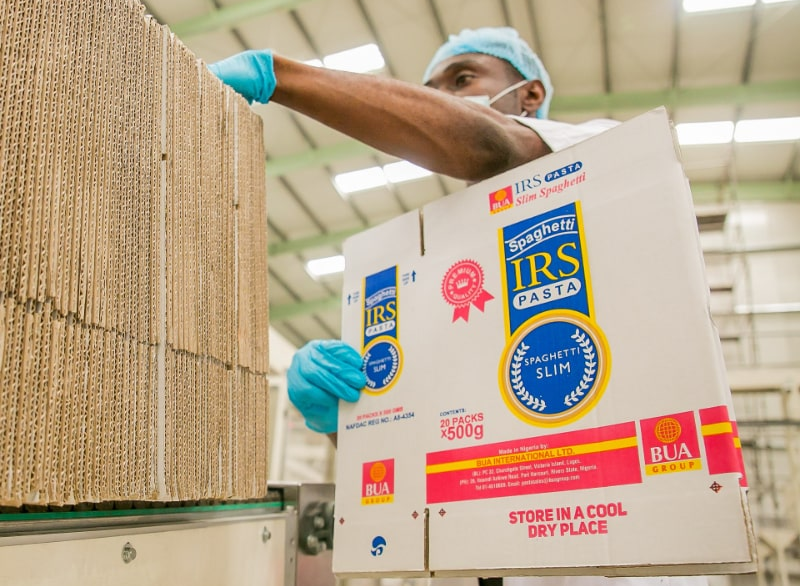
  • Pasta Division: Saw a 31% uptick in revenue to N96.9 billion.
  • Rice Division: Surged to N39.3 billion from N1.3 billion, marking a 2,923% increase.

A Groupwide Boom

The strong showing from BUA Foods follows closely behind the stunning performance of its sister company, BUA Cement Plc, which reported a 510.65% increase in pre-tax profit to N115.06 billion for Q2 2025. For the half-year, BUA Cement posted a PBT of N214.8 billion, more than five times the N40.1 billion recorded in H1 2024. Revenue for the cement firm grew to N580.3 billion, up 59.45% year-on-year.

The sharp turnaround was largely driven by improved revenue flows, cost controls, and the elimination of exchange rate losses, which had plagued Nigerian firms after last year’s FX liberalization. Cement was the sole revenue driver for BUA Cement, with the company reinforcing its dominance in Nigeria’s fast-expanding construction sector.

BUA’s Integrated Strategy Paying Off

The record-breaking results from both BUA Foods and BUA Cement highlight the success of BUA Group’s integrated industrial strategy, which combines backward integration with heavy investments in manufacturing infrastructure. Under the leadership of Abdul Samad Rabiu, BUA Group has built a vertically integrated empire focused on food security, construction materials, and industrial independence.

In recent years, the Group has scaled up investments in food processing, milling, sugar refining, and cement production, relying less on imports and shielding operations from foreign exchange shocks. These gains are now materializing in the form of explosive profits and stronger margins across the board.

BUA Foods is positioning itself as a key food supplier across West Africa as it pushes deeper into agriculture and rice production. Analysts say its rising equity and expanding asset base offer room for further growth in an economy where local content and industrial capacity are increasingly paramount.

Microsoft Surges Past $4tn in Market Cap, Intensifying Race Among U.S. Tech Giants

0

Microsoft on Thursday joined the exclusive $4 trillion club, pushing past the milestone after its shares jumped more than 5% on the back of strong quarterly results.

The surge intensifies the ongoing high-stakes race among America’s biggest tech titans—Microsoft, Apple, and more recently, Nvidia—to dominate the trillion-dollar valuation tier that now serves as a litmus test of global tech supremacy.

The software giant reported 18% revenue growth—its fastest in more than three years—driven almost entirely by the continued strength of its Azure cloud computing division. For the first time, Microsoft disclosed actual dollar figures for Azure and related cloud services, revealing they pulled in more than $75 billion in fiscal 2025. That’s a 34% jump from the prior year and underscores how critical Microsoft’s cloud infrastructure has become in powering the ongoing artificial intelligence boom.

With Thursday’s rally, Microsoft became the second U.S. company to hit the $4 trillion mark this year, following Nvidia, which briefly crossed the threshold earlier in June. Nvidia, whose graphics processing units (GPUs) are the essential hardware behind most AI models—including those from OpenAI, Microsoft, Google, and Meta—has seen explosive investor demand amid an industry-wide rush to build data centers and scale AI capacity. Its stock is up 33% in 2025 alone.

Apple, once the undisputed leader of the trillion-dollar club and the first company to ever cross the $1 trillion threshold back in 2018, now trails both Microsoft and Nvidia. Apple’s market cap sits around $3.2 trillion, following a 17% drop in its stock price this year. Investor concerns have mounted over Apple’s sluggish push into generative AI, with critics suggesting the company is falling behind while rivals like Microsoft and Nvidia reap first-mover advantage.

Analysts say Apple has failed to match the pace of its peers in building or acquiring advanced AI capabilities. While rivals like Microsoft and Google have poured tens of billions into AI research, cloud infrastructure, and landmark acquisitions, Apple has remained tight-lipped, offering only incremental updates to Siri and vague promises through its “Apple Intelligence” initiative.

“The incomplete AI strategy is still the biggest overhang, but we think Apple still has approximately 1.5 years to effect a compelling solution,” TD Cowen analyst Krish Sankar wrote in a note on Monday. He recommends buying the shares.

The fierce competition among these U.S. tech behemoths has become one of the defining narratives of the global financial markets. For over a year, Microsoft and Apple traded places as the world’s most valuable public company. Then came Nvidia, whose rise has rewritten the traditional order by turning chipmaking into a central pillar of the AI economy.

All three companies are not only battling for investor confidence but are deeply intertwined in the AI race—Microsoft has invested billions into OpenAI and continues to integrate AI across its suite of products; Nvidia supplies the hardware that makes AI possible; and Apple, while quieter, is expected to roll out AI features across its devices and operating systems.

Apple is set to release its quarterly earnings later Thursday, and markets are watching closely for signals about its AI roadmap. A strong showing could help Apple regain ground, but as it stands, Microsoft and Nvidia are setting the pace in a market increasingly dominated by cloud, chips, and artificial intelligence.

As these companies vie for position in the $4 trillion stratosphere, the battle is no longer just about size—it’s now about relevance in the next era of technology. And for now, the companies building the tools and infrastructure for AI appear to have the upper hand.

MTN Nigeria Surges to Record Pre-Tax Profit of N419.61bn in H1 2025, Reclaims Top Spot on NGX

0

MTN Nigeria has reported a remarkable recovery in its second-quarter 2025 results, announcing a pre-tax profit of N419.61 billion, a stark turnaround from the pre-tax loss of N179.60 billion in the same period last year.

This result builds on the momentum from Q1, where it posted a N202.63 billion pre-tax profit, bringing its half-year 2025 pre-tax profit to N622.24 billion—its strongest half-year performance in years.

The performance marks MTN Nigeria’s third consecutive profitable quarter, solidifying its rebound after two difficult years marred by heavy foreign exchange losses and spiraling interest expenses triggered by the naira’s devaluation.

Chief Executive Officer Karl Toriola attributed the recovery to disciplined execution of strategic priorities.

“We are excited by the progress made in the first half of 2025, reflecting the successful execution of the strategic priorities we previously communicated to the market. Building on the momentum from the first quarter, we delivered strong growth in service revenue for the period under review,” he said.

Revenue Growth Anchored on Data

MTN’s revenue surged 69% year-on-year in Q2 to N1.3 trillion, while half-year revenue rose by 54.5% to N2.4 trillion, already accounting for 71% of its full-year 2024 revenue. The increase was largely powered by demand for data and voice services, as well as pricing adjustments implemented in Q2.

Data revenue took center stage, contributing more than half of the company’s total revenue. It soared 85% to N699.95 billion in Q2, bringing the H1 total to N1.23 trillion. Although voice revenue rose 58% in Q2 to N427 billion, its relative contribution fell to just 32.36%, underlining the company’s transition into a data-led business.

Toriola noted, “During the period, we completed the phased implementation of the new price adjustments across voice and data bundles, largely benefiting Q2. Pleasingly, the demand for our services remained resilient.”

Operating Discipline and FX Stability Bolster Profit

MTN Nigeria’s bottom line was lifted not just by revenue, but also by cost discipline and a dramatic easing of forex-related pressure. While total expenses grew modestly—up 14.2% in Q2 to N611.9 billion—this paled in comparison to revenue growth, allowing the company to deliver a robust earnings before interest, taxes, depreciation, and amortization (EBITDA) of N709.5 billion, up 183% year-on-year. For the half-year, EBITDA reached N1.2 trillion, and the EBITDA margin held firm at 51%.

A major factor in the profit rebound was the reduction in net foreign exchange losses, which had previously plagued the company. In Q2 2025, MTN even posted a net FX gain of N295 million, a massive improvement from the N231.32 billion loss in Q2 2024. For H1 2025, net FX losses were down to just N5.23 billion, compared to N887.68 billion last year.

As a result, the company achieved a net profit margin of 21% in Q2 and 17.45% for the half year. Earnings per share (EPS) also rebounded significantly, rising to N13.41 in Q2 and N19.78 for H1 2025.

Stronger Balance Sheet and Asset Base

The rebound in profitability also reflected on the balance sheet. Total assets grew 13.69% to N4.77 trillion, while retained losses were slashed to N192.89 billion, compared to N607.47 billion in December 2024. This improvement helped reduce the company’s negative shareholders’ equity from -N458 billion to just -N42.45 billion, placing MTN within reach of a full capital recovery.

Subscribers and Service Use Trends

  • Total subscribers grew to 84.7 million, a 6.7% increase YoY
  • Active data users rose to 51.0 million, up 11.8%
  • MoMo Wallet users dropped sharply by 51.1% to 2.7 million
  • Capex (excluding leases) spiked by 288.4% to N565.7 billion
  • Free Cash Flow (FCF) increased 18% YoY to N409.8 billion
  • Stock Performance and Market Valuation

MTN’s improved financial health has not gone unnoticed by investors. Its share price has rallied 136% year-to-date, reaching N471.10 per share as of July 30, 2025. The rally has catapulted MTN Nigeria to the top of the Nigerian Exchange (NGX), overtaking Airtel Africa as the most valuable listed company on the bourse.

Outlook

In 2023 and 2024, MTN’s operations were severely constrained by Nigeria’s volatile FX market, with foreign exchange losses and debt servicing costs ballooning due to the sharp devaluation of the naira. The company’s latest earnings report signals that those headwinds have eased—at least for now—and that the telco is executing a disciplined recovery strategy.

Analysts believe that if MTN maintains its current trajectory, it may end the year with record profit and potentially positive equity, a symbolic milestone after grappling with massive retained losses.

Factors Contributing to Base Surpassing Solana in Daily Token Launches

0

Coinbase’s Layer 2 network, Base, surpassed Solana in daily token creation for the first time since early 2023, driven by the Zora platform. Zora, a token launchpad on Base, created 51,575 tokens in a single day, accounting for 67.7% of all token creations across both Base and Solana.

In contrast, Solana’s leading platforms, LetsBonk and Pump.fun, created 22,554 and 4,173 tokens, respectively. Zora’s model, which turns every social media post into a token, has fueled this surge, with 6,500 tokens created daily on average last month. This shift highlights Base’s growing traction in the blockchain space, while Solana’s Pump.fun has seen its market share decline significantly since early 2024.

However, Zora’s token creation is heavily speculative, with 93% of users classified as traders rather than creators. The primary driver of Base’s surge in daily token launches is the Zora platform, which accounted for 67.7% of token creations across both Base and Solana on July 30, 2025, with 51,575 tokens created in a single day. Zora’s innovative model, which tokenizes every social media post, has fueled speculative activity and significantly boosted token creation on Base.

Base, as a Coinbase-backed Ethereum Layer 2 solution, benefits from low transaction fees and high scalability, making it an attractive platform for developers and users launching new tokens. These characteristics mirror Solana’s strengths but are enhanced by Base’s integration with Ethereum’s ecosystem, providing access to a broader user base and infrastructure.

The surge in token launches on Base is largely driven by speculative activity, with 93% of Zora users classified as traders rather than creators. This speculative frenzy, similar to Solana’s memecoin boom, has driven mass token creation, particularly for memecoins, which thrive on hype and community engagement. Base overtook Solana in token creation after trailing in previous months (e.g., Solana’s 455,000 tokens vs. Base’s 177,000 in May 2024).

The shift reflects Base’s growing adoption and its ability to capture mindshare in token launches, particularly as Solana’s memecoin-driven model faces challenges. Platforms like Zora on Base have simplified token creation, allowing users to launch tokens with minimal technical expertise, much like Solana’s Pump.fun. This accessibility has attracted a wave of new projects, boosting Base’s token launch numbers.

Solana’s Traction Amid Memecoin Decline

Solana’s earlier dominance in token launches was heavily tied to memecoins, with platforms like Pump.fun and LetsBonk driving up to 70% of its decentralized exchange (DEX) volumes in early 2025. However, by July 2025, memecoin popularity has declined, with Pump.fun’s market share dropping to 10.6% and LetsBonk capturing 82.6% of Solana’s launch volume. This decline has reduced Solana’s daily token creation, allowing Base to surpass it.

Solana’s daily active addresses fell from 6.4 million in November 2024 to 2.8 million by March 2025, reflecting a sharp drop in user engagement as memecoin hype cooled. Network revenue also plummeted, with fees dropping to $39.25 million in the past 30 days by March 2025, down from earlier highs of over $4 million daily. This decline highlights Solana’s reliance on memecoin-driven activity for traction.

High-profile memecoin scandals, such as the LIBRA debacle in February 2025, which wiped out $4.4 billion in market cap, and pump-and-dump schemes on platforms like Pump.fun, have eroded investor confidence in Solana’s ecosystem. These incidents have contributed to a 19% decline in DeFi total value locked (TVL) and a contraction in DEX trading volumes, further weakening Solana’s traction.

Despite the memecoin decline, Solana is attempting to diversify its ecosystem. Projects like Jito and Marinade Finance in DeFi, along with initiatives like Solana Pay and tokenized real-world assets (e.g., Homebase’s tokenized rental property), aim to broaden its use cases. Institutional interest is also growing, with firms like VanEck and Bitwise filing for Solana-based exchange-traded products, signaling long-term confidence in the network.

Solana’s network has faced recurring outages, with eight major and ten partial incidents reported, including a 5-hour downtime in February 2024. These issues, combined with a significant token unlock of 15 million SOL ($2.5 billion) in March 2025, have added bearish pressure on SOL’s price, which dropped 60% from its January 2025 high of $261 to around $104 by July. This has further dampened Solana’s traction amid the memecoin decline.

Base’s surge in daily token launches is driven by Zora’s speculative token creation model, low transaction costs, and ease of use, allowing it to overtake Solana. Meanwhile, Solana’s traction has weakened due to a decline in memecoin popularity, scams, network outages, and token unlocks. However, Solana’s efforts to diversify into DeFi, tokenized assets, and institutional products.