Oracle shares suffered a dramatic decline, plummeting by 13% on Thursday following the issuance of a significantly weaker-than-expected earnings forecast.
This sharp drop, which threatened to erase over $90 billion from Oracle’s market capitalization, triggered a broader selloff across the technology sector. The plunge points to a growing skepticism among investors regarding the immense capital cost and delayed profitability associated with the company’s aggressive, debt-fueled expansion into Artificial Intelligence (AI) infrastructure.
The disappointing financial predictions from the crucial OpenAI cloud-computing partner revealed the uneven and often protracted returns from the nascent technology. While many corporate leaders believe AI is the future, Oracle’s results suggest that the massive upfront investments have so far yielded only limited, visible productivity gains or corresponding revenue spikes.
The Financial Strain of the AI Build-Out
Oracle’s financial health is currently being defined by its commitment to the AI race. The company, long a smaller cloud player, dramatically escalated its profile by securing a massive $300 billion cloud computing deal with OpenAI, beginning in 2027. This high-stakes partnership has tightly linked Oracle’s fortunes to the AI startup, leading to increased stock volatility fueled by concerns that rivals like Google may be pulling ahead of OpenAI.
The core financial concerns center on an astonishing acceleration in capital expenditure (CapEx) that is currently straining the balance sheet:
Oracle shocked the market by announcing that its expected CapEx for fiscal year 2026 is now projected to be $15 billion higher than its estimates just last September. This increase pushes the company’s total planned spending to an unprecedented level over the planning horizon, primarily to fund the construction of colossal data centers necessary to meet the demanding requirements of its AI contracts. The OpenAI agreement alone is expected to utilize 4.5 gigawatts of power capacity over the five-year term of the deal.
The immediate cost of this expansion is visible in the company’s cash flow. Oracle reported burning approximately $10 billion in cash during the first half of its fiscal year due to these AI investments, resulting in a negative free cash flow of around -$13.18 billion in the most recent quarter. To finance this build-out, the company has increasingly relied on debt, holding approximately $100 billion in total debt.
Further dampening sentiment, Oracle missed Wall Street consensus estimates for its total revenue, which came in at $16.06 billion versus expectations of around $16.21 billion. It also issued a third-quarter revenue growth forecast that fell below Wall Street estimates, signaling margin pressure as the investment cycle ramps up.
Credit Markets Signal Caution
The sheer scale and speed of Oracle’s debt-fueled CapEx have injected anxiety into the credit markets. This behavior—relying on significant bond issuance rather than strong operating cash flows—marks a departure for Big Tech companies, though rivals like Meta and Amazon.com have also recently issued over $30 billion and $15 billion in bonds, respectively, to finance their AI infrastructure arms race.
Concerns about Oracle’s debt were immediately reflected in derivatives markets. The cost to insure against Oracle’s default, measured by credit-default swaps (CDS), surged by nearly 12 basis points on Thursday, reaching a minimum of five-year highs. Investors are actively dumping Oracle bonds while piling into these CDS contracts to hedge against potential default risk.
The market value hit to Oracle directly impacted its leadership. Larry Ellison, whose net worth of $276 billion (according to Forbes) is largely derived from his roughly 40% stake in the company, saw his net worth potentially decline by more than $30 billion in the wake of the stock plunge.
Broader Tech Sector Selloff
Oracle’s struggles triggered a sympathetic selloff across the entire AI-focused segment, heightening fears that the ongoing AI market frenzy has become an investment bubble reminiscent of the 1990s dot-com boom. This fear is exacerbated by the circular deals and massive, undetailed future spending commitments, such as those from OpenAI (valued at $500 billion but still unprofitable), which is expected to spend over $1 trillion on AI infrastructure by 2030.
The tech-heavy Nasdaq fell to a one-week low as other AI-related stocks and chipmakers followed Oracle’s trajectory. Key components of the AI supply chain—including Nvidia, Advanced Micro Devices, Micron, Broadcom, and Arm Holdings—all recorded declines ranging from 3.1% to 4.2%.
Despite the immediate negative market reaction, at least 13 brokerages cut their price targets, but some analysts defended the company’s strategy. BofA Global Research analysts argued that the decline represents an investment cycle payment, stating, “The current weakness is more capex investment cycles needed to support demand, with the company paying the price for the abnormal speed in which investment is required to meet current AI demand trends.”
However, the market is demanding greater clarity. Oracle now trades at a forward price-to-earnings (P/E) ratio of 29.56, still slightly above that of rivals like Microsoft at 27.24 and Amazon at 29.06, leaving its current valuation under intense scrutiny until its massive CapEx translates into sustained, high-margin cloud revenue.
Wallets associated with the bankrupt FTX exchange and its trading arm, Alameda Research, unstaked 194,861 SOL tokens from a staking account, unlocking approximately $25.5 million worth of Solana at prevailing prices around $131 per SOL.
This transaction, tracked by on-chain analytics firms like Lookonchain and Arkham Intelligence, follows a predictable monthly pattern of unlocks that began in late 2023 as part of the estate’s asset liquidation process to fund creditor repayments.
The unstaked SOL was transferred to a new address controlled by the estate, increasing available liquidity for potential sales. However, the same staking address still holds about 4.048 million SOL, valued at roughly $620 million, indicating this is just one installment in a larger unwind.
Since November 2023, FTX and Alameda have unstaked over 8 million SOL—worth nearly $1 billion at various points—often depositing portions to exchanges like Coinbase and Binance for controlled sales approved by U.S. Bankruptcy Court.
Market impact appears muted so far: SOL’s price dipped 5.4% in the prior 24 hours amid broader crypto weakness, but community sentiment views these events as routine liquidity injections rather than protocol threats.
No immediate dumps have occurred, thanks to court limits on weekly sales capped at $200 million. This aligns with prior unlocks, like March 2025’s $431 million batch, which caused short-term volatility but didn’t derail Solana’s ecosystem growth in DeFi and NFTs.
BlackRock’s IBIT Bitcoin ETF Records $192M Inflows
BlackRock’s iShares Bitcoin Trust (IBIT) saw $192 million in net inflows on February 27, 2025, leading a rebound in spot Bitcoin ETF activity amid a volatile market.
This marked a strong single-day performance for the fund, which has dominated institutional demand since its January 2024 launch, amassing over $52 billion in year-to-date inflows by late 2025 and becoming BlackRock’s top revenue generator with estimated $245 million in annual fees.
The inflows contributed to a broader $290 million net positive day for U.S. spot Bitcoin ETFs, offsetting Grayscale’s GBTC outflows of $599 million. Fidelity’s FBTC added $66 million, while ARK/21Shares’ ARKB brought in $24 million.
This surge helped Bitcoin rebound 4% to around $68,000 that week, signaling renewed institutional confidence after earlier outflows tied to year-end rebalancing and macro uncertainty. By mid-2025, IBIT had grown to $70+ billion in assets under management, holding over 700,000 BTC— 3.3% of total supply and outpacing rivals like Fidelity’s FBTC.
Despite a recent six-week outflow streak totaling $2.7 billion through November 2025—reflecting Bitcoin’s 27% pullback from October highs—the fund’s annualized return exceeded 40% from debut to November, underscoring its role as a key proxy for U.S. crypto adoption.
While the immediate market reaction was a 5.4% SOL price dip amid broader crypto weakness, the implications ripple across short-term volatility, long-term ecosystem health, and regulatory oversight. The unlocked 194,861 SOL increases circulating supply, potentially flooding exchanges if sold off.
Historical data shows similar events—like the March 2025 $431M batch—triggered 13-15% drops due to heightened sell-side liquidity. Court caps limit weekly sales to $200M, mitigating instant dumps, but thin holiday volumes could amplify downside if buyers hesitate.
Analysts note SOL’s resilience, often rebounding within days as DeFi activity absorbs the supply. This move advances FTX’s court-mandated asset unwind, with ~$620M in remaining staked SOL signaling more unlocks ahead.
It underscores the bankruptcy’s maturity—total unstaked SOL now nears 9M tokens worth $1.2B—potentially accelerating payouts to defrauded users by mid-2026. Positive for justice, but it highlights lingering risks from concentrated holdings tied to one failed entity.
Solana’s network fundamentals remain strong, with institutional inflows and tools like Grayscale’s GSOL ETF providing hedges. However, repeated events erode retail confidence, as seen in declining social metrics and 22% trading volume drops post-similar unlocks.
Long-term, it could deter new projects if perceived as a “FTX overhang,” though Solana’s low fees and speed continue driving DeFi/NFT growth. Analysts see these inflows as a bullish counter to retail selling, with potential for more if Bitcoin stabilizes above $100,000 into 2026.
Recent developments suggest Binance is expanding tokenized real-world asset (RWA) access via its ecosystem, with indirect “hints” through wallet integrations and API-adjacent announcements—though no explicit API updates for tokenized stocks were found in official docs.
In late November 2025, Ondo Finance integrated its Ondo Global Markets platform with Binance Wallet, enabling over 280 million users to access 100+ tokenized U.S. stocks and ETFs like Apple, Microsoft, MicroStrategy directly on BNB Chain with 0% trading fees.
USERS CAN BROWSE AND TRADE THESE IN THE WALLET’S “MARKETS > STOCKS” TAB, REPRESENTING FRACTIONAL ON-CHAIN OWNERSHIP OF TRADITIONAL SECURITIES.
This builds on Binance’s prior tokenized stock experiments like Tesla, Coinbase tokens in 2021, which faced regulatory scrutiny and were discontinued on Binance.com in 2022 to focus on other products—migrating EEA/Swiss users to CM-Equity AG’s portal.
THE ONDO INTEGRATION REVIVES THE CONCEPT WITHOUT DIRECT EXCHANGE LISTING, LEVERAGING BLOCKCHAIN FOR 24/7 LIQUIDITY AND COMPOSABILITY. BINANCE’S SPOT API DOCS— V3 ENDPOINTS FOR MARKET DATA, KLINES, ETC. REMAIN UNCHANGED AND DO NOT REFERENCE TOKENIZED STOCKS, BUT THE WALLET EXPANSION COULD IMPLY FUTURE API EXTENSIONS FOR RWA TRADING PAIRS OR DATA FEEDS.
Analysts view this as Binance’s “move fast and break things” push into RWAs amid global tokenization growth, potentially challenging platforms like Backed or Franklin Templeton. No direct API “hints” were confirmed.
Fogo ICO Announcement
Fogo, a high-performance Solana Virtual Machine (SVM)-compatible Layer 1 blockchain leveraging the Firedancer validator client for ultra-low latency under 40ms block times and high throughput over 54,000 TPS, has officially detailed its public token sale.
The ICO is set to raise $20 million by selling 2% of the total 10 billion $FOGO token supply at a price of $0.10 per token, implying a fully diluted valuation (FDV) of $1 billion.
This follows earlier funding rounds totaling $13.5 million: a $5.5 million seed round in December 2024 led by Distributed Global with CMS Holdings participation at a $100 million FDV, and an $8 million community raise via Cobie’s Echo platform in January 2025, also at $100 million FDV, which sold out in under two hours and brought over 3,000 angel investors on board.
TGE and mainnet is slated January 13, 2026 100% unlocked at token generation event, with 2% of team supply burned. Real-time on-chain experiences for DeFi, gaming, and physics simulations, with multi-local consensus for regional low-latency validation. Devnet is live, Testnet launches Q1 2026, Mainnet Q2 2026.
Community sentiment on X is mixed: excitement around the tech and rapid prior raises contrasts with skepticism over the aggressive $1B FDV in a bearish market, with pre-market perps on Hyperliquid pricing it at ~$1.3B FDV and Polymarket odds favoring a lower launch valuation around $300M.
As a pure Firedancer chain with multi-local consensus co-located validators for regional low-latency and a curated validator set, Fogo accelerates Solana’s tech evolution. It retains full SVM compatibility, enabling seamless dApp migration which could fragment but ultimately strengthen the ecosystem by stress-testing Firedancer findings for Solana’s upgrades.
This “accretive” approach—forking open-source code—irks some Solana devs but fosters cross-pollination, potentially drawing 84M+ Solana users to experiment with real-time apps like high-frequency trading or physics-based gaming.
Fogo targets “institutional-grade on-chain finance,” bridging TradFi speed (NASDAQ-like) with decentralization for DeFi, RWAs, and derivatives. Integrations like Wormhole, Pyth, and Ambient Finance could unlock $16T in tokenized assets by 2033, especially for low-latency needs like options or prediction markets.
Early “Flames” points and potential airdrops reward 3,000+ angels from prior $13.5M raises, fostering community but risking centralization critiques. Fogo’s “Flames” points program rewards early community engagement, potentially tying into future airdrops.
This positions Fogo as a “pure Firedancer” chain aiming to outpace Solana in performance while maintaining decentralization, though some Solana devs have critiqued the reuse of open-source code.
Google on Thursday introduced Disco, a new Gemini-powered AI experiment that pushes the boundaries of how a browser can reshape information on the fly.
The tool’s core feature, GenTabs, analyzes the pages a user has open and can instantly turn them into custom, interactive applications built around the user’s ongoing tasks. The system also incorporates past context from a user’s Gemini chat history, giving it a broader understanding of what the person is working toward.
Google positions Disco as an experiment meant to blend browsing, workflow management, and app creation into a single layer inside Chrome. Instead of asking an AI chatbot for help in a separate window, Disco rewires the browsing session itself. GenTabs can propose building a web app the moment it detects patterns in a user’s tabs — whether that means studying a topic, researching a purchase, planning a trip, or gathering information from several sources. Once an app is generated, users can continue refining it through natural language, making changes in real time.
The company emphasizes that the generative elements link back to the original sources, maintaining transparency on where the information came from. Disco uses Gemini 3 to assemble these on-the-fly experiences, making it effectively a web-based AI development engine that shapes itself around a user’s intent.
Google’s move reflects a broader trend in the tech industry as companies race to weave AI directly into core computing environments. Instead of launching a separate AI browser like Perplexity’s Comet or OpenAI’s Atlas, Google is taking the route of enhancing Chrome, which already dominates the global browser market share. Embedding AI at this level allows Google to leverage the familiar workflow of tabs, bookmarks, and browsing sessions while layering in intelligence that reacts to users’ habits.
Google has already taken early steps in this direction by allowing Gemini to answer questions about any webpage inside Chrome. Disco pushes that idea further by analyzing multiple tabs at once and treating the browser window as a canvas for task-specific applications. It marks one of the clearest signals yet that Google sees the browser as a future operating environment for AI — a place where apps are not downloaded but generated dynamically based on what users are doing.
The company says Disco will first roll out to a small group of testers through Google Labs. As with other Labs experiments, the goal is to gather detailed feedback on usability, performance, and the kinds of custom apps people build.
Google notes that successful ideas developed through Disco may eventually appear in larger services or consumer-facing products. The firm also makes it clear that GenTabs is the first in what is expected to be a series of experimental features under the Disco project, suggesting a longer-term vision for AI-driven browsing.
Disco will initially be available via a waitlist, starting with macOS users who will need to download a dedicated app. Google has not given a timeline for broader availability.
The introduction of Disco underscores Google’s evolving strategy in the AI era: rather than treating AI as a separate destination, the company is steadily infusing it into the most fundamental layers of digital life. If the experiment succeeds, the browser could shift from being a passive window into the web to an active workspace where AI shapes information into tools the moment they are needed.
Invent, innovate and drive organizational transformation, performance, and growth. Capture emerging opportunities in changing markets while optimizing innovation and profitability. Digitally evolve your business or functional area, turning digital disruption into a competitive capability and advantage. Master the concepts of building category-king companies, and thrive.
Registration for another edition of Tekedia Mini-MBA opens. Tekedia Mini-MBA, from Tekedia Institute, is an innovation management 12-week program, optimized for business execution and growth, with digital operational overlay. It runs 100% online. The theme is Innovation, Growth & Digital Execution – Techniques for Building Category-King Companies. All contents are self-paced, recorded and archived which means participants do not have to be at any scheduled time to consume contents. Our programs are designed for ALL sectors, from fintech to construction, healthcare to manufacturing, agriculture to real estate, etc.
More so, the sector- and firm-agnostic management program comprises videos, flash cases, challenge assignments, labs, written materials, webinars, etc and is delivered by a global faculty coordinated by Prof Ndubuisi Ekekwe. When we finish, we will issue a certificate from the Tekedia Institute, Boston USA.
Register and join us. You will emerge transformed with tools and capabilities that engineer confidence, performance and growth. Accelerate your leadership ascent with us! Here are our programs and costs.
Program Cost
Code
Description
Cost
MINI
Tekedia Mini-MBA. And WhatsApp School
US$170 or N120,000 naira
MINF
Annual Package: 3 consecutive MINI and 2 optional capstones AND annual access to Blucera.com.
$340 or N180,000
MINR
(optional) Homework review; faculty will review your homework with feedback.
$30 or N10,000
CAPS
(optional) Tekedia capstone is a research paper, analogous to final college project.
Supply Chain Management, Global Partnership & Contracting – Adebayo Adeleke, ex-Chief of Contracting and Deputy Chief, Business Operations Division, US Army
Intellectual Property: Strategy, Management & Commercialization – Ifeanyi Okonkwo, University of Cape Town & Jackson, Etti & Edu
Business Relationship Management & Negotiation Skills - Charles Okeibunor, CEO IRMP
Due Diligence and Business Intelligence – Chike Obimma, Partner at NICCOM LLP (Commercial Law Firm)
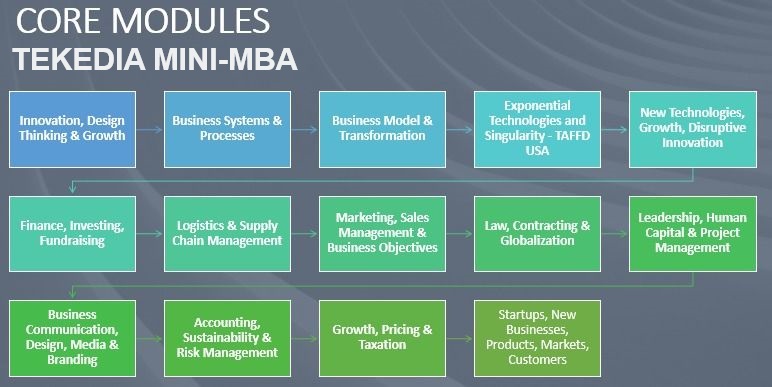
Week 10: Leadership, Human Capital & Project Management
Leadership, Knowledge Management – Prof. Ayodeji Oyebola, Saint Mary’s University of Minnesota
Human Resources Management - Adora Ikwuemesi, Director Kendor Consulting
Leading and Managing Teams, Stakeholder Management with NICER Model – Dr. Chisom Ezeocha, Project Delivery Manager, Shell
Career Planning – Precious Ajoonu, Manager, Jobberman
Tax Treaties and Their Benefits - Emmanuel Eze, Manager, Federal Inland Revenue Service (FIRS)
Regional Case: Tax Law and Compliance in Lagos State - Abimbola Abdur-Rahman Lekki, Lagos Internal Revenue Service
Effective Product & Service Pricing, Accelerated Revenue, Profit Maximization - Saima Khan, Partner, Strategic Pricing Management Group, Toronto, Canada
Establishing Business Consulting & Advisory Services - Mustafa Yusuf-Adebola, Founder, Provisio Professional
Driving Profitable Growth, Marginal Cost, Scaling – Prof. Ndubuisi Ekekwe
Stimulating New Markets Through Innovation and Perception Demand – Prof Ndubuisi Ekekwe
Week 14: Startups, New Businesses, Products, Markets, Customers
The Mechanics of Minimum Viable Product and Product Development - Prof Ndubuisi Ekekwe
The NEP Framework – Discovering and Listening to Customers - - Prof Ndubuisi Ekekwe
Customer Validation and Building for What Customers Really Want. - - Prof Ndubuisi Ekekwe
Knowing and Defining Your Market - Prof Ndubuisi Ekekwe
Navigating Business Growth Phases - Prof Ndubuisi Ekekwe
ChatGPT, DALL-E 2 and Emerging AI Innovations: Business Opportunities in Africa - Zion Pibowei, Head of Data Science, Periculum Canada
How to Scale a Business/Startup - Jane Egerton-Idehen, Head of Sales Middle East & Africa at Meta (Facebook parent company)
Final Week: Execution and Closure
The Call to Business Execution, Closure – Prof Ndubuisi Ekekwe
Graduation Day – Prof Ndubuisi Ekekwe
Tekedia Live: Optional Zoom session which holds thrice per week (Tue, Thur, Sat at 7pm WAT). It is archived for those unable to make the session live. Our faculty members and invited guests rotate to anchor the sessions. Live provides a platform for members to ask questions and get live responses.
Welcome! Unleash your leadership potential, master business excellence, and embrace transformation with Tekedia Mini-MBA. Join us and experience a cutting-edge business management & leadership program: online, self-paced, and world-class. At Tekedia Institute, we co-learn with thousands of professionals and students, from many countries, on the mechanics of business, connecting innovation, growth and operational execution, across market territories and industrial sectors.
Our faculty members come from Microsoft, Google, Shell, Flutterwave, Nigerian Breweries, NNPC, Jobberman, Coca Cola, PwC, BUA Cement, and other great organizations. Besides pre-recorded courseware, thrice weekly, we hold live Zoom sessions (Tue, Thur and Sat at 7pm WAT) – Prof Ndubuisi Ekekwe, Tekedia Institute Lead Faculty.
Access to any Facyber Certificate program for free. Facyber offers online cybersecurity programs on policy, technology, management, and forensics.
Capstone Program
Here are the 12 tracks:
CLSM: Certificate in Logistics and Supply Chain Management
CBIS: Certificate in Business Innovation, Growth & Sustainability
CMAB: Certificate in Media, Advertising & Branding
CSBM: Certificate in Startup and Small Business Management
CIBA: Certificate in Business Administration
CPFM: Certificate in Personal Finance & Wealth Management
CMSM: Certificate in Marketing and Sales Management
CDBG: Certificate in Digital Business Growth
CIAM: Certificate in Agribusiness Management
CHRM: Certificate in Human Resources Management
CETS: Certificate in Exponential Technologies and Singularity
CBPM: Certificate in Business Transformation & Project Management
The program is completely capstone-based. Tekedia capstone is a research paper or a case study exploring a topic, market, sector or a company. It is the project component of Tekedia Min-MBA.
Theme: Innovation, Growth & Digital Execution – Techniques for Building Category-King Companies
Introduction
Over the last few decades, digital technology has emerged as a very critical element in organizational competitiveness. It has transformed industrial sectors and anchored new business architectures, redesigning markets and facilitating efficiency in the allocation and utilization of factors of production. The impacts have been consequential: continents like Africa are moving towards knowledge-based economic structures and information societies, comprising networks of individuals, firms and states that are linked electronically and in interdependent relationships. In this program, we will examine this redesign within the context of fixing market frictions and deploying growth business frameworks in a world of perception demand where meeting needs and expectations of customers are not enough.
Program Time: Feb 9 – May 2, 2026
Venue & Format: Online via videos, articles, webinars, and flash cases. Program is self-paced which means you consume the materials at your own time and pace. It is completely online. Where you live or your time zone would not be an issue as program is not live-delivered.
Cost: US$170 (N120,000 naira). We have a payment plan, i.e. installment payment plan (email us for details)
Target Audience: This program is designed for professionals and students across functional areas like sales, marketing, technology, administration, legal, strategy, finance, etc across all business sectors and domains. The program is designed for:
Ambitious mid-level managers seeking to advance their careers by acquiring essential business knowledge and skills.
Busy professionals who value continued education but require a flexible alternative to a traditional MBA program.
Experienced professionals aiming to broaden their business acumen, enhance leadership capabilities, and explore new career opportunities.
Professionals in transition, committed to staying informed about business trends and developing skills for continuous professional growth.
Mid-level managers and executives across industries, driven to accelerate career growth and take on increased responsibilities.
Technology and innovation-focused professionals looking to strengthen business acumen and strategic thinking.
Aspiring entrepreneurs seeking a solid foundation in business management and growth strategies.
Consultants and advisors aiming to expand their knowledge base and provide comprehensive solutions to clients.
Professionals transitioning into new roles or industries, recognizing the value of upskilling for success.
Students and recent graduates seeking a competitive edge in the job market by combining academic qualifications with practical business skills.
Tekedia Mini-MBA program offers a flexible and comprehensive learning experience tailored to the needs of ambitious professionals, providing the tools and knowledge necessary to thrive in today’s dynamic business landscape. Participants will have the opportunity to acquire knowledge that has value and can be used in everyday business activities.
Learning Objectives: To innovate is to set a new basis of competition in an economy, business sector or market. Sometimes, it results in disruption. This program is designed for private (large, SMEs, startups, sole businesses), public and government institutions, and individuals. Participants will:
Master the mechanics of growth – the reward of innovation – through frameworks, cases and evolving strategies.
Understand how to undergo transformation journey that is fully aligned with corporate objectives through measurable and realizable benchmarks.
Acquire business capability tools that do not just RUN their firms but can TRANSFORM them.
Design corporate growth experiments in Lab sessions based on One Oasis Strategy, Aggregation Construct, Double Play Strategy, Accumulation of Capability Construct, and more.
ETC
Why Tekedia Institute
Interactive Online Learning: Engage with industry experts and fellow professionals through our state-of-the-art online learning platform, where you can access course materials, participate in discussions, and collaborate on real-world case studies.
Comprehensive Curriculum: Gain a deep understanding of key functional areas such as strategy, marketing, finance, operations, and more, equipping you with the knowledge and skills to excel in any business environment.
Practical Case Studies: Apply your learning to real-world scenarios through hands-on case studies and projects, allowing you to develop critical thinking and problem-solving skills.
Flexibility and Convenience: Access the program online from anywhere at your own pace, fitting your studies into your busy schedule without compromising your professional and personal commitments.
Expert Faculty: Learn from renowned industry practitioners and thought leaders who bring their expertise and real-world insights to the program, ensuring you receive the most relevant and up-to-date knowledge.
Benefits of Tekedia Mini-MBA
Enhance Your Leadership Potential: Unlock your leadership capabilities and develop the skills to lead teams, drive innovation, and navigate complex business challenges with confidence.
Master Business Excellence: Gain a holistic understanding of business functions, strategies, and best practices, enabling you to make informed decisions and contribute to organizational success.
Embrace Digital Transformation: Stay ahead of the curve by embracing digital technologies and leveraging them to transform your business and stay competitive in the digital age.
Accelerate Your Career: With the Tekedia Mini-MBA on your CV, you’ll stand out to employers, demonstrating your commitment to continuous learning and your readiness to take on new responsibilities.
Network and Collaboration: Connect with a diverse community of professionals, expand your network, and foster collaboration opportunities that can lead to future partnerships and career advancements.
Cost-Effective Investment: Enjoy the benefits of a comprehensive business education at a fraction of the cost of traditional MBA programs, maximizing the return on your investment.
We run optional three Live Zoom sessions (two weekdays and one Saturday). This provides a way for our members to ask our Faculty and experts live questions and get feedback.
Tekedia Mini-MBA certificate sample
Tekedia Institute offers certificates at the end of all programs.
Our Contact Email: info@tekedia.com
Refund policy is full refund within 6 days from start of a program; after that, none, but we can defer as requested.
Lead Faculty of Tekedia Institute
Prof Ndubuisi Ekekwe is the Lead Faculty of Tekedia Institute
PhD, Electrical & Computer Engineering, Johns Hopkins University, USA
MBA, University of Calabar, Nigeria
BEng Electrical & Electronics Engineering ( Federal University of Technology, Owerri, Nigeria)
Prof Ndubuisi Ekekwe invented and patented a robotic system which the United States Government acquired assignee rights. Dr Ekekwe holds two doctoral and four master’s degrees including a PhD in engineering from the Johns Hopkins University, USA. He earned undergraduate degree from FUT Owerri where he graduated as his class best student. While in Analog Devices Corp, he co-designed an accelerometer for the iPhone. A recipient of IGI Global “Book of the Year” award, a TED Fellow, IBM Global Entrepreneur and World Economic Forum Young Global Leader, Prof. Ekekwe has held professorships in Carnegie Mellon University and Babcock University, and served in the United States National Science Foundation Committee.
The South African press called him “a doctor of innovation” for helping organizations on the mechanics of business innovation, strategy, and growth. Since 2009, the Chairman of Fasmicro Group which controls many startups and entities has been writing in the Harvard Business Review. He was recognized by The Guardian as one of 60 Nigerians Making “Nigerian Lives Matter” on Nigeria’s 60th Independence Day (Oct 1, 2020).