DD
MM
YYYY

PAGES

DD
MM
YYYY

spot_img

PAGES

Home Blog Page 8

Dangote’s Dollar Dividend Playbook and the Redesign of Nigeria’s Capital Market

0

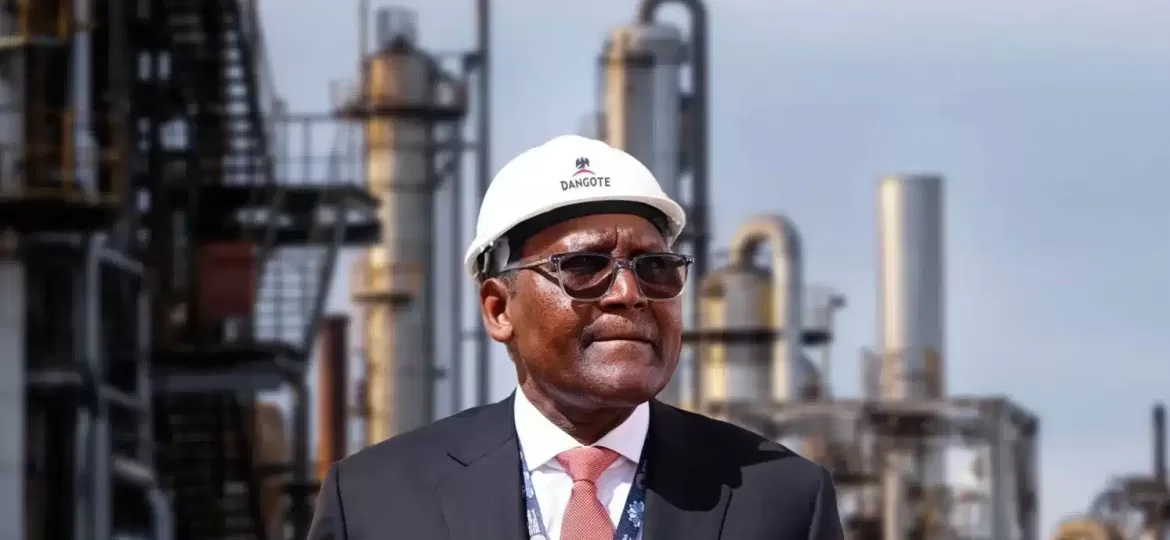
Aliko Dangote has unveiled one of the boldest ideas in his business playbook career, and it has little to do with building factories. Instead, it is about re-engineering Nigeria’s capital market through a play of currency. Dangote has announced plans to list 10 percent of his $20 billion refinery on the Nigerian Exchange in 2026, a move that could fundamentally reshape the market and attract global investors seeking hard-currency returns.

He revealed this at the unveiling of the Dangote Vision 2030 roadmap in Lagos, outlining a long-term strategy centered on massive revenue growth, aggressive expansion in petrochemicals, and most notably a shift toward dollar-denominated dividends. The message was unmistakable: Dangote is positioning his companies for far greater international relevance. He confirmed that discussions are already advanced with the Nigerian Exchange and the Securities and Exchange Commission to finalize the structure of the offering, alongside engagements with the Ministry of Finance to secure approvals for the proposed dividend framework. As he put it succinctly: “You buy in naira, but you get dividends in dollars.”

If this plan succeeds, it will trigger a tectonic shift in Nigeria’s capital market. It will set a new benchmark that leading Nigerian banks, many of which already earn substantial dollar revenues through their African subsidiaries, will be forced to match or risk losing investor interest. In a market where capital seeks protection from currency risk, USD-denominated dividends will become a powerful magnet. If Dangote delivers this model, investors will naturally gravitate toward it, compelling others to follow. This is not just a listing; it is a strategic redesign of how value is captured and distributed in Nigeria’s financial markets.

It may not be bad for Naira provided the equities are paid for in Naira even as the dividends come in USD.

“You Buy In Naira, But You Get Dividends In Dollars”: Dangote Affirms Plan Of Refinery’s Historic NGX Listing In 2026

“You Buy In Naira, But You Get Dividends In Dollars”: Dangote Affirms Plan Of Refinery’s Historic NGX Listing In 2026

0

Aliko Dangote has opened a new chapter for his industrial empire with a sweeping plan to list a 10 percent stake in his $20 billion refinery on the Nigerian Exchange in 2026, a move that could reshape Nigeria’s capital market and pull in global investors hungry for hard-currency returns.

He affirmed the plan at the unveiling of the Dangote Vision 2030 roadmap in Lagos, where he laid out a long-term strategy built around massive revenue growth, aggressive expansion in petrochemicals, and a bold shift toward dollar-denominated dividends for shareholders. His message throughout the evening carried the tone of a man positioning his companies for far larger international visibility.

During the presentation, Dangote said his team is already deep in talks with regulators at both the Nigerian Exchange and the Securities and Exchange Commission to finalize the structure of next year’s public offering. He noted that the initiative also includes ongoing engagement with the Ministry of Finance to secure the necessary approvals for the proposed payout framework.

“You buy in naira, but you get dividends in dollars,” he said, adding that the final go-ahead for this framework would come from the Finance Minister.

The dollar-dividend plan is anchored on the refinery’s growing export capacity. Dangote explained that shareholders across Dangote Cement, the refinery, and the fertilizer business would benefit from returns funded by roughly $6.4 billion in annual export earnings. The bulk of that money is expected to come from sales of polypropylene, fertilizer, and other petrochemical products, which will supply the consistent foreign-exchange inflows needed for payouts in US currency.

Analysts say this could mark a major turning point for the Nigerian market, providing a rare instrument that offers hard-currency income at a time when the local currency has struggled.

The refinery listing also aligns with a broader expansion drive that will define the next phase of the conglomerate’s trajectory. Dangote is targeting revenue of about $100 billion by 2030, a leap from the current $18 billion. The ambition is matched by an equally aggressive pursuit of scale, including a plan to push group-wide market capitalization beyond $200 billion before the end of the decade. Within that horizon, Dangote hopes to place his group among the world’s top 100 companies by value.

For the refinery itself, the numbers continue to climb. The 650,000-barrel-per-day plant is already turning out diesel, aviation fuel, and petrol, and Dangote disclosed that capacity will rise to 1.4 million barrels per day within three years. That would make the project one of the largest single-site refineries anywhere in the world and strengthen its role in Nigeria’s effort to produce its own fuels on a large scale.

He called the planned NGX listing the refinery’s first real step toward opening its ownership to the public, and added that secondary listings abroad could follow later, even though the Nigerian market remains the starting point.

“We want the Dangote Refinery to be the golden stock of the Exchange,” he said.

The refinery’s offering is expected to draw vigorous attention from institutional investors. With capacity climbing, export receipts rising, and a potential dollar-dividend structure on the table, analysts say the transaction could become one of the defining market events of the decade, setting a new standard for how large Nigerian companies court global capital.

However, the decision to list a 10 percent stake has stirred debate among analysts who say the offer is too small for a project of such scale, and signals his intent to retain tight control of what is now the most powerful industrial asset in the country.

A refinery of this magnitude would normally be expected to offer a wider public float that encourages broader price discovery, deeper liquidity, and greater institutional participation. Instead, Dangote’s decision to cap the float at 10 percent is being read as a strategic move to maintain overwhelming command of the asset. Given the refinery’s revenue potential, control of the boardroom translates into control of pricing, export strategy, and supply decisions that will shape Nigeria’s fuels market for decades.

So far, the Nigerian National Petroleum Company Limited’s existing stake in the refinery appears to be the largest. NNPC holds 7.2 percent of the project and has openly stated its intention to raise that stake to 20 percent once regulatory conditions allow. If that purchase proceeds, NNPC would become the largest minority shareholder, creating a new equation in which control of the refinery is split between Dangote’s majority position and the government-backed oil company’s strategic influence.

Looking ahead, the dollar-dividend model remains one of the listing’s main attractions. In a currency environment where volatility has made planning difficult for both corporates and individuals, the prospect of regular dollar income has already begun to generate interest among foreign and domestic funds.

Oracle’s AI Ambitions Spark Tech Selloff: Over $90B Market Value Wiped Amid Debt and Delayed Returns

0

Oracle shares suffered a dramatic decline, plummeting by 13% on Thursday following the issuance of a significantly weaker-than-expected earnings forecast.

This sharp drop, which threatened to erase over $90 billion from Oracle’s market capitalization, triggered a broader selloff across the technology sector. The plunge points to a growing skepticism among investors regarding the immense capital cost and delayed profitability associated with the company’s aggressive, debt-fueled expansion into Artificial Intelligence (AI) infrastructure.

The disappointing financial predictions from the crucial OpenAI cloud-computing partner revealed the uneven and often protracted returns from the nascent technology. While many corporate leaders believe AI is the future, Oracle’s results suggest that the massive upfront investments have so far yielded only limited, visible productivity gains or corresponding revenue spikes.

The Financial Strain of the AI Build-Out

Oracle’s financial health is currently being defined by its commitment to the AI race. The company, long a smaller cloud player, dramatically escalated its profile by securing a massive $300 billion cloud computing deal with OpenAI, beginning in 2027. This high-stakes partnership has tightly linked Oracle’s fortunes to the AI startup, leading to increased stock volatility fueled by concerns that rivals like Google may be pulling ahead of OpenAI.

The core financial concerns center on an astonishing acceleration in capital expenditure (CapEx) that is currently straining the balance sheet:

Oracle shocked the market by announcing that its expected CapEx for fiscal year 2026 is now projected to be $15 billion higher than its estimates just last September. This increase pushes the company’s total planned spending to an unprecedented level over the planning horizon, primarily to fund the construction of colossal data centers necessary to meet the demanding requirements of its AI contracts. The OpenAI agreement alone is expected to utilize 4.5 gigawatts of power capacity over the five-year term of the deal.

The immediate cost of this expansion is visible in the company’s cash flow. Oracle reported burning approximately $10 billion in cash during the first half of its fiscal year due to these AI investments, resulting in a negative free cash flow of around -$13.18 billion in the most recent quarter. To finance this build-out, the company has increasingly relied on debt, holding approximately $100 billion in total debt.

Further dampening sentiment, Oracle missed Wall Street consensus estimates for its total revenue, which came in at $16.06 billion versus expectations of around $16.21 billion. It also issued a third-quarter revenue growth forecast that fell below Wall Street estimates, signaling margin pressure as the investment cycle ramps up.

Credit Markets Signal Caution

The sheer scale and speed of Oracle’s debt-fueled CapEx have injected anxiety into the credit markets. This behavior—relying on significant bond issuance rather than strong operating cash flows—marks a departure for Big Tech companies, though rivals like Meta and Amazon.com have also recently issued over $30 billion and $15 billion in bonds, respectively, to finance their AI infrastructure arms race.

Concerns about Oracle’s debt were immediately reflected in derivatives markets. The cost to insure against Oracle’s default, measured by credit-default swaps (CDS), surged by nearly 12 basis points on Thursday, reaching a minimum of five-year highs. Investors are actively dumping Oracle bonds while piling into these CDS contracts to hedge against potential default risk.

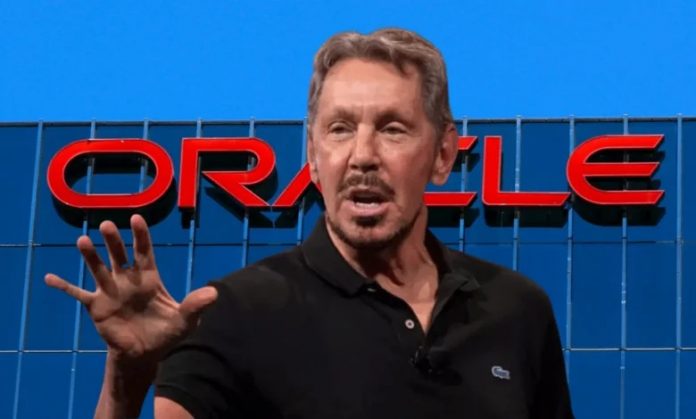
The market value hit to Oracle directly impacted its leadership. Larry Ellison, whose net worth of $276 billion (according to Forbes) is largely derived from his roughly 40% stake in the company, saw his net worth potentially decline by more than $30 billion in the wake of the stock plunge.

Broader Tech Sector Selloff

Oracle’s struggles triggered a sympathetic selloff across the entire AI-focused segment, heightening fears that the ongoing AI market frenzy has become an investment bubble reminiscent of the 1990s dot-com boom. This fear is exacerbated by the circular deals and massive, undetailed future spending commitments, such as those from OpenAI (valued at $500 billion but still unprofitable), which is expected to spend over $1 trillion on AI infrastructure by 2030.

The tech-heavy Nasdaq fell to a one-week low as other AI-related stocks and chipmakers followed Oracle’s trajectory. Key components of the AI supply chain—including Nvidia, Advanced Micro Devices, Micron, Broadcom, and Arm Holdings—all recorded declines ranging from 3.1% to 4.2%.

Despite the immediate negative market reaction, at least 13 brokerages cut their price targets, but some analysts defended the company’s strategy. BofA Global Research analysts argued that the decline represents an investment cycle payment, stating, “The current weakness is more capex investment cycles needed to support demand, with the company paying the price for the abnormal speed in which investment is required to meet current AI demand trends.”

However, the market is demanding greater clarity. Oracle now trades at a forward price-to-earnings (P/E) ratio of 29.56, still slightly above that of rivals like Microsoft at 27.24 and Amazon at 29.06, leaving its current valuation under intense scrutiny until its massive CapEx translates into sustained, high-margin cloud revenue.

Wallets Connected to FTX/Alameda Research Unstake $25M in Solana

0

Wallets associated with the bankrupt FTX exchange and its trading arm, Alameda Research, unstaked 194,861 SOL tokens from a staking account, unlocking approximately $25.5 million worth of Solana at prevailing prices around $131 per SOL.

This transaction, tracked by on-chain analytics firms like Lookonchain and Arkham Intelligence, follows a predictable monthly pattern of unlocks that began in late 2023 as part of the estate’s asset liquidation process to fund creditor repayments.

The unstaked SOL was transferred to a new address controlled by the estate, increasing available liquidity for potential sales. However, the same staking address still holds about 4.048 million SOL, valued at roughly $620 million, indicating this is just one installment in a larger unwind.

Since November 2023, FTX and Alameda have unstaked over 8 million SOL—worth nearly $1 billion at various points—often depositing portions to exchanges like Coinbase and Binance for controlled sales approved by U.S. Bankruptcy Court.

Market impact appears muted so far: SOL’s price dipped 5.4% in the prior 24 hours amid broader crypto weakness, but community sentiment views these events as routine liquidity injections rather than protocol threats.

No immediate dumps have occurred, thanks to court limits on weekly sales capped at $200 million. This aligns with prior unlocks, like March 2025’s $431 million batch, which caused short-term volatility but didn’t derail Solana’s ecosystem growth in DeFi and NFTs.

BlackRock’s IBIT Bitcoin ETF Records $192M Inflows

BlackRock’s iShares Bitcoin Trust (IBIT) saw $192 million in net inflows on February 27, 2025, leading a rebound in spot Bitcoin ETF activity amid a volatile market.

This marked a strong single-day performance for the fund, which has dominated institutional demand since its January 2024 launch, amassing over $52 billion in year-to-date inflows by late 2025 and becoming BlackRock’s top revenue generator with estimated $245 million in annual fees.

The inflows contributed to a broader $290 million net positive day for U.S. spot Bitcoin ETFs, offsetting Grayscale’s GBTC outflows of $599 million. Fidelity’s FBTC added $66 million, while ARK/21Shares’ ARKB brought in $24 million.

This surge helped Bitcoin rebound 4% to around $68,000 that week, signaling renewed institutional confidence after earlier outflows tied to year-end rebalancing and macro uncertainty. By mid-2025, IBIT had grown to $70+ billion in assets under management, holding over 700,000 BTC— 3.3% of total supply and outpacing rivals like Fidelity’s FBTC.

Despite a recent six-week outflow streak totaling $2.7 billion through November 2025—reflecting Bitcoin’s 27% pullback from October highs—the fund’s annualized return exceeded 40% from debut to November, underscoring its role as a key proxy for U.S. crypto adoption.

While the immediate market reaction was a 5.4% SOL price dip amid broader crypto weakness, the implications ripple across short-term volatility, long-term ecosystem health, and regulatory oversight. The unlocked 194,861 SOL increases circulating supply, potentially flooding exchanges if sold off.

Historical data shows similar events—like the March 2025 $431M batch—triggered 13-15% drops due to heightened sell-side liquidity. Court caps limit weekly sales to $200M, mitigating instant dumps, but thin holiday volumes could amplify downside if buyers hesitate.

Analysts note SOL’s resilience, often rebounding within days as DeFi activity absorbs the supply. This move advances FTX’s court-mandated asset unwind, with ~$620M in remaining staked SOL signaling more unlocks ahead.

It underscores the bankruptcy’s maturity—total unstaked SOL now nears 9M tokens worth $1.2B—potentially accelerating payouts to defrauded users by mid-2026. Positive for justice, but it highlights lingering risks from concentrated holdings tied to one failed entity.

Solana’s network fundamentals remain strong, with institutional inflows and tools like Grayscale’s GSOL ETF providing hedges. However, repeated events erode retail confidence, as seen in declining social metrics and 22% trading volume drops post-similar unlocks.

Long-term, it could deter new projects if perceived as a “FTX overhang,” though Solana’s low fees and speed continue driving DeFi/NFT growth. Analysts see these inflows as a bullish counter to retail selling, with potential for more if Bitcoin stabilizes above $100,000 into 2026.

Binance API Hints at Tokenized Stock Offerings As Fogo Announces $1B FDV ICO Raise

0

Recent developments suggest Binance is expanding tokenized real-world asset (RWA) access via its ecosystem, with indirect “hints” through wallet integrations and API-adjacent announcements—though no explicit API updates for tokenized stocks were found in official docs.

In late November 2025, Ondo Finance integrated its Ondo Global Markets platform with Binance Wallet, enabling over 280 million users to access 100+ tokenized U.S. stocks and ETFs like Apple, Microsoft, MicroStrategy directly on BNB Chain with 0% trading fees.

USERS CAN BROWSE AND TRADE THESE IN THE WALLET’S “MARKETS > STOCKS” TAB, REPRESENTING FRACTIONAL ON-CHAIN OWNERSHIP OF TRADITIONAL SECURITIES.

This builds on Binance’s prior tokenized stock experiments like Tesla, Coinbase tokens in 2021, which faced regulatory scrutiny and were discontinued on Binance.com in 2022 to focus on other products—migrating EEA/Swiss users to CM-Equity AG’s portal.

THE ONDO INTEGRATION REVIVES THE CONCEPT WITHOUT DIRECT EXCHANGE LISTING, LEVERAGING BLOCKCHAIN FOR 24/7 LIQUIDITY AND COMPOSABILITY. BINANCE’S SPOT API DOCS— V3 ENDPOINTS FOR MARKET DATA, KLINES, ETC. REMAIN UNCHANGED AND DO NOT REFERENCE TOKENIZED STOCKS, BUT THE WALLET EXPANSION COULD IMPLY FUTURE API EXTENSIONS FOR RWA TRADING PAIRS OR DATA FEEDS.

Analysts view this as Binance’s “move fast and break things” push into RWAs amid global tokenization growth, potentially challenging platforms like Backed or Franklin Templeton.  No direct API “hints” were confirmed.

Fogo ICO Announcement

Fogo, a high-performance Solana Virtual Machine (SVM)-compatible Layer 1 blockchain leveraging the Firedancer validator client for ultra-low latency under 40ms block times and high throughput over 54,000 TPS, has officially detailed its public token sale.

The ICO is set to raise $20 million by selling 2% of the total 10 billion $FOGO token supply at a price of $0.10 per token, implying a fully diluted valuation (FDV) of $1 billion.

This follows earlier funding rounds totaling $13.5 million: a $5.5 million seed round in December 2024 led by Distributed Global with CMS Holdings participation at a $100 million FDV, and an $8 million community raise via Cobie’s Echo platform in January 2025, also at $100 million FDV, which sold out in under two hours and brought over 3,000 angel investors on board.

TGE and mainnet is slated January 13, 2026 100% unlocked at token generation event, with 2% of team supply burned. Real-time on-chain experiences for DeFi, gaming, and physics simulations, with multi-local consensus for regional low-latency validation. Devnet is live, Testnet launches Q1 2026, Mainnet Q2 2026.

Community sentiment on X is mixed: excitement around the tech and rapid prior raises contrasts with skepticism over the aggressive $1B FDV in a bearish market, with pre-market perps on Hyperliquid pricing it at ~$1.3B FDV and Polymarket odds favoring a lower launch valuation around $300M.

As a pure Firedancer chain with multi-local consensus co-located validators for regional low-latency and a curated validator set, Fogo accelerates Solana’s tech evolution. It retains full SVM compatibility, enabling seamless dApp migration which could fragment but ultimately strengthen the ecosystem by stress-testing Firedancer findings for Solana’s upgrades.

This “accretive” approach—forking open-source code—irks some Solana devs but fosters cross-pollination, potentially drawing 84M+ Solana users to experiment with real-time apps like high-frequency trading or physics-based gaming.

Fogo targets “institutional-grade on-chain finance,” bridging TradFi speed (NASDAQ-like) with decentralization for DeFi, RWAs, and derivatives. Integrations like Wormhole, Pyth, and Ambient Finance could unlock $16T in tokenized assets by 2033, especially for low-latency needs like options or prediction markets.

Early “Flames” points and potential airdrops reward 3,000+ angels from prior $13.5M raises, fostering community but risking centralization critiques. Fogo’s “Flames” points program rewards early community engagement, potentially tying into future airdrops.

This positions Fogo as a “pure Firedancer” chain aiming to outpace Solana in performance while maintaining decentralization, though some Solana devs have critiqued the reuse of open-source code.