DD
MM
YYYY

PAGES

DD
MM
YYYY

spot_img

PAGES

Home Blog Page 8

“Our Energy Exports Will Not Be Held Hostage:” UAE Accelerates Move to Reroute Energy Exports as Iran War Exposes Gulf Vulnerabilities

0

Abu Dhabi expands ports, pipelines and alternative trade corridors as Gulf states seek greater economic and security autonomy from the Strait of Hormuz

The United Arab Emirates is accelerating efforts to develop alternative routes for energy exports and international trade, seeking to ensure that its economy is not held hostage by the continuing conflict between the United States and Iran, a senior presidential adviser said on Monday.

The war has exposed the vulnerability of Gulf economies that depend heavily on the Strait of Hormuz, a critical maritime chokepoint through which a large share of global energy supplies normally passes.

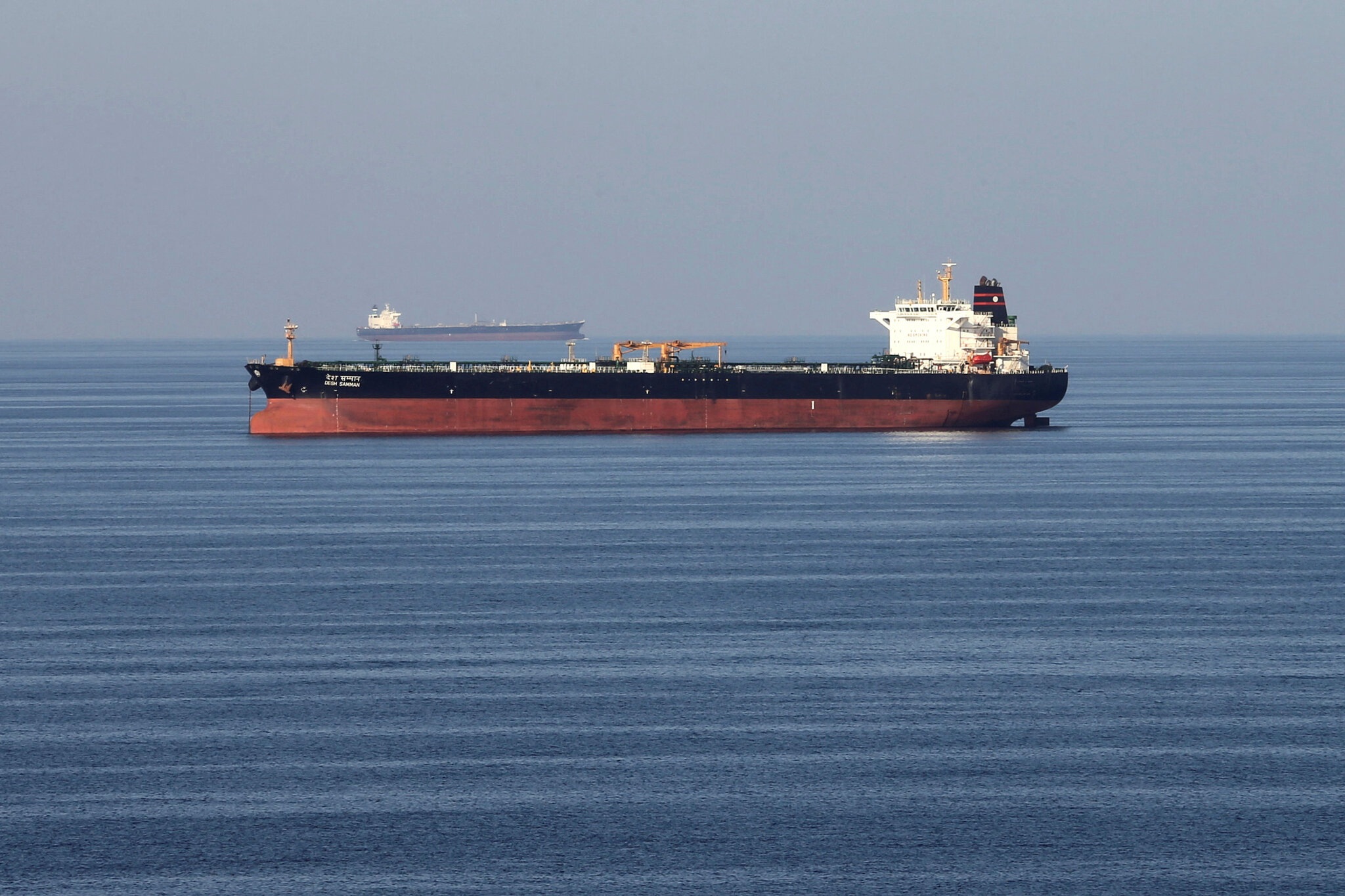
The UAE has been particularly affected after Iran launched missile attacks against the country and targeted oil tankers operating in and around the strategic waterway.

“Our energy exports will not be held hostage, nor will our trade and economic activity,” UAE presidential adviser Anwar Gargash told the Hili Forum in Abu Dhabi.

Gargash said the UAE was expanding port capacity along its eastern coast while developing pipelines, rail links and alternative trade corridors that could allow energy and commercial shipments to bypass the Strait of Hormuz.

The investments represent more than an infrastructure programme. They are part of a broader effort by Gulf states to reduce the economic consequences of future disruptions in the waterway and strengthen their ability to operate independently during regional crises.

The alternative export infrastructure is expected to provide the country with greater flexibility if maritime traffic through Hormuz remains restricted or becomes vulnerable to renewed attacks. It could also reduce the extent to which disruptions in the Gulf immediately translate into interruptions in the country’s oil exports and wider trade flows.

The conflict has also prompted a reassessment of the Gulf’s long-standing reliance on the United States for regional security. Gargash said relations with Iran could eventually recover, but warned that rebuilding confidence after the attacks could take decades.

He also criticized Gulf Arab states for failing to develop a sufficiently coordinated response to Iran, arguing that countries with similar security concerns had struggled to turn those shared interests into a unified strategy.

Qatar’s Foreign Ministry spokesperson, Majed al-Ansari, delivered a similar message at the forum, saying the region could not rely exclusively on its strategic partnership with Washington.

“We need to realize in the Gulf that having international forces in the region, having a strategic alliance with the U.S. is very important but is not enough,” al-Ansari said.

“Self-sufficiency when it comes to security is the only way forward.”

Gargash said the UAE would continue to regard its relationship with the United States as essential, but argued that the conflict had demonstrated the limits of relying entirely on an external security guarantor.

“Our security is our first priority. When we depend entirely on others, we cannot always assume it will be their priority,” he said.

The comments point to a potentially important long-term shift in Gulf policy. Rather than abandoning alliances with Washington, regional governments appear increasingly focused on building their own economic and security buffers so that a future conflict does not automatically translate into a systemic disruption.

The Strait of Hormuz remains one of the most contentious issues in negotiations between Washington and Tehran, which are being mediated by Qatar and Pakistan.

Iran followed through on threats to restrict traffic through the waterway, causing major disruption to energy shipments and sending oil prices sharply higher.

The strait has historically carried roughly one-fifth of global energy supplies, making any prolonged disruption capable of producing consequences far beyond the Gulf. Its strategic importance also explains why the waterway has become a central obstacle to efforts to revive negotiations.

Iran has asserted that the strait is under the jurisdiction of Iran and Oman, a position that Gulf Arab states broadly reject. For the UAE and other Gulf economies, the issue is not simply territorial. It is directly connected to their ability to export energy and maintain access to international markets.

“Freedom of navigation is not a concession to be granted, nor a principle to be renegotiated under pressure,” Gargash said.

He added that any durable settlement would need to include credible guarantees preventing further Iranian attacks against Gulf Arab states.

Economic Diversification Meets Geopolitical Reality

The UAE has spent years positioning itself as a global logistics, trading and financial hub, making uninterrupted access to international shipping routes a threat to its economic model.

The current conflict has demonstrated the limits of that model when regional instability reaches a major maritime chokepoint. Developing alternative ports, pipelines, railways and overland trade corridors could therefore serve two purposes. It would strengthen the UAE’s economic resilience while giving Abu Dhabi greater strategic autonomy in any future confrontation involving Iran or other regional powers.

The approach could also influence how other Gulf states think about infrastructure. If the cost of disruption at Hormuz remains high, governments may view redundant export routes, domestic logistics networks and alternative shipping corridors as strategic assets rather than simply commercial infrastructure.

The immediate challenge, however, remains the unresolved conflict.

The war began with U.S. and Israeli strikes on Iran on February 28. A preliminary ceasefire reached in June has since unraveled, while negotiations aimed at restoring a durable peace have made limited progress.

For Gulf governments, the lesson is that even with American military support, regional stability cannot be assumed.

Thus, the UAE’s response is to build economic infrastructure that gives it more options when diplomacy or military deterrence fails. Its message is that energy exports and trade must continue regardless of who controls the battlefield or how negotiations over Hormuz unfold.
Europe’s Isar Aerospace Reaches Orbit, Setting Commercial Space Challenge with SpaceX

0

German rocket maker Isar Aerospace has reached orbit for the first time, marking a major step forward for Europe’s effort to build an independent commercial launch industry and challenge the dominance of U.S. providers such as SpaceX.

The Munich-based company’s Spectrum rocket reached low Earth orbit on Saturday and successfully deployed its payloads during its second test flight. The achievement gives Isar a crucial demonstration of launch capability as it prepares to move from development and testing toward higher-volume commercial operations.

The company now plans to accelerate rocket production and increase launch frequency to capitalize on what it describes as rapidly expanding demand for orbital launch services.

“There’s a lot of new … constellations and new projects that have come out, and actually they’re financed,” Isar Chief Commercial Officer Stella Guillen told CNBC’s “Squawk Box Europe” on Monday.

Guillen said the company has a pipeline worth more than 10 billion euros ($11.6 billion), although Isar did not immediately specify how much of that figure represents firm, contracted orders.

“The demand is so big,” she said, adding that the space industry is “desperate” for additional launch capacity.

The successful flight comes at a pivotal moment for Europe’s space sector. The rapid expansion of satellite constellations for communications, Earth observation, navigation, defense and other applications is increasing demand for launches, while governments and companies are seeking alternatives to relying heavily on a small number of foreign providers.

For Isar, the next challenge is no longer simply proving that Spectrum can reach orbit. It is demonstrating that the company can manufacture rockets at an industrial scale and launch them frequently enough to serve a growing customer base.

“Right now, it’s all about scalability, so industrialization is a huge thing for us, and we are ramping up,” Guillen said. “It really is about scaling and being able to launch… not one rocket but hundreds of rockets.”

That ambition highlights the gap between Europe’s emerging launch companies and established U.S. operators. SpaceX has spent years developing reusable launch technology, high-volume manufacturing and a dense launch schedule, giving it a scale that European startups are still trying to achieve.

Isar is also warning that rocket manufacturing is only part of the challenge. Europe will need additional launch infrastructure, including launch sites and associated facilities, if the region is to support a much larger commercial space industry.

The company has been building its financial base to support that expansion. Isar raised 270 million euros in a Series D funding round in June, with the proceeds intended to increase production capacity and expand its international launch network.

Its investors include Porsche, venture capital firms Lakestar and HV Capital, and the NATO Innovation Fund, giving the company backing from both private capital and institutions with an interest in Europe’s strategic technology and defense capabilities.

The investment is significant because access to space has increasingly become a strategic issue rather than solely a commercial one. Satellites are critical to communications, intelligence, navigation, military operations, climate monitoring and a growing range of commercial services. Dependence on foreign launch providers can therefore create vulnerabilities when geopolitical tensions disrupt access or governments impose restrictions.

Isar’s orbital milestone could strengthen Europe’s position in that market, but sustained competitiveness will depend on whether the company can convert its large prospective pipeline into contracts and repeat launches.

Germany’s Chancellor Friedrich Merz described the achievement as “the beginning of a new era,” while EU defense and space commissioner Andrius Kubilius said Europe’s independent access to space had received “a major boost.”

The immediate test for Isar will be turning Saturday’s successful mission into a repeatable commercial operation. Experts say that if the company can increase Spectrum production and launch frequency while securing sufficient launch infrastructure and customers, it could become one of the key European competitors in the global space market.

8 Patents Issued by Federal Republic of Nigeria to Contisx

0

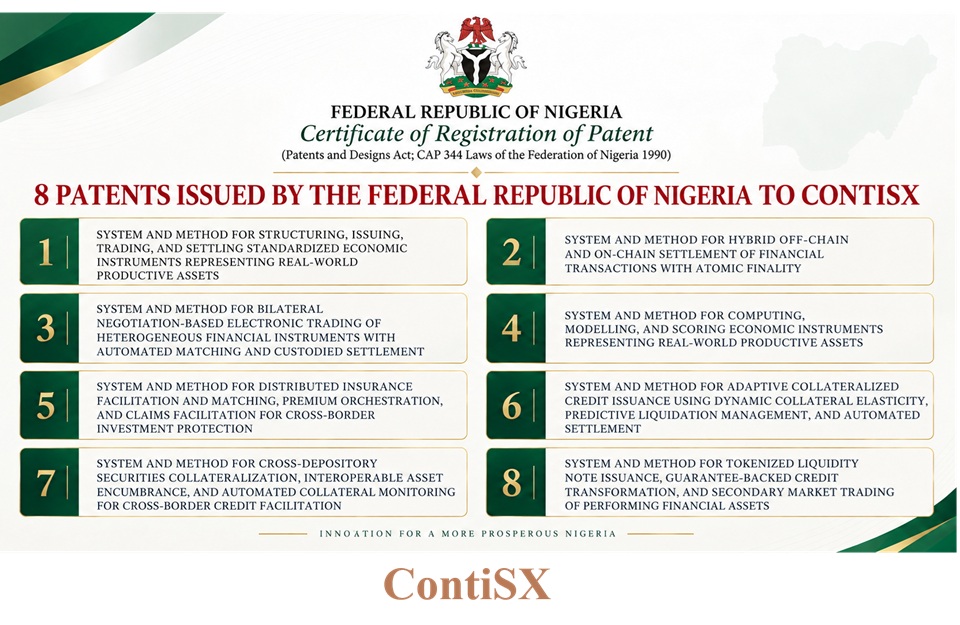
Good People, I am pleased to announce that Contisx Securities Exchange Plc, which is scheduled to launch next month, has received its eighth patent from the Federal Republic of Nigeria. Presented below are the eight patents issued to the Exchange.


  1. System and Method for Structuring, Issuing, Trading, and Settling Standardized Economic Instruments Representing Real-World Productive Assets

  2. System and Method for Hybrid Off-Chain and On-Chain Settlement of Financial Transactions with Atomic Finality

  3. System and Method for Bilateral Negotiation-Based Electronic Trading of Heterogeneous Financial Instruments with Automated Matching and Custodied Settlement.

  4. System and Method for Computing, Modelling, and Scoring Economic Instruments Representing Real-World Productive Assets

  5. System and Method for Distributed Insurance Facilitation and Matching, Premium Orchestration, and Claims Facilitation for Cross-Border Investment Protection

  6. System and Method for Adaptive Collateralized Credit Issuance Using Dynamic Collateral Elasticity, Predictive Liquidation Management, and Automated Settlement .

  7. System and Method for Cross-Depository Securities Collateralization, Interoperable Asset Encumbrance, and Automated Collateral Monitoring for Cross-Border Credit Facilitation

  8. System and Method for Tokenized Liquidity Note Issuance, Guarantee-Backed Credit Transformation, and Secondary Market Trading of Performing Financial Assets

As soon as we launch, we will open our Careers page. We look forward to welcoming outstanding statisticians, mathematicians, software developers, engineers, accountants, economists, and linguists specializing in Hausa, Igbo, Yoruba and Nigerian Pidgin to join our innovative team.

ContiSX >> exchanging prosperity | visit contisx.com

Oil Near $98 as Hormuz Attacks Deepen Supply Risks and Treasury Yields Face 4.8% Test

0

Escalating attacks on tankers threaten a wider oil shock as investors also confront rising U.S. borrowing costs and mounting fiscal pressures

Oil prices hovered near six-week highs on Monday as escalating attacks involving the United States and Iran disrupted commercial shipping through the Strait of Hormuz, raising the prospect of a more severe energy-supply shock across global markets.

Brent crude futures were down 9 cents, or 0.1%, at $96.19 a barrel by 0822 GMT after earlier reaching $97.93, their highest level since July 24. U.S. West Texas Intermediate crude fell 45 cents to $91.03 a barrel, also close to a six-week high.

Brent gained about 8% last week, while WTI climbed nearly 10%, as U.S. and Iranian forces resumed attacks and concerns grew that the conflict could spill over into commercial shipping.

The latest escalation came Saturday when U.S. forces struck three Iranian oil tankers, according to U.S. Central Command, including one off the coast of Kharg Island, Iran’s main oil export hub.

Iran’s Islamic Revolutionary Guard Corps navy said it had targeted three oil tankers traveling through unauthorized routes in the Strait of Hormuz, as well as three additional U.S. vessels elsewhere. The attacks mark a potentially important change in the risk to global energy markets because commercial shipping is becoming directly entangled in the conflict.

“The Saturday attacks represented a ‘major escalation,’” maritime intelligence firm Marisks said, warning that commercial tankers were increasingly being used as instruments of reciprocal economic pressure.

That development has hit the oil market hard. The Strait of Hormuz is one of the world’s most important energy chokepoints, and a sustained reduction in tanker traffic could transform the current price shock into a much larger supply disruption.

An average of just 10 commodity ships passed through the strait each day over the past 10 days, the lowest level since May, according to data from analytics firm Kpler.

“If tanker traffic begins to slow materially, the market could price in a much larger supply shock. And there are already signs that this is happening,” said Priyanka Sachdeva, head of market insights at Phillip Nova.

Goldman Sachs has warned that crude could rise as high as $120 a barrel if attacks on shipping intensify.

Iran is also preparing to tighten restrictions around the strategic waterway. Mohsen Rezaei, secretary of Iran’s Supreme National Security Council, said a restricted zone would be announced outside the Strait of Hormuz in the coming days, according to Iranian state media.

OPEC+ Holds Course As Supply Risks Increase

Against that backdrop, OPEC+ left its oil-output policy unchanged for October at a meeting on Sunday. The producer group said it needed to agree on new quotas before determining its next production steps.

The decision leaves the market heavily dependent on the actual scale and duration of the shipping disruption. If tanker traffic continues to deteriorate, spare production capacity elsewhere may not be sufficient to immediately compensate for logistical constraints in the Gulf.

The consequences would extend beyond gasoline and diesel prices. A sustained oil shock could feed directly into headline inflation, increase transportation and production costs, and complicate monetary policy for central banks that might otherwise be considering lower interest rates.

That creates a particularly difficult backdrop for financial markets because oil is rising at the same time that long-term government bond yields are already under pressure.

Treasury Yield Faces Critical 4.8% Threshold

The 10-year U.S. Treasury yield now faces a closely watched 4.8% level, with a sustained break above it potentially triggering broader stress across equities, credit and other asset classes, according to Matt Maley, chief market strategist at Miller Tabak.

“We remain concerned about the Treasury market…as rising fiscal deficits, massive debt issuance, and heavy corporate borrowing continue to pressure long-term yields… while Treasury Department jawboning has failed to produce the desired decline in rates (at least so far),” Maley said in a note over the weekend.

A sustained move above 4.8%, which corresponds with the high reached in January 2025, would be significant because it could signal that investors are demanding substantially more compensation to hold long-duration U.S. government debt.

Maley said recent efforts by the U.S. Treasury Department and Secretary Scott Bessent to encourage lower yields have not produced the desired result. Those efforts came as investors held large short positions in Treasuries and summer trading volumes were relatively thin, creating expectations that official comments could help trigger a bond-market rally. Instead, the market’s resilience at elevated yields points to a deeper problem: investors are increasingly focused on the underlying supply of government debt rather than simply reacting to policymakers’ statements.

The U.S. national debt has surpassed $40 trillion, while the federal government continues to run large budget deficits. At the same time, the Treasury market is competing with a heavy pipeline of corporate borrowing for investors’ capital.

More than $8.4 trillion of U.S. government securities are scheduled to roll over between now and the end of the year, according to Maley. September could also become a record month for high-grade corporate issuance, while Goldman Sachs recently raised its forecast for U.S. dollar investment-grade corporate issuance in 2026 to $2.3 trillion.

That combination creates a formidable supply challenge for fixed-income markets.

Rising Yields Threaten Wider Asset Repricing

The concern is not limited to Treasuries.

Michael Chen, general manager of Noah ARK Hong Kong, said a disorderly rise in long-term Treasury yields could force a repricing across assets whose valuations depend heavily on long-term interest rates.

Ultra-long-duration bonds, highly valued growth stocks, commercial real estate and some private-market assets could be particularly vulnerable because higher discount rates reduce the present value of their future cash flows.

Chen said structural pressure on the Treasury market was building as investors demand greater compensation for fiscal risk. He favors gold and hard currencies as longer-term hedges and remains underweight ultra-long-duration Treasuries, while maintaining exposure to quality equities, real assets and physical infrastructure associated with AI, including electricity generation, power grids, energy storage and data centers.

The gap between AI-related investment optimism and rising discount rates is becoming notable for markets. The AI infrastructure boom can support corporate earnings and productivity, but higher Treasury yields raise the cost of financing that investment and reduce the valuation investors are willing to assign to future profits.

Global Bond Markets Face The Same Fiscal Problem

The pressure is also spreading across developed economies.

HSBC has become more cautious on long-dated government bonds and raised its end-2026 forecast for the 10-year U.S. Treasury yield to 4.65% from 4.30%, citing a higher structural floor for long-term yields and a more hawkish range of potential monetary-policy outcomes. The bank also raised its end-2026 forecast for 10-year German Bund yields to 3% from 2.8% and said it remains cautious on long-end bonds across developed markets.

Japan, Britain and France face their own fiscal challenges, suggesting that the pressure on government bonds is not simply a U.S. phenomenon.

For investors, the combination of higher oil prices and elevated bond yields is particularly uncomfortable. Oil threatens to revive inflation, while higher long-term yields tighten financial conditions even without additional central-bank rate increases. Analysts warn that this could leave policymakers confronting a familiar but difficult combination of slower growth and renewed price pressures.

Maley cautioned that the Treasury market could still stage a sharp near-term rally.

Bearish positioning is already elevated, and any deterioration in economic data or geopolitical developments that trigger a flight to safety could push investors back into government bonds and temporarily lower yields.

But he argued that such a move would not necessarily represent a reversal of the longer-term trend. The market’s psychological thresholds have already moved progressively higher, from 4.4% to 4.5%, 4.6% and 4.7%, as investors adjusted to persistently high debt issuance and fiscal concerns.

“If we get a bounce in the Treasury market soon (and thus a drop in yields)…and even if it can last through the mid-term election…it’s not something that can be softened over the longer-term…without some serious changes on the fiscal front,” Maley said.

That leaves markets facing two potentially reinforcing sources of pressure. A further escalation around the Strait of Hormuz could push crude toward $100 and beyond, reviving inflation risks just as investors are demanding higher yields to absorb unprecedented volumes of government and corporate debt.

If both trends persist, the result could be a broad tightening in global financial conditions, with consequences for equities, credit, real estate and other risk assets.

Ethereum co-founder Vitalik Buterin Rejects Claim That AI Could Crash Bitcoin by 50%

0

Ethereum co-founder Vitalik Buterin has firmly rejected a prediction that advances in artificial intelligence could undermine Bitcoin’s security and trigger a price drop of more than 50% within two years.

In a direct response on X, Buterin said he takes the opposite side of the forecast, noting that roughly 90% of his net worth is already effectively positioned against such an outcome.

He wrote,

I take the opposite side of that. My basic reasons are that I am quite optimistic about cybersecurity in the long term. I see the primary problem as being the transition. I expect BTC to handle at least any issues that do not require social consensus well (upgrading clients, mining pools, etc to deal with network-layer hacks is in this category) (and I think the probability of actual breaks in hashes or PoW is tiny). I would offer a bet, but given what my holdings are I’m basically taking this bet (I assume you believe the same re ETH) with 90% of my net worth already”.

The original claim in this conversation came from Silicon Valley angel investor and AI-risk commentator Liron Shapira, who said BTC prices will crash 50%+ in the next 2 years because AI is undermining what people imagined were its security or robustness guarantees.

His argument goes beyond the usual concerns about market volatility, regulation, or macroeconomic conditions, focusing instead on whether Bitcoin’s technological foundations can remain secure as artificial intelligence becomes increasingly capable.

According to Shapira’s thesis, increasingly sophisticated AI systems could eventually identify vulnerabilities, automate complex cyberattacks, or expose weaknesses across the infrastructure supporting Bitcoin.

Even if the underlying cryptography were not immediately broken, a credible discovery of a major vulnerability could undermine investor confidence in the network.

Such a development could have significant consequences for Bitcoin’s price. The cryptocurrency’s value is partly built on the belief that its transactions, ownership structure, and underlying network are highly resistant to manipulation.

If AI were to challenge those assumptions, investors could begin reassessing Bitcoin’s risk profile, potentially triggering large-scale selling and a sharp decline in its market value

However, Buterin countered that he remains quite optimistic about cybersecurity over the long term. He identified the main challenge as managing the transition period rather than any fundamental collapse.

He argued that Bitcoin should handle most problems that do not require changes to the network’s social consensus, such as upgrading clients and mining pools to address network-layer attacks.

In contrast, he described the probability of actual breaks in Bitcoin’s hash functions or proof-of-work mechanism as tiny. The remark underscores his strong personal conviction in the resilience of the cryptographic foundations shared across major blockchains, including those underlying Ethereum.

Bitcoin’s price history since the AI boom instead demonstrates considerable resilience. From approximately $16,600 at the beginning of 2023 to a record above $126,000 in 2025, the cryptocurrency experienced a dramatic appreciation while AI capabilities were advancing at an unprecedented pace.

Bitcoin’s subsequent weakness in 2026 also cannot simply be attributed to AI. Macroeconomic conditions, interest-rate expectations, liquidity, institutional flows, and broader risk appetite have remained major drivers of cryptocurrency prices.

Consequently, the claim that AI will crash Bitcoin by 50% or more should be viewed as a high-risk scenario rather than an established forecast

The conversation highlights a broader debate about how rapidly advancing AI might affect blockchain security. While AI could increase the sophistication of certain attacks, such as those targeting software clients or infrastructure, Buterin’s view centers on the adaptability of existing systems through routine upgrades rather than catastrophic cryptographic failure.

His comments suggest that practical vulnerabilities are more likely to be manageable than a sudden breakdown of core primitives like SHA-256 or the proof-of-work model itself.

The discussion has drawn attention across crypto circles, reinforcing ongoing conversations about the interplay between artificial intelligence and decentralized networks at a time when both technologies continue to evolve quickly.