DD
MM
YYYY

PAGES

DD
MM
YYYY

spot_img

PAGES

Home Blog Page 832

Increased Banks Exposure To Crypto Could Tie Traditional Finance To Volatile Markets

0

The Federal Reserve, along with the Office of the Comptroller of the Currency (OCC) and the Federal Deposit Insurance Corporation (FDIC), issued a joint statement clarifying that U.S. banks are permitted to provide custody services for Bitcoin and other crypto assets. This guidance does not introduce new regulations but reaffirms that banks can hold digital assets for customers in both fiduciary and non-fiduciary capacities, provided they adhere to existing risk management frameworks and comply with applicable laws, such as the Bank Secrecy Act, anti-money laundering (AML) regulations, and cybersecurity standards.

Banks must maintain full control over cryptographic keys, ensuring no other party, including customers, can access the assets during safekeeping. They are also liable for any third-party custodians they employ, requiring thorough due diligence. The statement emphasizes the need for robust cybersecurity, operational expertise, and risk assessments to address complexities like key loss, cyberattacks, and market volatility. This regulatory shift, building on earlier guidance relaxations in 2025, aims to reduce uncertainty, foster institutional adoption, and align crypto custody with traditional banking practices.

Banks offering custody services legitimize crypto as an asset class, encouraging institutional investors (e.g., hedge funds, pension funds) to allocate capital to Bitcoin and other cryptocurrencies. This could drive price appreciation and market stability due to increased liquidity. Banks providing custody services lower barriers for retail investors wary of self-custody risks (e.g., losing private keys). This could boost retail participation, potentially increasing crypto market capitalization.

Banks’ involvement strengthens crypto infrastructure, integrating digital assets into traditional financial systems. This could lead to new financial products like crypto-backed loans, ETFs, or derivatives, enhancing market sophistication. The statement builds on earlier 2025 relaxations, providing banks with a clearer path to offer custody services under existing regulations (e.g., Bank Secrecy Act, AML, KYC). This reduces legal ambiguity, encouraging banks to innovate in the crypto space.

Banks must implement robust cybersecurity, key management, and operational controls to mitigate risks like hacks or key loss. This could set industry standards for secure custody, benefiting the broader crypto ecosystem. The U.S. move may pressure other jurisdictions to clarify their crypto custody rules, fostering global regulatory alignment. However, discrepancies (e.g., stricter EU or Asian regulations) could create competitive challenges for U.S. banks.

Custody services open fee-based revenue opportunities for banks, diversifying income beyond traditional lending or wealth management. Large banks like JPMorgan or Goldman Sachs, already exploring crypto, may gain a first-mover advantage, pressuring smaller banks to adapt or risk losing market share. Banks must invest heavily in technology and expertise to manage crypto’s unique risks (e.g., blockchain forks, wallet vulnerabilities), potentially straining resources for smaller institutions.

Increased bank exposure to crypto could tie traditional finance to volatile markets, raising concerns about systemic risk if crypto prices crash, as seen in past cycles (e.g., 2022’s $2 trillion market drop). Banks holding large crypto assets become high-value targets for cyberattacks, necessitating advanced defenses to prevent losses that could impact depositors or shareholders.

While the statement clarifies custody, it may invite stricter oversight of banks’ crypto activities, potentially leading to future restrictions if risks materialize.

Crypto enthusiasts, including figures like Michael Saylor or Cathie Wood, see bank custody as a step toward mass adoption, validating Bitcoin’s role as “digital gold” or a hedge against inflation. They argue it bridges DeFi and TradFi, enhancing trust and accessibility. Posts on X reflect excitement, with some users predicting Bitcoin could hit $100,000 by 2026 due to institutional inflows. Banking purists and regulators like Gary Gensler (former SEC chair) remain cautious, citing crypto’s volatility, lack of intrinsic value, and use in illicit activities (e.g., 5-10% of crypto transactions tied to money laundering, per Chainalysis 2025 estimates).

They argue banks’ involvement risks destabilizing the financial system, especially without stricter oversight. Banks’ entry into custody aligns with CeFi, where trusted intermediaries manage assets. This appeals to institutional and risk-averse retail investors but contrasts with crypto’s decentralized ethos, where “not your keys, not your crypto” emphasizes self-custody.

Crypto purists, active on X and platforms like Reddit, argue bank custody undermines Bitcoin’s core principles of decentralization and censorship resistance. They fear banks could freeze or seize assets under regulatory pressure, as seen in some jurisdictions during 2022-2023 crypto crackdowns. The Federal Reserve’s guidance aligns with pro-innovation regulators who see crypto as a transformative technology. This view is supported by recent U.S. policy shifts, including the 2024 approval of spot Bitcoin ETFs, signaling a friendlier stance.

Some regulators, particularly in the FDIC or international bodies like the Basel Committee, remain wary, advocating for higher capital requirements or restrictions on banks’ crypto exposure. This divide could lead to uneven regulatory enforcement, creating uncertainty for banks. Bank custody may favor wealthy clients and institutions, who gain access to secure, regulated crypto services, potentially widening the wealth gap. Smaller investors reliant on unregulated platforms face higher risks (e.g., exchange hacks like the 2022 FTX collapse).

The Federal Reserve’s statement is a pivotal step toward integrating crypto into mainstream finance, promising increased adoption, regulatory clarity, and banking innovation. However, it introduces risks like market volatility and cybersecurity threats while deepening divides between crypto advocates and skeptics, centralized and decentralized philosophies, and progressive and conservative regulatory approaches.
Factors Fueling Strategy’s $472.5M Bitcoin Purchase

0

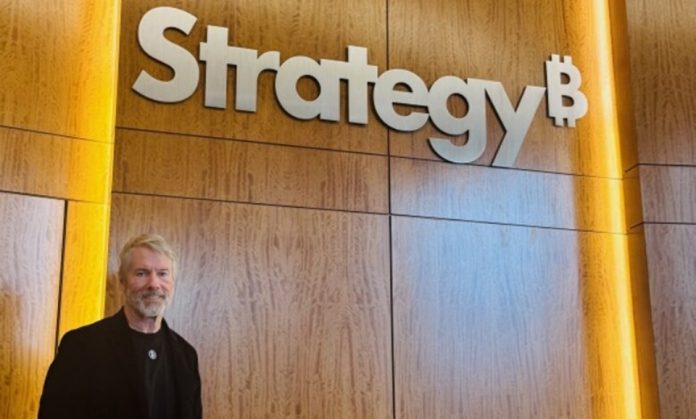
Strategy (formerly MicroStrategy) announced on July 14, 2025, that it acquired 4,225 Bitcoin (BTC) for approximately $472.5 million between July 7 and July 13, at an average price of $111,827 per Bitcoin. This purchase increased Strategy’s total Bitcoin holdings to 601,550 BTC, acquired for about $42.87 billion at an average cost of $71,268 per coin.

The acquisition was funded through the sale of 797,008 shares of Class A common stock (MSTR) for $330.9 million and preferred stock sales (STRK, STRF, STRD) raising $141.4 million. This move, led by Michael Saylor, reflects Strategy’s ongoing commitment to Bitcoin as a treasury asset, achieving a 20.2% BTC yield year-to-date in 2025. The purchase aligns with Bitcoin’s recent price surge, reaching all-time highs above $123,000.

Strategy, under Michael Saylor’s leadership, has positioned Bitcoin as a core component of its corporate treasury strategy since 2020. The company views BTC as a hedge against inflation and currency devaluation, driven by macroeconomic concerns like fiat currency printing and low interest rates.

Bitcoin’s price has soared past $123,000 recently, reflecting growing institutional adoption, market optimism, and positive sentiment following events like the U.S. presidential election and pro-crypto policy signals. This bullish market likely encouraged Strategy to capitalize on momentum.

Strategy funded the purchase through equity sales ($330.9M from MSTR stock) and preferred stock offerings ($141.4M). Its ability to raise capital efficiently allows aggressive Bitcoin accumulation without relying solely on cash reserves. The broader trend of institutions, including BlackRock and Fidelity, embracing Bitcoin via ETFs and custody solutions has bolstered confidence. Strategy’s move aligns with this shift, reinforcing BTC’s legitimacy as an asset class.

Saylor’s public advocacy for Bitcoin as “digital gold” and a superior store of value drives Strategy’s strategy. The company’s 20.2% BTC yield in 2025 underscores its success in this approach, encouraging further investment. Large purchases like Strategy’s can signal strong demand, potentially stabilizing or boosting Bitcoin’s price, especially in a bullish market.

Strategy’s continued commitment reinforces positive market sentiment, encouraging other investors and institutions to consider Bitcoin exposure. Strategy’s success (601,550 BTC valued at ~$74B at current prices) sets a model for other corporations to allocate treasury reserves to Bitcoin, potentially accelerating institutional adoption.

However, it also highlights risks, as Strategy’s stock (MSTR) is increasingly tied to Bitcoin’s volatility, which could deter more risk-averse firms. Large corporate Bitcoin purchases may attract attention from regulators, especially in jurisdictions debating crypto’s role in financial systems. This could lead to stricter reporting or tax requirements for companies holding crypto.

Strategy’s move reinforces Bitcoin’s appeal as an inflation hedge, particularly if global economic uncertainties (e.g., debt levels, monetary policy) persist. Critics may argue that such large holdings by a single entity could exacerbate wealth concentration in crypto markets, raising concerns about market manipulation.

If Bitcoin’s price continues to rise, Strategy’s $42.87B investment could yield significant returns, strengthening its balance sheet. A sharp Bitcoin price correction could impair Strategy’s valuation, given its heavy BTC exposure, potentially impacting shareholders and creditors.

Strategy’s $472.5M Bitcoin purchase is driven by its long-standing belief in BTC as a superior store of value, fueled by favorable market conditions and access to capital. The move strengthens Bitcoin’s institutional credibility but amplifies Strategy’s exposure to crypto volatility. It may inspire other corporations to follow suit, though regulatory and market risks remain key considerations.

OpenAI Partners with Google Cloud to Provide Additional Computing Power For AI Services

0

OpenAI said Wednesday it is partnering with Google Cloud to provide additional computing power for its popular AI services, including ChatGPT and its developer-facing API, marking a significant shift in the company’s cloud infrastructure strategy as it scrambles to meet soaring demand for generative AI tools.

The move broadens OpenAI’s roster of cloud providers beyond Microsoft, its most prominent backer and infrastructure partner since 2019. Google now joins Microsoft, CoreWeave, and Oracle as suppliers of computing capacity for OpenAI’s growing suite of AI products. According to the company, ChatGPT and its API will now run on Google Cloud infrastructure in the United States, the United Kingdom, Japan, the Netherlands, and Norway.

This diversification follows rising strain on OpenAI’s capacity. In April, CEO Sam Altman made a blunt public appeal, posting on X: “if anyone has GPU capacity in 100k chunks we can get asap please call!”—a clear sign that the company was hitting the limits of its compute power amid explosive user demand and rapid product expansion. The company relies heavily on Nvidia’s advanced graphics processing units (GPUs) to power its large language models.

The Google partnership marks a key win for Google Cloud, which has been playing catch-up with Amazon Web Services and Microsoft Azure in the cloud services market. It also reinforces Google’s deepening play in AI infrastructure, where it already hosts Anthropic—a leading OpenAI rival founded by former OpenAI employees—and continues to advance its own models like Gemini.

OpenAI’s new arrangement also reflects shifting dynamics in its relationship with Microsoft. Despite Microsoft’s multi-billion-dollar investment in OpenAI and early exclusivity over its cloud workloads, that arrangement has evolved. In January, Microsoft confirmed it had moved to a “right of first refusal” model, meaning OpenAI can now seek other vendors when more capacity is needed. Microsoft still holds exclusive rights to OpenAI’s APIs and integrates them into its own products like Copilot in Microsoft 365, Azure OpenAI Service, and GitHub.

In recent months, OpenAI has aggressively expanded its compute partnerships. In March, it signed a $12 billion deal with CoreWeave, a specialized AI cloud provider backed by Nvidia. That agreement, set to run for five years, aimed to bolster OpenAI’s infrastructure with GPU-dense data centers tailored for training and serving large AI models. Oracle, another infrastructure partner, announced last year it was working with Microsoft and OpenAI to allow OpenAI workloads to run on Oracle Cloud Infrastructure (OCI) via Microsoft’s Azure platform.

Google Cloud, which once lagged in major AI hosting deals, has now become a direct beneficiary of the generative AI gold rush. Its data centers are designed to handle massive AI workloads and include Google’s own Tensor Processing Units (TPUs), which rival Nvidia’s GPUs in AI performance. While OpenAI is not expected to rely on Google’s TPUs in this arrangement, the move still places Google alongside Microsoft as one of the key players supporting ChatGPT’s growth.

Industry analysts say OpenAI’s multi-cloud strategy is part of a broader trend among AI firms trying to reduce risk, avoid vendor lock-in, and ensure continuity amid GPU shortages. It also underscores the arms race among hyperscalers—Microsoft, Google, Amazon, and Oracle—each vying to dominate the infrastructure layer of the AI economy.

The deal enhances Google’s reputation as a credible host for mission-critical AI services, not just for its in-house teams but also for the broader ecosystem of AI companies competing for scale and global reach.

State Of Solana’s Blockchain RWAs Projects, Kamino Lend’s Integration of Tokenized Equities Impact for DeFi

0

Real-world assets (RWAs) represent a paradigm shift in decentralized finance, bridging traditional finance (TradFi) with blockchain infrastructure by tokenizing offchain assets such as government bonds, private credit, public equities, real estate, and even physical goods. This transformation offers new levels of liquidity, programmability, and global accessibility, particularly for financial instruments that have historically been illiquid, restricted, or inefficiently distributed. Over the past year, Solana has emerged as a serious contender in this space, establishing itself as a viable platform for institutions and retail users alike to access and interact with RWAs onchain.

Solana’s appeal stems from its high throughput, near-zero transaction costs, and robust developer ecosystem. Technical innovations like the Token-2022 standard and fast block finality enable seamless compliance tooling, yield distribution, and composable DeFi integrations. These traits make Solana uniquely suited for hosting a broad spectrum of RWAs, from tokenized Treasury tokens to onchain equities and tokenized commodities. Its infrastructure is increasingly tailored to the needs of asset issuers, regulators, and users, paving the way for RWA adoption at both institutional scale and community levels.

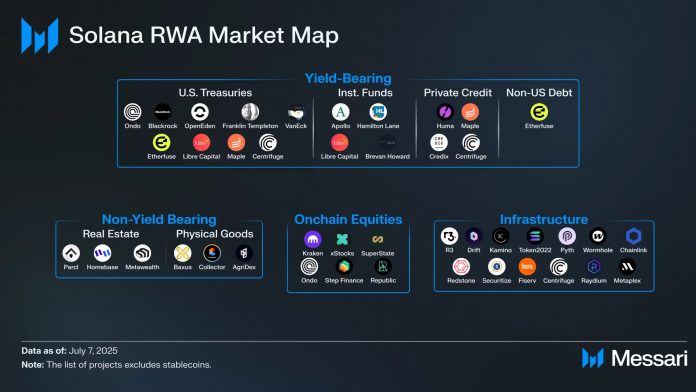
RWAs on Solana exist across four core categories: (1) yield-bearing assets, including tokenized U.S. Treasuries, institutional funds, and private credit protocols like Ondo Finance, Franklin Templeton, and Maple; (2) tokenized public equities, with upcoming launches from Superstate, Kraken, and Ondo Global Markets; (3) non-yielding assets such as tokenized real estate and collectibles from platforms like Parcl and BAXUS; and (4) emerging infrastructure providers like R3 and Securitize that underpin compliance and interoperability. Through this lens, we assess Solana’s trajectory as a rising hub for onchain RWAs and what it means for the future of global capital markets.

Yield-Bearing Assets

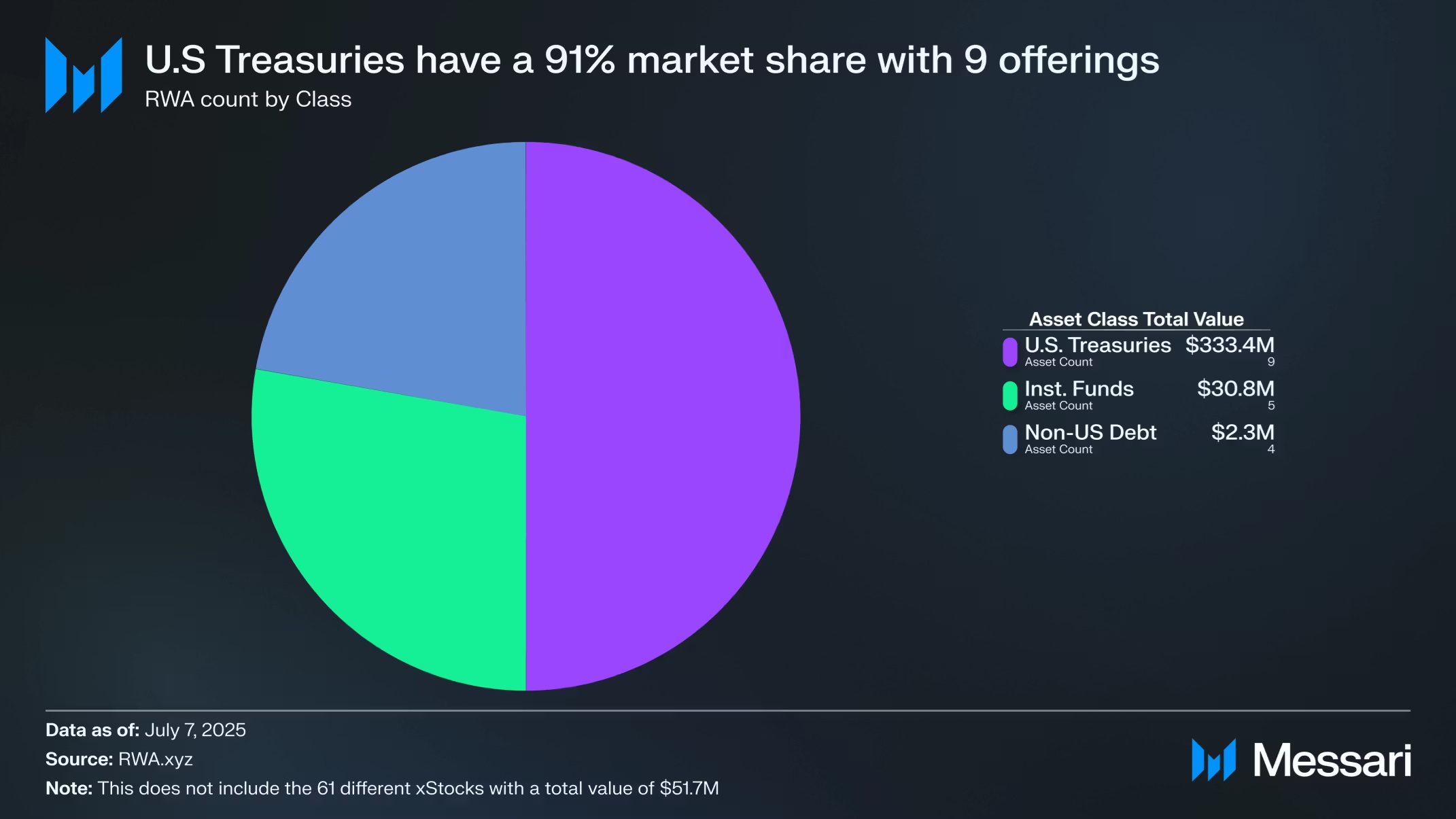
Yield-bearing RWAs are the most significant and fastest-growing segment in Solana’s RWA landscape, capturing the vast majority of non-stablecoin RWA value (USD). These assets, ranging from tokenized U.S. Treasuries to institutional funds and private credit, provide onchain investors with direct exposure to offchain yield streams, often with enhanced composability and 24/7 accessibility compared to their TradFi counterparts.

Tokenized U.S. Treasuries

Tokenized Treasuries offer a digital wrapper for the world’s most liquid and trusted yield instruments and have become a foundational pillar for onchain asset management, stablecoin collateralization, and DAO treasury operations. Solana’s tokenized Treasury market has grown from a small base to encompass a range of products from both native and cross-chain asset issuers.

Ondo Finance – OUSG & USDY (Treasury and Yield Tokens)

OUSG and USDY represent Ondo Finance’s dual approach to tokenized U.S. Treasuries.

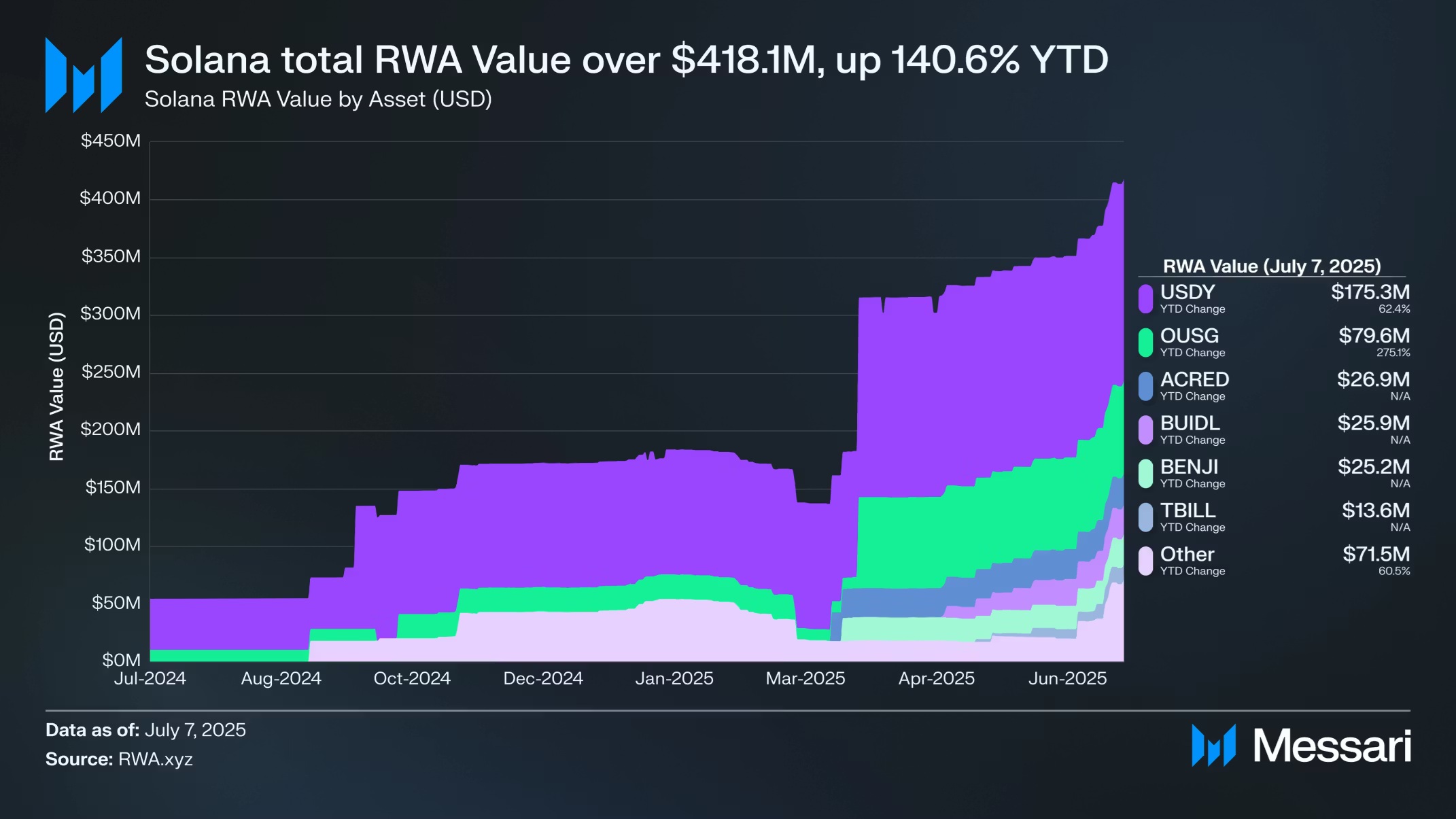
  • OUSG, introduced in January 2023, is a tokenized fund initially structured around BlackRock’s BUIDL Fund. It is primarily intended for accredited investors. In July 2025, OUSG was the second-largest yield-bearing asset by market cap on Solana, with seven holders and a market cap of $79.6 million.
  • USDY, launched in August 2023, is a token backed by Treasuries and bank deposits, designed to function as a yield-bearing stablecoin with broad accessibility. USDY appreciates in price as interest accrues. The token is transferable across chains using LayerZero, making it highly composable in DeFi applications. As of July 2025, USDY was the largest yield-bearing RWA by market cap on Solana, with 6,978 holders and a market cap of $175.3 million.

Kamino Lend’s Integration of Tokenized Equities Is A Game-Changer For DeFi

Kamino Finance, a Solana-based decentralized lending protocol, has integrated tokenized equities (xStocks) into its Kamino Lend platform, enabling users to borrow against assets like SPYx (S&P 500), NVDAx (NVIDIA), MSTRx (MicroStrategy), and others directly on-chain. This integration, powered by Chainlink’s xStocks oracle and Backed Finance, marks a significant step in blending traditional finance (TradFi) with DeFi, allowing 24/7 trading and lending without intermediaries.

Users can deploy these tokenized stocks as collateral to borrow assets like USDC, potentially leveraging their positions. However, this feature is not available to users in restricted jurisdictions like the U.S., U.K., and EU due to regulatory constraints. The initiative has been highlighted as a pioneering move in DeFi, with trading volumes for assets like MSTRx showing significant activity, such as $3.4M in 24-hour trading volume recently reported.

Tokenized equities enable traditional financial assets to be used in DeFi protocols, allowing users to borrow against stocks without selling them. This creates new liquidity options, potentially increasing capital efficiency for investors who can leverage their holdings for loans (e.g., borrowing USDC against NVDAx) while retaining exposure to price appreciation.

Unlike traditional markets with set trading hours, tokenized equities on Kamino Lend operate on-chain, enabling round-the-clock trading and lending. This could attract users seeking flexibility, especially in volatile markets where assets like MSTRx have shown high trading volumes (e.g., $3.4M in 24 hours).

By integrating familiar assets like SPYx (S&P 500), Kamino Lend lowers the entry barrier for TradFi investors, potentially driving mainstream adoption of DeFi. This could expand the total value locked (TVL) in Solana-based protocols, which already saw Kamino Lend’s TVL grow significantly after its launch. Borrowing against tokenized equities introduces leverage, amplifying potential returns but also risks. Users could face liquidations if collateral values drop, a risk heightened by the volatility of assets like NVDAx or MSTRx.

This requires robust risk management and reliable oracles (e.g., Chainlink’s xStocks oracle) to ensure accurate pricing. Tokenized equities can be used in complex DeFi strategies, such as yield farming or collateralized lending, creating new financial products. This could reshape how investors interact with equities, moving beyond traditional “buy and hold” strategies.

Kamino Lend’s tokenized equities are unavailable in jurisdictions like the U.S., U.K., and EU due to strict securities regulations. This creates a divide where users in permitted regions (e.g., parts of Asia or LATAM) gain access to innovative financial tools, while others are excluded, reinforcing a fragmented global financial system.

DeFi platforms like Kamino require technical knowledge and crypto wallets, which may exclude less tech-savvy or underbanked populations. Even within permitted regions, only those with access to Solana-based assets and stablecoins can participate, widening the gap between crypto-native users and traditional investors.

The ability to borrow against high-value tokenized equities benefits users with significant holdings, potentially concentrating wealth among those already invested in assets like NVDAx or SPYx. Smaller retail investors may struggle to participate at scale, exacerbating financial inequality. Sophisticated users with DeFi expertise can navigate the risks of leverage and volatility, while less experienced users may face losses due to liquidations or market swings.

While Kamino Lend operates on decentralized principles, reliance on oracles (Chainlink) and tokenized asset issuers (Backed Finance) introduces points of centralization. Users in regions with less trust in centralized entities may hesitate to engage, creating a trust divide. Kamino Lend’s integration of tokenized equities is a game-changer for DeFi, offering new ways to unlock liquidity and merge traditional and decentralized finance.

However, it also underscores a divide—regulatory, economic, and technical—that limits access and benefits to certain users and regions. As DeFi evolves, addressing these disparities through clearer regulations, user education, and broader accessibility will be crucial to ensuring equitable participation.

Abia State Opens Phase 2 of Governor Otti’s Abia Development Playbook

1

I am excited to announce that Abia States has entered phase 2 of Governor Otti’s Abia development playbook. The phase 1 has stabilized the administrative systems, provided basic amenities in major cities, deepened the school system (from #19 to top 3 in NECO, WAEC, etc), improved the legal infrastructures, restored lost accreditations in medical school, brought back the spirit of Abia in workers with pension paid on time, etc, etc.

Phase 2 will focus on integrated infrastructure development and that “infrastructure” goes beyond physical things, to include processes, systems, and enablers of markets. Our model is that a working Aba and Umuahia will generate funds that will drive the development of other parts of Abia at a faster rate. That thesis has been validated as Abia State remains the #1 state in Nigeria in paying down debts in Nigeria. Aba is roaring back as businesses relocate and open offices in the Enyimba city.

The second phase 2 begins this month. Abia will build industrial platforms and pillars that will enable the actualization of “prosperity through enterprise” for all, as encapsulated in the state coat of arms. That prosperity is not just bank accounts, but aspirations on health, wellbeing, and more.

I want to thank African Development Bank (AfDB), the Islamic Development Bank (IsDB), and the Federal Government of Nigeria for the support on this mission, projected to “become a cornerstone of the state’s economic revival, unlocking long-stalled potential in manufacturing, trade, and services, especially in Aba, a city with deep roots in industrial production and informal enterprises.” We recently launched the Export Lab in partnership with the United Nations.

Good People, the future is full of abundance, and shared prosperity should be our working philosophy. We’re the God’s Own People, and children of the Lord will always live in abundance. We’re volunteers with the tough love for our state as we have a man who has demonstrated uncommon vision, unalloyed commitment and leadership to make our state a shining city on a hill, with opportunities and hope, where boys and girls, men and women, and all, will experience abundance. Let’s make Abia GREAT and Nigeria AMAZING!

Ndubuisi Ekekwe

Member, Abia State Global Economic Advisory Council