DD
MM
YYYY

PAGES

DD
MM
YYYY

spot_img

PAGES

Home Blog Page 833

JPMorgan’s Exploration of Crypto-Backed Loans Could Reshape Wealth Management And Accelerate Crypto Integration

0
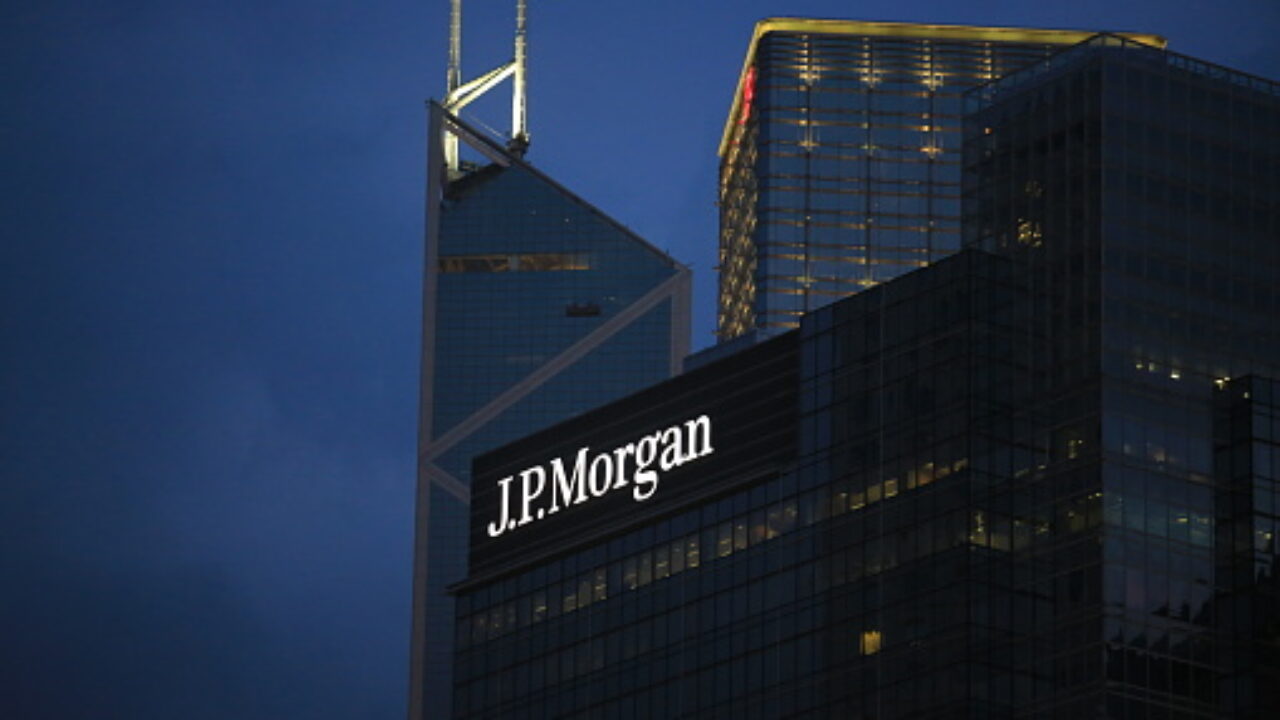
Hong Kong, October 08 2017: JPMorgan Chase & Co. building in Central, Hong Kong . JPMorgan is a Swiss global financial services company, One of big financial company in the world

JPMorgan Chase is exploring offering loans backed by clients’ cryptocurrency holdings, such as Bitcoin and Ethereum, potentially as early as 2026, according to a July 22, 2025, Financial Times report. This follows their earlier move in June 2025 to accept crypto exchange-traded funds (ETFs), like BlackRock’s iShares Bitcoin Trust (IBIT), as loan collateral. The bank is also considering factoring crypto holdings into clients’ net worth and liquidity assessments, treating them similarly to traditional assets like stocks or real estate.

This shift comes despite CEO Jamie Dimon’s historical skepticism toward crypto, though he has softened his stance, acknowledging client demand and supporting their right to invest in digital assets. The move aligns with a broader trend among U.S. banks, spurred by a more crypto-friendly regulatory environment under the Trump administration, including the passage of the GENIUS Act and relaxed Federal Reserve guidelines. However, challenges remain, such as technical issues around managing seized crypto assets and legal hurdles, as not all U.S. states have fully adopted changes to the Uniform Commercial Code to recognize crypto as valid collateral.

JPMorgan’s move signals a significant step toward integrating cryptocurrencies into traditional banking, legitimizing digital assets as collateral akin to stocks or real estate. This could encourage other major banks to follow, accelerating crypto adoption in mainstream finance. It reflects growing client demand for crypto-related services, as evidenced by JPMorgan’s acceptance of crypto ETFs as collateral and the broader trend of U.S. banks exploring similar offerings.

Clients holding crypto assets could unlock liquidity without selling their holdings, potentially attracting high-net-worth individuals and institutional investors who want to leverage their crypto portfolios for loans. This could drive up demand for cryptocurrencies, particularly Bitcoin and Ethereum, as they become more usable in traditional financial systems.

A more crypto-friendly U.S. regulatory environment, including the GENIUS Act and relaxed Federal Reserve guidelines, enables this development. However, uneven state-level adoption of the Uniform Commercial Code amendments creates legal risks and inconsistencies. Volatility in crypto markets poses risks for both lenders and borrowers, as sharp price drops could trigger margin calls or loan defaults, requiring robust risk management frameworks.

JPMorgan’s early mover advantage could pressure competitors like Goldman Sachs, Morgan Stanley, or smaller crypto-focused banks to accelerate their own crypto-backed lending programs, intensifying competition in wealth management and private banking. Technical hurdles, such as managing seized crypto assets in case of default, remain unresolved. Banks need infrastructure to securely hold and liquidate digital assets.

Legal uncertainties, especially in states lagging on crypto collateral laws, could complicate enforcement of loan agreements. Public perception of crypto’s volatility and past scandals (e.g., FTX collapse) may deter conservative clients or regulators from fully embracing these products. Traditional banks like JPMorgan entering the crypto space could marginalize crypto-native platforms (e.g., Coinbase, Kraken) that have offered crypto-backed loans for years.

Banks have greater regulatory credibility and client trust, but crypto firms offer more flexible, decentralized solutions. This could lead to a split where institutional and high-net-worth clients gravitate toward banks, while retail crypto enthusiasts stick with decentralized platforms. While federal policies (e.g., GENIUS Act) and Trump-era deregulation support crypto integration, inconsistent state-level laws create a patchwork environment. This divide could slow adoption in certain regions or lead to legal disputes over collateral enforcement.

Within JPMorgan, the contrast between CEO Jamie Dimon’s historical crypto skepticism and the bank’s pivot to client-driven crypto services reflects a broader divide in finance. Some executives and investors remain wary of crypto’s volatility and regulatory risks, while others see it as an inevitable part of the financial future. This divide extends to clients, with younger, tech-savvy investors likely embracing crypto-backed loans, while traditional wealth management clients may hesitate.

The U.S. is catching up to regions like Switzerland or Singapore, where crypto-backed lending is more established. However, the U.S.’s fragmented regulatory landscape contrasts with more unified frameworks abroad, potentially putting American banks at a disadvantage in the global race to integrate crypto.

Citadel Securities Submits A Letter Urging SEC’s Crypto Task Force Caution On Tokenized Securities

0

Citadel Securities submitted a letter to the SEC’s Crypto Task Force on July 21, 2025, urging caution on tokenized securities. The firm argues that rushed adoption could disrupt traditional markets, siphon liquidity, and create investor confusion. They oppose broad exemptions, advocating for a formal rulemaking process to ensure tokenized equities align with existing securities regulations, emphasizing investor protection, market integrity, and transparency.

Key concerns include potential harm to the IPO market and the creation of inaccessible liquidity pools. Citadel insists tokenized securities should succeed through genuine innovation, not regulatory arbitrage. Citadel’s letter highlights the risk of tokenized securities fragmenting liquidity in traditional markets. By creating separate pools of liquidity on blockchains, tokenized assets could reduce trading volume in established exchanges, potentially increasing volatility and widening bid-ask spreads. This could harm investors by making it harder to execute trades efficiently.

Citadel’s push for formal rulemaking over exemptions signals a longer, more rigorous regulatory process. This could delay the adoption of tokenized securities, as the SEC may prioritize aligning new frameworks with existing securities laws to ensure investor protection and market integrity. While Citadel supports innovation, its emphasis on preventing regulatory arbitrage suggests a high bar for tokenized securities to prove their value. Startups and blockchain firms may face increased compliance costs and barriers, potentially stifling innovation in the short term.

Citadel warns that tokenized securities could undermine the IPO market by offering alternative fundraising mechanisms that bypass traditional exchanges. This could reduce the visibility and capital access of public markets, affecting both issuers and investors. The firm’s focus on transparency and investor confusion indicates a concern that retail investors may not fully understand tokenized assets, leading to misinformed decisions or exposure to fraud in less-regulated platforms. The debate over tokenized securities reveals a broader divide in the financial industry:

Traditional Finance (TradFi) vs. DeFi: Citadel, a major TradFi player, prioritizes the stability of established markets and regulatory compliance. In contrast, DeFi advocates and blockchain firms (e.g., Coinbase, Ripple) push for tokenized securities as a democratizing force, offering faster settlement, fractional ownership, and global access. This pits centralized market giants against decentralized innovators.

Regulatory Philosophy: Citadel’s call for formal rulemaking aligns with a conservative, risk-averse approach, favored by legacy institutions. Meanwhile, crypto-native firms argue for exemptions or lighter regulations to foster innovation, creating tension between regulatory caution and technological progress.

Market Control: TradFi firms like Citadel may see tokenized securities as a threat to their dominance in market infrastructure, as blockchain platforms could disintermediate brokers and exchanges. DeFi proponents view this as an opportunity to challenge entrenched players, intensifying the divide.

Investor Base: TradFi emphasizes protecting retail investors through established safeguards, while DeFi often targets tech-savvy or underserved investors, highlighting a split in how each side perceives investor needs and capabilities.

This divide could shape the SEC’s approach, balancing innovation with stability. If Citadel’s perspective prevails, expect stricter rules and slower adoption. If DeFi gains traction, lighter regulations could accelerate tokenization but risk market disruptions. The outcome hinges on how the SEC weighs these competing interests.

CoinShares Secures Markets In Crypto-Assets (MiCA) License

0

CoinShares, a European cryptocurrency investment firm, secured a Markets in Crypto-Assets (MiCA) license through its French subsidiary, CoinShares Asset Management, from France’s Autorité des Marchés Financiers (AMF). This makes CoinShares the first continental European regulated asset management company to receive MiCA authorization. The license allows the firm to offer crypto portfolio management and advisory services across all 27 EU member states under a unified regulatory framework, leveraging EU passporting rights.

CoinShares now holds a rare triple license combination—MiCA, MiFID (Markets in Financial Instruments Directive), and AIFM (Alternative Investment Fund Managers Directive)—enabling comprehensive investment services across both crypto and traditional assets in the EU. This milestone enhances CoinShares’ ability to operate in the €33 trillion European asset management market and positions it as a leader in the region’s regulated crypto industry.

The MiCA license establishes CoinShares as a fully compliant crypto asset management firm under the EU’s comprehensive crypto regulatory framework. This enhances its credibility among institutional and retail investors, as it aligns with strict EU standards for investor protection, transparency, and anti-money laundering (AML) compliance. The license signals to the market that CoinShares meets high regulatory standards, potentially attracting more risk-averse investors who prioritize regulated entities.

With the MiCA license, CoinShares can operate seamlessly across all 27 EU member states via passporting rights, eliminating the need for separate licenses in each jurisdiction. This opens up the €33 trillion European asset management market, allowing CoinShares to scale its crypto portfolio management and advisory services efficiently. The ability to offer both crypto and traditional investment services (via MiFID and AIFM licenses) positions CoinShares as a one-stop shop for investors seeking diversified exposure to both asset classes.

As the first continental European regulated asset management company with a MiCA license, CoinShares gains a first-mover advantage in the EU’s regulated crypto space. This could help it capture significant market share before competitors achieve similar licensing. The triple license combination (MiCA, MiFID, AIFM) sets CoinShares apart from other crypto firms, enabling it to offer a broader range of services compared to firms with only crypto-specific licenses.

CoinShares’ achievement may set a benchmark for other crypto firms seeking MiCA licenses, encouraging more companies to pursue compliance to remain competitive in the EU market. It demonstrates the feasibility of integrating crypto services into traditional financial frameworks, potentially influencing future regulatory developments globally.

Firms with MiCA licenses gain access to the EU’s vast market under a clear regulatory framework, attracting institutional investors and those prioritizing compliance. These firms benefit from trust, scalability, and cross-border operations. Entities without MiCA licenses may face barriers to operating in the EU, as the framework imposes strict requirements starting December 30, 2024. Non-compliant firms risk being excluded from the EU market or facing penalties, limiting their growth potential.

Established players like CoinShares, with the resources to navigate complex regulatory processes and secure multiple licenses (MiCA, MiFID, AIFM), are better positioned to dominate the market. Their ability to offer integrated crypto and traditional financial services gives them an edge in attracting institutional capital. Smaller crypto firms or startups may struggle to meet MiCA’s stringent capital, compliance, and operational requirements. The cost and complexity of obtaining a MiCA license could exclude them from the EU market, creating a competitive gap.

The MiCA framework provides a unified regulatory environment, giving EU-based firms like CoinShares a strategic advantage in serving the European market. They can leverage passporting to operate across member states without additional regulatory hurdles. Crypto firms based outside the EU (e.g., in the U.S. or Asia) may face challenges entering the EU market unless they secure MiCA compliance, which could require establishing a European entity. This creates a divide between EU and non-EU firms in terms of market access.

The MiCA framework may drive consolidation in the EU crypto industry, as larger, compliant firms acquire or outcompete smaller, non-compliant players. CoinShares’ early adoption of MiCA positions it to lead this trend. The EU’s MiCA regulation is seen as a global benchmark for crypto regulation. CoinShares’ success could encourage other jurisdictions to adopt similar frameworks, further widening the gap between regulated and unregulated markets.

CoinShares’ MiCA license is a landmark achievement that strengthens its position in the EU’s crypto and traditional investment markets. It creates a divide between regulated, well-resourced firms and smaller or unregulated players, with implications for market access, competition, and innovation. While CoinShares benefits from enhanced trust, scalability, and a first-mover advantage, smaller firms and non-EU players may face challenges adapting to the EU’s stringent regulatory landscape.

The Digital Financial Revolution: How Fintech is Transforming Access to Financial Services for Women in Arab Countries

0

In the rapidly evolving global finance landscape, perhaps the most profound transformation is occurring at the intersection of technology and inclusion. Across Arab countries—from the Gulf to North Africa—financial technology (fintech) is transforming not just how services are delivered, but fundamentally who can access them. Women, historically shut out of traditional financial systems throughout the region, are now witnessing—and indeed driving—a quiet revolution that can arguably be posited as the most significant economic trend of the decade.

The Historical Context of Financial Exclusion

Financial exclusion of women in the Arab world is an outcome of a complex interplay between socio-cultural norms, regulatory frameworks, and infrastructural limitations. Legacy banking systems have long operated under circumstances that, by design or by fate, put extremely high obstacles to women’s financial inclusion. The contrast between the likes of such legacy systems and newer digital platforms is day and night in terms of user experiences. Digital financial applications, including those where one can melbet apk and other similar platforms that offer the functionality to carry out financial transactions, are exemplary of how technology reduces friction in accessing finance. This technological revolution is especially important for women who had no easy means of managing money on their own before. The digital revolution cuts across different financial services, from banking to investment services, opening up several avenues for the previously excluded groups.

Women in most Arab nations have faced particular obstacles in attempting to gain access to conventional financial institutions. They vary from constraining documentation prerequisites that tend to operate against women who lack particular forms of identification; branch hours of operation that conflict with family responsibilities disproportionately carried by women; and geographic limitations that render physical banks unreachable in localities where women’s mobility is limited.

Cultural Impediments and Structural Challenges

The deeply entrenched cultural factors that have historically limited women’s financial autonomy cannot be overstated. These include:

  • Legal guardianship requirements — In several countries, women have needed male guardians’ permission to open accounts or access certain financial products, though these restrictions have been easing in recent years
  • Social attitudes regarding financial decision-making — Traditional expectations often place financial authority primarily with male household members
  • Limited financial literacy opportunities — Women have frequently received less exposure to financial education and mentorship
  • Inheritance and property rights disparities — Legal frameworks in some countries have allocated smaller inheritance shares to women, affecting their collateral capacity

Aside from these cultural elements, structural elements have compounded the challenge. Banking systems based substantially on salaried employment have inevitably disadvantaged women who more frequently work in informal economies or direct domestic economies. The digital space has introduced new facets to financial inclusion beyond traditional frontiers. Social media incorporation has immensely amplified this phenomenon across the region. Many women now hear about financial services through channels like Facebook MelBet pages, and other similar social platforms that combine entertainment, sports betting, and financial transactional features in easily accessible digital spaces. This convergence of social media and financial services has created new paths to financial inclusion that bypass traditional gatekeepers, like credit-scoring systems that have traditionally overlooked alternative indicators of creditworthiness that better reflect women’s financial capabilities and activities.

This range of challenges has created a huge gender gap in financial inclusion across the region, with some countries having up to 30 percentage points disparity between men’s and women’s access to formal financial services—a gap which fintech innovations are now beginning to close with remarkable success.

Fintech Solutions Breaking Down Traditional Barriers

The emergence of fintech represents not merely an incremental improvement but a radical reconception of financial systems. Digital innovations are systematically eliminating the very barriers that have historically excluded women from financial inclusion. The transformation is occurring on multiple dimensions simultaneously, building a strong convergence of opportunities.

Before examining specific solutions, it’s worth understanding the comparative advantages that fintech offers compared to traditional banking services:

Feature Traditional Banking Fintech Solutions Impact on Women’s Financial Inclusion
Access Requirements Physical presence, extensive documentation Digital-first, simplified KYC processes Reduces mobility constraints and documentation barriers
Service Hours Limited business hours 24/7 availability Accommodates women’s complex scheduling needs around caregiving
Transaction Costs Higher fees, minimum balances Lower costs, micropayment capability Makes services accessible regardless of economic status
Privacy Limited confidentiality in close-knit communities Enhanced privacy through digital interfaces Enables financial independence without community scrutiny
Product Design Standardized offerings Personalized, data-driven solutions Addresses women’s specific financial needs and behaviors

Mobile money platforms have been particularly groundbreaking in bringing about greater financial inclusion among women. These services enable individuals to save, send, and receive money using basic mobile phones, creating financial capability without requiring smartphones or internet connections. This technology cannot be emphasized enough in regions where women may not have access to more advanced levels of technology, but are ever more likely to own basic mobile phones.

Digital wallets and payment applications have also revolutionized women’s financial inclusion. These platforms facilitate cashless transactions, bill payments, and merchant purchases through smartphone applications. The reduction in the physical handling of money offers not just convenience but also better security and monitoring of transactions—benefits that resonate strongly with women entrepreneurs and home financial managers.

Regional Success Stories and Emerging Models

While the fintech revolution sweeps across the entire Arab world, certain markets have emerged as particularly dynamic ecosystems for women’s financial inclusion. The UAE and Saudi Arabia have experienced runaway growth in fintech startups targeting women, often underpinned by state-driven economic diversification and labor force feminization initiatives.

Egypt and Jordan also provide another compelling case, where fintech innovation has been especially successful in reaching underserved women in rural and urban areas. Companies like Fawry in Egypt have built expansive digital payment networks enabling women to manage finances, pay bills, and transfer money without the necessity of traditional bank accounts. Similarly, Jordan’s CliQ and JoMoPay platforms have expanded financial services to previously underbanked women.

The North African nations, particularly Morocco and Tunisia, have developed innovative fintech products that specialize in microfinance and business development. These platforms frequently include features specifically designed to address the needs of women entrepreneurs, such as flexible repayment schedules to align with seasonal business cycles and integrated business development services.

What is particularly noteworthy about these regional trends is the pattern of localization and adaptation that is starting to manifest. Rather than importing fintech models from other international markets wholesale, these developments have reflected thoughtful customization to address specific regional challenges and opportunities. The most successful platforms have been culturally sensitive even as they have disrupted outdated constraints—a balance that has proved crucial to wide adoption.

Challenges and Future Directions

Despite significant progress, substantial challenges remain in fully realizing fintech’s potential for women’s financial inclusion in Arab countries. Persistent issues include:

  1. Digital literacy gaps that disproportionately affect women, particularly in rural areas and among older generations
  2. Regulatory frameworks that sometimes lag behind technological capabilities, creating compliance uncertainties
  3. Data privacy concerns that may be especially acute for women in conservative societies
  4. Cybersecurity vulnerabilities that could undermine trust in digital financial systems
  5. Limited connectivity infrastructure in remote regions where many women reside

To address such challenges, coordination among various stakeholders will be required: government regulatory authorities, private sector innovators, civil society, and international development partners. Incentivized investment in digital infrastructure, education programs to enhance women’s technological capacities, and regulatory sandboxes that facilitate innovation while ensuring consumer protection are some of the solutions with potential.

In the coming years, several emerging technologies have particular potential to further accelerate women’s financial inclusion. Blockchain technologies promise secure identity verification that can break through documentation limitations, while artificial intelligence promises further personalization of financial products. Voice-based services can break through literacy limitations, and biometric authentication can break through identification limitations.

The Broader Socioeconomic Implications

The effect of the fintech revolution extends way beyond the one financial transaction—there are profound implications for women’s economic empowerment and for social transformation. Greater financial autonomy through digital means is enabling women to play a more assertive role in domestic decision-making, pursue entrepreneurial aspirations, and weather economic shocks with more resilience.

To policymakers across all Arab nations, the connection between macroeconomic objectives and women’s financial inclusion has become better appreciated. Nations that economically diversify recognize that integrating women into the financial system at maximum levels is not only socially desirable but also economically imperative. Each percentage point of growth in women’s financial participation equals measurable GDP expansion.

This transition underway is a once-in-a-generation opportunity to correct generations of economic imbalances and create financial systems that are custom-designed to 21st-century needs and opportunities. As mobile financial services continue to evolve to the special needs of women in Arab countries, they are writing a new chapter in the economic development of the region—one based on an unprecedented level of inclusiveness and innovation.

The way forward may have hurdles, but the congruence of technological capability, market opportunity, and social forces suggests that fintech will continue to reshape financial spaces in ways that increasingly empower women throughout the Arab region.

Little Pepe (LILPEPE) Price Prediction: Why Top Analysts Forecast a 20x-50x Boom in the Upcoming Bull Run

0

Many investors are now scouting altcoins that promise huge gains as the market anticipates the upcoming bull run. One coin stealing the spotlight in the meme space is Little Pepe (LILPEPE), a light-hearted spin on the classic Pepe meme, featuring DeFi capabilities and driven by a lively, dedicated community. Top analysts are forecasting a 20x to 50x surge in price for LILPEPE, and the reasons behind this bold prediction are as compelling as they are exciting. From lightning-fast presale sellouts to strong community engagement and CEX listing plans, Little Pepe (LILPEPE) is poised to make a historic splash in the meme coin universe. Here’s why top analysts are betting big on LILPEPE in 2025.

Presale Momentum: Over $7.72M Raised

One of the strongest indicators of a token’s future success is early investor demand, and Little Pepe has absolutely crushed expectations. In Presale Stage 5, $LILPEPE raised over $6.57 million, selling out faster than originally anticipated. That momentum hasn’t slowed: Stage 6 launched at $0.0015 per token and has already crossed $1 million in contributions within just two days.

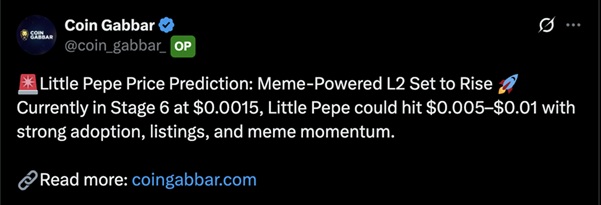
Coin Gabber on X

Crypto analyst @coin_gabbar_ on X (formerly Twitter) predicts that LILPEPE could hit $0.005 to $0.01 during the upcoming bull run, provided strong adoption and key listings continue. For presale investors, that means potential 20x to 50x gains, aligning perfectly with broader bullish sentiment surrounding meme coins.

The Meme Coin with a Mission: No Taxes, No Rugs, Just Vibes

In a market crowded with gimmicks and vaporware, Little Pepe (LILPEPE) is offering something radically different: pure meme energy, no hidden traps. Built on the ERC-20 network, LILPEPE isn’t just riding on hype—it’s creating an authentic and decentralized community, free from taxes and rug-pull fears. What truly sets LILPEPE apart is its irresistible branding and narrative. With a tongue-in-cheek roadmap that boasts being in the “pregnancy stage,” cooking in the “crypto-womb” with Mumma Pepe, LILPEPE blends humor, culture, and tokenomics in a way that resonates deeply with the meme coin community. This unique identity and cultural presence mean LILPEPE isn’t just another meme coin—it’s a movement. And in crypto, the community is everything.

Massive $777K Giveaway Fueling Viral Growth

LILPEPE isn’t just building hype—it’s rewarding its community in a way few projects dare to. The group has initiated an enormous giveaway of $777,000. Ten fortunate participants will each win $77,000 in LILPEPE tokens. The campaign has already recorded over 55,000 entries and has been bringing in thousands more viewers and wallet holders which helps to reinforce loyalty among the early supporters. In an era where user acquisition is paramount, this bold move is yielding significant benefits for community engagement and solidifying LILPEPE as a people-first project.

Big Listings and Exchange Plans: Momentum Set to Explode

While many meme coins rely solely on hype, LILPEPE is preparing for serious market exposure. Already listed on CoinMarketCap, the token is aiming even higher. The team has confirmed plans to list on two major centralized exchanges (CEX) immediately after the presale ends.  Notably, a clear roadmap is in place to list on the world’s largest crypto exchange. These upcoming listings are pivotal.  As seen with other meme coins in the past, CEX listings often act as launchpads for explosive 20x to 50x moonshot price action. What makes LILPEPE special isn’t just the meme—it’s the execution, energy, and ecosystem being built from day one. While other projects scramble for relevance, LILPEPE is organically going viral, fueled by its authentic Web3 culture and the power of decentralized community.

Conclusion: Will You Catch the Wave?

Meme coins have always been about emotion, culture, and momentum. And right now, Little Pepe (LILPEPE) is generating all three in massive waves. With analysts predicting a potential 20x to 50x surge, the time to get in is before the rocket launches. Whether you’re a seasoned investor or just meme-curious, LILPEPE is shaping up to be the breakout star of 2025. The next chapter in meme coin evolution is being written—and it’s got a green frog, a lot of hype, and possibly life-changing returns. Don’t miss out. Join the $LILPEPE revolution today.


For more information about Little Pepe (LILPEPE) visit the links below:

Website: https://littlepepe.com

Whitepaper: https://littlepepe.com/whitepaper.pdf

Telegram: https://t.me/littlepepetoken

Twitter/X: https://x.com/littlepepetoken