DD
MM
YYYY

PAGES

DD
MM
YYYY

spot_img

PAGES

Home Blog Page 888

AAS Miner Launches Bitcoin Cloud Mining Platform with XRP Payments

0

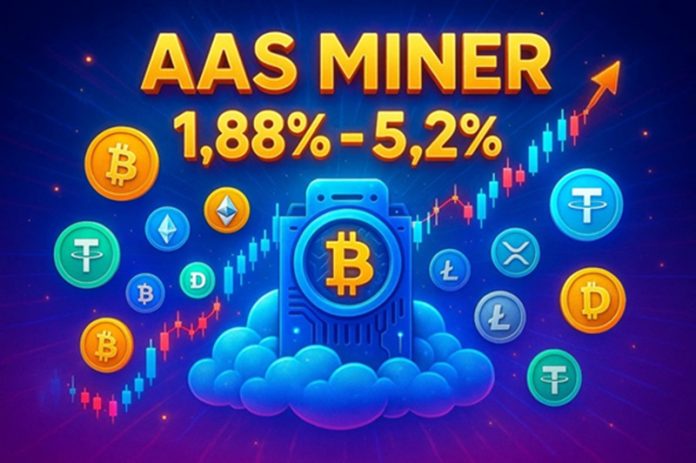
Experience AAS Miner, the world’s first AI-driven Bitcoin cloud mining platform – secure, energy-efficient, and optimized for maximum returns. Support BTC, BCH, ETH, SOL, XRP, LTC, DOGE, USDT, USDC and other stablecoin payments, and get a guaranteed daily return of 1.88% to 5.2% in a fully transparent and convenient cloud mining solution.

In the rapidly evolving world of Bitcoin Mining, staying ahead of the curve means embracing innovation, transparency, and user-centric services. Today, AAS Miner proudly announces the launch of its next-generation Bitcoin Cloud Mining solution—a cutting-edge Cloud Mining Platform that simplifies digital asset investment and empowers users worldwide. Featuring seamless XRP payments and backed by AI-driven optimization, this platform sets a new industry benchmark for efficiency, security, and passive income generation.

Revolutionizing Bitcoin Mining with AI-Driven Cloud Technology

Traditional Bitcoin mining requires significant upfront investment in hardware, technical know-how, and ongoing maintenance. AAS Miner’s new Bitcoin Cloud Mining offering removes these barriers. By leveraging powerful, top-of-the-line mining machines in state-of-the-art data centers, AAS Miner provides:

Effortless Access: No complex setup or hardware management—simply sign up, choose your plan, and start mining immediately.

AI-Driven Efficiency: Proprietary AI algorithms optimize mining operations in real time, ensuring maximum hash rates and reduced energy consumption.

Scalability on Demand: Upgrade or scale down your mining power at any time to match market conditions and personal investment goals.

This innovative Cloud Mining Platform caters to both seasoned miners and newcomers, delivering a user-friendly dashboard, real-time performance analytics, and 24/7 technical support.

Seamless XRP Payments for Faster, Cheaper Transactions

Recognizing the importance of flexible and cost-effective payment options, AAS Miner integrates XRP Payments directly into its Cloud Mining Platform. XRP’s speed and low transaction fees enable:

Instant Contract Activation: Fund your account and deploy mining contracts in seconds—no waiting for blockchain confirmations.

Global Accessibility: XRP’s liquidity and widespread exchange listings make it easy for users in any region to participate.

Reduced Fees: Enjoy lower processing costs compared to traditional fiat or other cryptocurrencies, preserving more of your mining returns.

By accepting XRP alongside Bitcoin and stablecoins, AAS Miner ensures a truly global and frictionless experience for all users.

Unmatched Trust: Guaranteed Yields and On-Chain Transparency

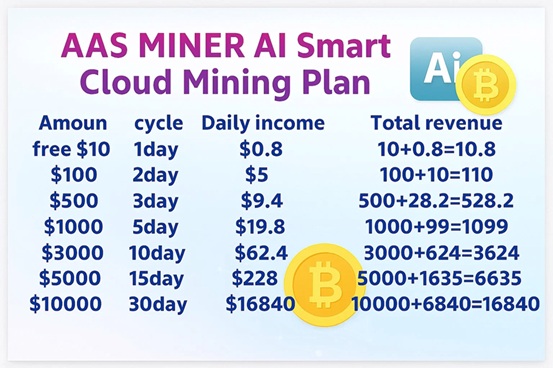
Investing in Cloud Mining can feel uncertain—but not with AAS Miner. Every AI cloud computing contract is 100% guaranteed for principal and interest, offering fixed daily yields between 1.88% and 5.2%. Underpinning this trust are:

AAS Miner AI cloud computing contract revenue example diagram (visualization)
On-Chain Transparency: All mining payouts and contract details are verifiable on public ledgers, ensuring full accountability.

Stringent Fund-Security Protocols: Cold storage, multi-signature wallets, and regular security audits protect user assets.

Dedicated Customer Support: AAS Miner’s expert team is available around the clock to address any questions or concerns.

Sign-Up Bonus: Kickstart Your Bitcoin Mining Journey

New to AAS Miner? There’s never been a better time to get started:

Receive a $10 welcome credit immediately upon sign-up.

Reinvest your credit into free daily mining contracts that yield approximately $0.80 per day.

These rewards enable you to experience the benefits of Bitcoin Cloud Mining risk-free, while building your passive income stream from day one.

Multi-Currency Support: Diversify Your Crypto Portfolio

Beyond Bitcoin, AAS Miner’s Cloud Mining Platform supports a wide range of popular cryptocurrencies, allowing you to diversify and maximize passive income opportunities:

BTC (Bitcoin) ,BCH (Bitcoin Cash),ETH (Ethereum),SOL (Solana),XRP (Ripple),LTC (Litecoin),DOGE (Dogecoin),USDT,USDC (Stablecoins)

With this comprehensive crypto portfolio, investors can pivot quickly between assets, optimizing returns based on market dynamics.

Why Choose AAS Miner’s Cloud Mining Platform?

AAS Miner is the world’s top AI-driven cloud mining industry benchmark platform, designed to provide a simple and convenient mining experience, and is committed to providing seamless services. Combined with top mining machines, it opens the door to the world of digital assets for investors, brings passive income, is efficient and energy-saving, safe and reliable. Join AAS Miner and start your cloud mining wealth appreciation journey.

AI-Optimized Operations: Continuously tuned for peak performance.

User-Centric Design: Intuitive interface and transparent reporting.

Robust Security: Multi-layered protection for peace of mind.

Flexible Plans: From entry-level contracts to enterprise-scale solutions.

Get Started Today

Embark on your Bitcoin Mining adventure with AAS Miner’s premier Cloud Mining Platform. Take advantage of the $10 sign-up bonus, guaranteed yields, and multi-currency support. Visit www.aas8.com now to open the door to effortless, AI-enhanced Bitcoin Cloud Mining.

Official Website: https://aas8.com
 

Hodling Bitcoin Now is Poor Strategy [podcast]

0

This vdeo podcast by Ndubuisi Ekekwe presents a strong argument against the long-term “hodling” of Bitcoin, particularly for investors seeking substantial future gains. The speaker, a self-proclaimed “mathematics guy,” bases the analysis on Bitcoin’s current market capitalization of approximately $2.4 trillion, arguing that most of its significant value appreciation has already occurred. By comparing Bitcoin to other trillion-dollar assets like gold, Microsoft, and “Nvidia,” they project that even in highly optimistic scenarios (e.g., $100 trillion market cap), the maximum return for new investors would be around 40x, with more realistic scenarios yielding much less (20x or 10x). This is contrasted with the massive returns enjoyed by early adopters who bought Bitcoin at significantly lower prices.

The speaker introduces the concept of “injection settlement,” suggesting that current purchases primarily serve to allow early investors to exit. They predict that once Bitcoin reaches an “inflection point” of around $250,000 per Bitcoin, its asset growth will largely halt, transforming it more into a transactional currency rather than a high-growth investment.

As an alternative, the speaker strongly advocates for investing in Bitcoin and cryptocurrency infrastructure companies. They believe these foundational infraco businesses have significant growth potential ahead, enabling the broader digital finance and digital economy. They claim that such infrastructure investments can yield returns of “50x faster” than direct Bitcoin investments, offering “better value” and easier 25x gains for those willing to take on risk. 

  • Podcast Video: Sign-up at Blucera and check Tekedia Daily podcast category under Training Module

Expansion of PYUSD To Arbitrum Strengthens PayPal’s Position In The Stablecoin Race

0

PayPal has expanded its USD-pegged stablecoin, PYUSD, to the Arbitrum blockchain, marking its first integration with an Ethereum Layer-2 network. Previously available on Ethereum (since August 2023) and Solana (since May 2024), PYUSD now leverages Arbitrum’s optimistic rollup technology for faster transactions and lower fees. This move aligns with PayPal’s goal to enhance digital payment efficiency and compete in the stablecoin market against Tether and Circle. Issued by Paxos, PYUSD is fully backed by USD deposits, US Treasury bonds, and similar assets, maintaining a 1:1 peg with the US dollar.

The expansion, reflected in PayPal’s updated terms on July 16, 2025, also introduces a rewards program offering daily yield for users holding at least 1.0 PYUSD in their Cryptocurrencies Hub, with no negative balances or restrictions. Arbitrum’s native token, ARB, surged 10% following the announcement, signaling market enthusiasm. The integration aims to boost PYUSD’s adoption, potentially mirroring its 45% market cap growth after the Solana expansion, despite its current $844 million valuation, down 17% from a June 2025 peak of $1.01 billion.

Arbitrum, as an Ethereum Layer-2 solution, offers faster transaction processing and lower gas fees compared to Ethereum’s mainnet. By integrating PYUSD with Arbitrum, PayPal enables cheaper and quicker transactions, making the stablecoin more attractive for everyday payments and DeFi applications. This could drive broader adoption of PYUSD in decentralized applications (dApps), particularly for microtransactions or high-frequency use cases where Ethereum’s high fees were prohibitive.

PYUSD’s expansion to Arbitrum follows its integration with Solana, showing PayPal’s strategy to diversify across high-performance blockchains. This positions PYUSD to compete more effectively with dominant stablecoins like Tether (USDT) and USD Coin (USDC), which together hold over 80% of the stablecoin market.

With a market cap of $844 million (as of July 2025), PYUSD remains a smaller player, but its 45% market cap growth post-Solana suggests potential for further gains. Arbitrum’s growing DeFi ecosystem (with over $3 billion in total value locked) could amplify PYUSD’s utility and market share. The integration enhances Arbitrum’s appeal as a Layer-2 network, especially for institutional-backed projects. The 10% surge in ARB’s price post-announcement reflects market confidence in Arbitrum’s growing relevance.

PYUSD’s presence could attract more developers and users to Arbitrum, fostering new dApps and liquidity pools, further strengthening its position against competitors like Optimism and Polygon. PayPal’s rewards program, offering daily yield for holding at least 1.0 PYUSD, is a strategic move to encourage retail adoption. Unlike many crypto reward programs, it avoids negative balances or restrictive conditions, making it accessible to PayPal’s vast user base.

This could bridge the gap between traditional finance (TradFi) and decentralized finance (DeFi), as PayPal’s 400 million+ users gain exposure to crypto through a familiar platform. Issued by Paxos and backed 1:1 by USD and Treasury bonds, PYUSD benefits from regulatory oversight and transparency, appealing to risk-averse users and institutions. Arbitrum’s integration further aligns with PayPal’s push for compliant, scalable blockchain solutions.

Tether ($110 billion market cap) and USDC ($34 billion) dominate due to their early-mover advantage and widespread integration across blockchains and exchanges. PYUSD, with under $1 billion, faces a steep climb to gain market share. Despite PayPal’s brand and user base, PYUSD’s growth is constrained by limited exchange support (e.g., only 20% of top exchanges list it compared to 90% for USDT). Arbitrum’s DeFi ecosystem could help, but PYUSD needs broader adoption in lending protocols and trading pairs to close the gap.

PayPal’s rewards program and integration with its payment infrastructure give PYUSD a unique edge for retail users, unlike USDT or USDC, which focus heavily on institutional and DeFi use cases. Ethereum’s high fees and slower transaction speeds have driven adoption of Layer-2 solutions like Arbitrum and Layer-1 alternatives like Solana. PYUSD’s presence on both Arbitrum and Solana positions it to leverage their strengths—Arbitrum’s Ethereum compatibility and Solana’s high throughput.

The divide between blockchain ecosystems (e.g., Ethereum vs. Solana) creates fragmentation. PYUSD’s multi-chain strategy mitigates this but requires seamless cross-chain bridging, which remains technically complex and costly for users. A significant divide exists between crypto-savvy users and mainstream consumers. PayPal’s integration of PYUSD into its Cryptocurrencies Hub lowers the entry barrier, but crypto’s complexity (e.g., wallet management, gas fees) still deters mass adoption.

While USDT and USDC dominate institutional DeFi (e.g., liquidity pools, lending), PYUSD’s retail focus via PayPal’s platform targets everyday users. The rewards program could narrow this divide by incentivizing non-crypto natives to hold PYUSD. Stablecoins face varying regulatory scrutiny globally. PYUSD’s Paxos backing and PayPal’s compliance efforts align with U.S. regulations, giving it an edge in markets with strict oversight. However, competitors like Tether face criticism for transparency issues, creating a divide in trust and adoption.

Arbitrum’s integration may attract regulatory attention, as Layer-2 solutions are less tested in compliance frameworks compared to Ethereum or Solana. The expansion of PYUSD to Arbitrum strengthens PayPal’s position in the stablecoin race by leveraging Layer-2 scalability and appealing to both DeFi and retail users. It narrows the technological and adoption divides by offering cost-efficient transactions and user-friendly rewards.

However, the competitive divide remains stark, with PYUSD trailing USDT and USDC in market cap and ecosystem integration. To bridge this gap, PayPal must expand PYUSD’s exchange listings, DeFi integrations, and cross-chain functionality while capitalizing on Arbitrum’s growing ecosystem to drive adoption.

Scale AI Slashes 200 Jobs Weeks After Meta’s $14.3bn Deal, Citing Overexpansion and Bureaucracy

0

Weeks after Meta poured $14.3 billion into Scale AI and hired its founder, Alexandr Wang, to lead its new AI division, the startup has laid off 200 full-time employees — about 14% of its staff — in a significant restructuring move aimed at trimming excess and restoring operational focus.

The job cuts were announced by Scale AI’s interim CEO Jason Droege in a memo to employees on Wednesday. Droege, who stepped in after Wang joined Meta as its Chief AI Officer, acknowledged that the company had ramped up its generative AI business too rapidly, leading to layers of bureaucracy and inefficiencies that, he said, clouded the company’s mission.

“While that felt like the right decision at the time, it’s clear this approach created inefficiencies and redundancies,” Droege said in the memo. “We created too many layers, excessive bureaucracy, and unhelpful confusion about the team’s mission.”

The layoffs come amid rising questions about Scale AI’s profitability and sustainability, particularly after it expanded its workforce to 1,400 globally and relied heavily on contracts from major players like OpenAI, Google, and Microsoft. But in the last year, OpenAI has significantly wound down its collaboration with Scale, and Google has reportedly begun cutting ties with the startup following its deepening alliance with Meta.

Bloomberg first reported the number of job cuts, which Scale AI later confirmed. Alongside the layoffs, the company is also ending contracts with 500 contractors, reducing the scale of its non-employee workforce as part of a broader pivot.

Despite the shake-up, Droege assured employees that Scale AI remains a well-funded and well-resourced company. He emphasized that the layoffs were not about survival but strategic recalibration.

“These changes will make us more nimble — enabling us to react more quickly to shifts in the market and customer needs,” he said.

The restructuring is aimed at streamlining the company’s generative AI division, cutting down from 16 “pods” to five key focus areas, and merging various business development roles into a single Demand Generation team. The company said it would deprioritize GenAI projects that generate little revenue or show low growth potential as part of its effort to become more efficient and move toward profitability — a point Droege appeared to acknowledge in his memo.

However, after publication, a company spokesperson disputed the notion that Droege called the company unprofitable, while refusing to clarify the statement.

Going forward, Scale AI plans to double down on its enterprise and public sector divisions. Droege said the company would “significantly increase headcount” in the second half of 2025 within these units, including across its international public sector business.

Founded in 2016 by Alexandr Wang, Scale AI made its name as a critical behind-the-scenes player in the AI revolution, providing data labeling and infrastructure services used to train large models for OpenAI, Google, and others. Its reputation surged as demand for generative AI exploded in the wake of OpenAI’s ChatGPT, but that growth appears to have outpaced strategic planning.

The Meta-Scale partnership, which included Meta’s acquisition of key Scale talent and Wang’s appointment to head Meta Superintelligence Labs, has raised eyebrows in the industry. Insiders say the alliance may have triggered nervousness among other big tech clients like Google and Microsoft, who are now reportedly scaling back ties with Scale due to potential conflicts of interest.

Scale spokesperson Joe Osborne said affected workers were being offered severance and that the company would continue to invest heavily in new AI initiatives.

“We’re streamlining our data business to help us move faster and deliver even better data solutions to our GenAI customers,” he said, adding that hiring in government and enterprise AI sectors would remain a priority.

Droege, in his message to staff, expressed gratitude to those affected by the cuts, describing their contributions as instrumental to Scale’s growth. However, the move underscores the growing pains many AI firms are experiencing as they shift from early hype and experimentation to monetization and long-term strategy.

The development also signals a sobering moment in Silicon Valley’s AI gold rush — even well-capitalized startups are beginning to tighten their belts, realizing that breakneck expansion without profitability or focus can be as dangerous as falling behind.

PENGU And MOG May Offer Longer-Term Growth Potential In Memecoin Ecosystems, As Aethir and Credible Launch First DePIN-Powered Credit Card

0

Over the past 7 days, memecoins Mog Coin (MOG) and PENGU have been among the top performers in the memecoin sector, with significant price surges driven by broader market momentum and specific catalysts. MOG, an Ethereum-based memecoin, saw a price increase of approximately 73.2% over the last 7 days, according to CoinGecko data. Its current price is around $0.000002 USD, with a market cap of roughly $735.10M.

The surge is attributed to heightened investor interest in memecoins, fueled by Bitcoin’s recent all-time high above $123,000, which has driven capital rotation into riskier assets like memecoins. MOG’s community-driven approach, centered around meme culture and viral content, has also contributed to its momentum. However, technical indicators like the Relative Strength Index (RSI) at 76.96 suggest MOG is in overbought territory, hinting at a potential correction if buying pressure wanes.

PENGU, a Solana-based memecoin tied to the Pudgy Penguins ecosystem, has outperformed with gains of around 80–90% over the past week, with its price reaching approximately $0.0233 as of July 11, 2025. Posts on X highlight PENGU’s strong momentum, with a 55.46% surge in the past week and a 150% increase over 30 days, driven by factors like the SEC’s acknowledgment of a PENGU ETF filing and its listing on platforms like eToro.

The Solana memecoin sector, valued at over $12.8 billion, has seen a 12.3% surge, with PENGU leading due to its real-world backing from $13M in Pudgy Penguins toy sales and strong community engagement. Technical analysis indicates PENGU faces resistance at $0.024, but sustained bullish momentum could push it toward $0.030. While both coins have seen impressive gains, approaching 100% as you noted, their volatility and reliance on market hype and Bitcoin’s performance suggest caution.

The surge in MOG (up ~88%) and PENGU (up ~85.9%) reflects a broader speculative wave in the memecoin sector, driven by Bitcoin’s recent record highs above $123,000. This suggests capital is rotating from major cryptocurrencies into high-risk, high-reward assets like memecoins, a common pattern in bull markets where “peak greed” often emerges. Such rallies indicate heightened retail and whale investor FOMO (fear of missing out), amplified by social media hype and influencer endorsements on platforms like X.

Investors should brace for volatility. Memecoin surges are often short-lived, and overbought indicators (e.g., PENGU’s RSI at 81, MOG’s at 76.96) suggest potential corrections. Traders may benefit from quick gains but risk significant losses if momentum fades. Bitcoin’s breakout above $113,000–$122,000 has acted as a catalyst, boosting altcoins and memecoins like PENGU, MOG, Dogecoin, and others.

The Solana ecosystem, in particular, has seen a 12.3% surge in its memecoin market cap ($12.8B+), with PENGU and BONK leading. This suggests memecoins are riding Bitcoin’s coattails, benefiting from increased liquidity and market euphoria. Memecoin gains may continue as long as Bitcoin sustains its upward trajectory, but a Bitcoin pullback could trigger sharp declines in these speculative assets due to their lack of fundamental utility.

PENGU’s rally is partly fueled by the SEC’s acknowledgment of Canary Capital’s Spot PENGU ETF filing, which proposes a memecoin-NFT hybrid fund (80–95% PENGU tokens, 5–15% Pudgy Penguins NFTs). This unprecedented move could legitimize memecoins, drawing institutional capital and retail adoption if approved. PENGU’s real-world revenue ($13M from Pudgy Penguins toy sales) and brand expansion (e.g., gaming integrations like Pudgy World) further bolster its appeal.

Approval of a PENGU ETF could set a precedent for memecoin-based financial products, potentially driving PENGU’s price toward $0.06–$0.15 by Q4 2025 (a 200–600% upside). However, regulatory uncertainty remains a risk, as the SEC’s stance on memecoins is untested. Both MOG and PENGU thrive on strong community engagement and viral branding. MOG’s cat-themed meme culture and PENGU’s Pudgy Penguins ecosystem (backed by NFTs, toys, and games) demonstrate the power of storytelling in driving crypto adoption.

Major players like Coinbase and OpenSea adopting Pudgy Penguins imagery on X further amplify PENGU’s dominance. Memecoins remain a cultural phenomenon, onboarding new users through relatable branding. This could sustain interest in PENGU and MOG, but their reliance on hype makes them vulnerable to shifts in sentiment or competing narratives (e.g., new memecoins like MemeCore or SPX6900).

Analysts warn that memecoin surges often signal “peak greed,” a precursor to market corrections. MOG’s 88% weekly gain and PENGU’s 531% 30-day surge highlight speculative excess, with technical indicators like RSI signaling overbought conditions. MOG needs to hold $0.000002014 support, and PENGU must maintain $0.021 to avoid declines.

Investors should manage risk carefully, as memecoins lack intrinsic value and are prone to sharp reversals. Portfolio rebalancing and stop-loss strategies are critical in this high-volatility environment. PENGU’s success on Solana (low fees, fast transactions) contrasts with MOG’s Ethereum-based rally, highlighting competition between blockchain ecosystems. Solana’s memecoin market has outperformed, with tokens like BONK and FARTCOIN also posting double-digit gains. MOG’s surge, however, shows Ethereum-based memecoins remain competitive, possibly due to broader DeFi integration.

Solana’s dominance in memecoins could attract more projects and capital, but Ethereum’s established infrastructure may keep it relevant for tokens like MOG. Investors may diversify across both ecosystems to hedge platform-specific risks. PENGU’s real-world utility (toys, gaming, NFTs) gives it an edge over purely speculative memecoins like MOG, which relies heavily on community hype and potential influencer backing (e.g., Elon Musk’s rumored interest in cat-themed tokens). Analysts project PENGU could reach $0.10–$0.15 by Q4 2025, while MOG’s upside depends on sustaining momentum toward $0.000002354.

PENGU may offer longer-term growth potential due to its ecosystem, but MOG’s reliance on social momentum makes it riskier. Investors seeking stability might prefer projects with utility, like PENGU or emerging tokens like Remittix (RTX). The MOG and PENGU rallies underscore the memecoin sector’s volatility and cultural significance in 2025’s bull market. While PENGU’s ETF narrative and real-world backing suggest stronger fundamentals, both coins face risks from overbought conditions and market sentiment shifts.

Aethir and Credible Launch First DePIN-Powered Credit Card and Loan Facility Backed by ATH Tokens

Aethir, the decentralized physical infrastructure network (DePIN) powering distributed GPU compute, and Credible Finance announced today the launch of the first credit card and loan product backed by DePIN. The new product allows holders of ATH, the native token of Aethir’s decentralized GPU network, to access stablecoin credit without selling their holdings, using their digital assets as collateral.

With this initiative, Aethir node operators and token holders can claim a free ATH-powered credit card issued by Credible, which can be topped up with ATH tokens or stablecoins on Solana or can be used to unlock a revolving credit line against ATH tokens. Participants also gain access to Credible’s private investor portal, featuring short-term lending opportunities with yields of up to 24% APY on USDC and USDT.

Loan approvals and credit limits are determined by Credible’s AI-powered credit engine, which analyzes borrowers’ onchain activity, digital assets portfolio, including $ATH, and transaction history to generate dynamic credit scores. Combining DePIN participation and onchain data, Aethir is opening a new avenue of access to capital for users traditionally underserved by current financial systems.

As traditional DeFi lending falls short, new RWA-backed credit models are being developed to meet the needs of global businesses building from emerging markets. In Q1 2025, borrowing across decentralized lending platforms fell by $4.75 billion — a 21% drop from the previous quarter — marking the steepest pullback since 2023. The total crypto-collateralized loan market fell to $39.07 billion in open borrows, whereas the global credit gap in the SME segment from emerging markets is $5.7 trillion dollars. This downturn underscores the limitations of overcollateralized lending models and highlights the need for credit systems that reflect real onchain activity and infrastructure ownership.

This partnership brings real utility to the ATH token,” said Mark Rydon, Chief Strategy Officer and Co-founder at Aethir. “It’s the first step toward building a financial system around decentralized infrastructure. This is the first DePIN-native token being activated for real-time credit,” said Shrikant Bhalerao, CEO and Co-founder of Credible Finance. “We’re turning tokenized infrastructure into usable financial capital.

Credit card access will initially be available to GPU providers, node operators, and token holders, with plans to expand as the ecosystem grows to check eligibility, explore features, and apply. All lending services comply with regulatory standards, including KYC and AML protocols, ensuring secure and lawful access for users across decentralized ecosystems.

Aethir is the world’s largest decentralized cloud GPU network, with over 430,000 enterprise-grade GPU containers across 94 countries. The platform provides scalable, cost-efficient cloud GPU services for AI, machine learning, gaming, and rendering applications, connecting users to distributed resources through a Decentralized Physical Infrastructure Network (DePIN). By making high-performance computing more accessible and efficient, Aethir is transforming how AI and enterprise applications are powered.

Credible is the world’s first impact-driven protocol that connects stablecoin lenders with secure credit opportunities in emerging markets through regulated Non-Banking Financial Institutions (NBFIs). Since its launch just 10 months ago, Credible has processed over $16 million in USDC-denominated loans across Africa and is now expanding into Asia. The platform places a strong emphasis on building a robust investor network, offering curated deal flow, exclusive credit products such as specialized crypto-backed credit cards, and access to premium events.