DD
MM
YYYY

PAGES

DD
MM
YYYY

spot_img

PAGES

Home Blog Page 903

Microsoft Reveals $500m in AI Savings, Following Layoffs, Fueling Debate Over Automation’s Human Cost

0

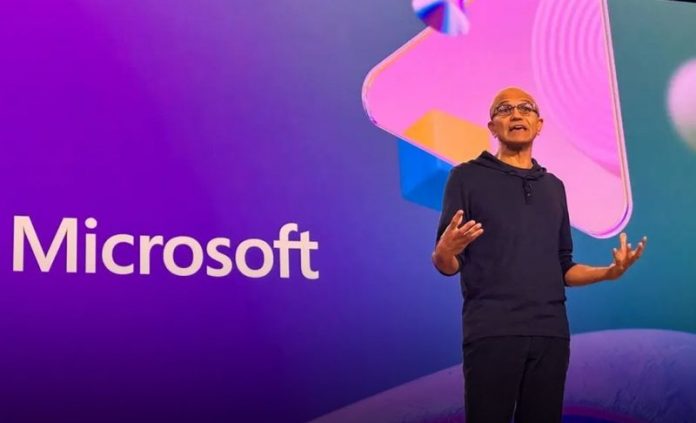
Microsoft has quietly revealed that artificial intelligence tools have saved the company over $500 million in its call centers alone over the past year, reinforcing the growing role of automation in corporate efficiency.

The internal admission, disclosed by Chief Commercial Officer Judson Althoff during a private presentation and first reported by Bloomberg, shows that AI is not just transforming productivity—it’s now playing a critical role in reshaping Microsoft’s workforce and cost structure.

The revelation comes just one week after Microsoft laid off more than 9,000 workers in its third major round of job cuts this year, bringing the total number of layoffs across the company in 2025 to nearly 15,000. These layoffs cut across departments, including Xbox, sales, customer service, and software engineering.

Microsoft’s announcement—celebrating efficiency gains from AI tools like Copilot, which now generate more than 35% of all new code—follows its revenue moment. The company reported $26 billion in profit and $70 billion in revenue in the most recent quarter. Its market capitalization surged to $3.74 trillion, displacing Apple and sitting just behind Nvidia, whose AI chips power Microsoft’s AI infrastructure.

Layoffs Amid Booming AI Profits

To many laid-off workers, the juxtaposition between record profitability and job loss stings, and the internal remarks have stirred resentment within the company.

While Microsoft hasn’t publicly attributed the latest layoffs directly to AI replacement, internal actions suggest a reshuffling of priorities that favor automation over manpower. The company has indicated that its call centers now rely heavily on AI to manage routine customer service functions, cutting down on the need for human agents. Althoff said AI support has enabled Microsoft to better serve smaller customers while keeping human staff focused on high-value clients.

At the same time, engineering teams are leaning more heavily on generative tools to accelerate software development. Copilot, Microsoft’s AI coding assistant, is contributing more than a third of the company’s production code, shrinking development timeframes and potentially reducing the need for large engineering teams.

Microsoft is also replacing some of the laid-off workers with more technically specialized roles. According to Business Insider, the company is prioritizing the hiring of “solution engineers” with strong AI and product knowledge to help push its enterprise tools like Copilot.

The tension between Microsoft’s AI-driven gains and its human cost has been further amplified by a controversial, now-deleted LinkedIn post from Matt Turnbull, a producer at Xbox Game Studios. In the post, Turnbull suggested that employees affected by the layoffs could turn to AI tools like ChatGPT and Copilot to help manage the emotional and cognitive load that comes with losing a job.

The post drew immediate backlash, with critics calling it “tone-deaf” and out of touch with the real pain of unemployment. It was quickly deleted, but the damage had been done, casting a shadow over Microsoft’s internal messaging and highlighting the emotional toll of AI-led restructuring.

AI as the New Corporate Workhorse

Microsoft’s embrace of AI is part of a broader industry shift. The company plans to invest $80 billion in AI infrastructure throughout 2025, focusing heavily on data centers, high-performance computing, and the continued rollout of AI-powered productivity tools across its ecosystem. Internally, executives have described this pivot as a redefinition of the company’s mission around “frontier AI.”

Insiders believe the $500 million in savings from AI is just the beginning. Microsoft expects similar efficiencies across other divisions in the coming years. Althoff emphasized that these gains are not just about saving money but also about enabling scale, noting that AI tools help Microsoft better serve a broader base of customers without proportional increases in staffing.

However, critics argue that the company’s gains are coming at the expense of its workforce. Many of the 15,000 jobs lost this year were in functions that AI is now beginning to replace—customer service, product marketing, and low-to-mid-tier software engineering. That’s leading to growing concern over what kinds of roles will survive in a corporate world increasingly defined by automation.

The layoffs and internal restructuring are occurring as Microsoft races to stay ahead in the AI arms race. In addition to deepening its investment in OpenAI, the company is pursuing AI dominance on multiple fronts—from Azure-based Copilot products to partnerships with AI chipmakers and a growing portfolio of AI-powered productivity and infrastructure services.

It is believed that Microsoft’s goal is to become the premier platform for enterprise AI across industries. The company is already one of the largest consumers of Nvidia’s AI chips and continues to funnel billions into expanding its AI datacenters around the globe.

IMF Flags Nigeria’s Crypto Surge as Threat to Capital Controls, Monetary Stability

0

The International Monetary Fund (IMF), in its latest country report on Nigeria, has raised alarm over the country’s booming crypto economy — warning that if left unchecked, it could destabilize Nigeria’s financial architecture, undermine regulatory controls, and punch holes in already strained capital flow management.

The warning comes at a time when Nigeria has become one of the world’s most active crypto markets. According to Chainalysis’ 2023 Global Crypto Adoption Index, Nigeria ranks among the top three globally, with more than $59 billion in crypto transactions recorded between July 2023 and June 2024. A separate poll by Consensys and YouGov found that 62% of Nigerian crypto users had owned Bitcoin, while others invested heavily in Binance Coin, Ethereum, Dogecoin, Tether, and Solana.

This explosion in adoption coincides with a global surge in crypto markets. Since January 2020, the total crypto market value has jumped from $211 billion to $3.4 trillion by the end of 2024 — a meteoric 1,511% rise in just five years. But Nigeria’s case is unique, both in scale and context. With a battered naira, rigid forex controls, and widespread distrust in formal financial institutions, crypto has flourished as both an escape hatch and a workaround.

But not without consequences.

The IMF’s core concern is that Nigeria’s crypto boom is expanding beyond regulatory reach. A significant portion of capital flows into and out of the country now bypasses traditional banking systems. This undermines the Central Bank’s ability to control liquidity, inflation, and exchange rates. More troubling, a large volume of these transactions go unrecorded, effectively stripping Nigeria of foreign exchange earnings and eroding tax revenue.

Informal crypto activity is also contributing to forex market distortions. As users trade naira for dollars through peer-to-peer platforms, dollar demand in the unofficial market rises, feeding speculative behavior and widening the gulf between the official and black-market rates. According to estimates from Bureau De Change operators, up to 90% of foreign currency inflows into Nigeria are now off the radar — a staggering figure that underscores how much influence crypto now has in shaping Nigeria’s currency dynamics.

Beyond economic instability, Nigeria is facing serious image problems internationally. The country remains on the FATF Grey List — a designation reserved for jurisdictions with strategic deficiencies in combating money laundering and terrorist financing. The situation is worsened by statistics from Sumsub’s 2024 “Fraudlympics,” which placed Nigeria first globally for crypto-related fraud, identity theft, and forced verification scams. In terms of terrorism risks, Nigeria ranked sixth globally in the 2025 Global Terrorism Index.

Faced with these pressures, Nigerian regulators have begun scrambling for a grip.

Under Dr. Emomotimi Agama, the Securities and Exchange Commission (SEC) is leading the charge. In early 2025, the country rolled out its first naira-backed stablecoin, the cNGN, launched through licensed exchanges. By June, the SEC introduced a suite of initiatives including the “Crypto Smart, Nigeria Strong” national awareness campaign, a framework for regulating stablecoins, and licensing guidelines for all virtual asset service providers (VASPs). It now mandates that crypto platforms must register, operate physically within Nigeria, and file regular transaction reports.

In a move to deepen oversight, the SEC has also begun integrating blockchain into its regulatory systems to ensure transparency and data integrity. It’s aligning closely with international watchdogs like the International Organization of Securities Commissions (IOSCO) in a bid to strengthen cross-border enforcement and secure Nigeria’s position in the global financial ecosystem.

Still, the IMF believes more must be done. In its advisory, it outlined a nine-point policy blueprint with 37 specific actions Nigeria must adopt — from defining the legal status of crypto assets and clarifying tax obligations to monitoring the impact of crypto on monetary policy and building resilient, regulated alternatives for cross-border payments.

The informal nature of Nigeria’s crypto economy means large sums are slipping through regulatory cracks. Profits go untaxed. Illicit financial flows remain hard to trace. And capital flight is harder to control. In a country already contending with high inflation, volatile exchange rates, and an economy that’s heavily dollar-dependent, the risks are real — and growing.

However, crypto’s appeal in Nigeria stems from a deeper distrust — in the naira, in banking systems, in government institutions. Nigerians are embracing crypto not just as a financial tool, but as a protest, a shield, and a last resort.

Financial experts have noted that if the Nigerian government hopes to regain control, it must do more than regulate. It must rebuild trust. That means implementing robust reforms and demonstrating a credible commitment to economic transparency.

Trump Fires Off New Tariff Threats to Eight Countries, Threatens Brazil With 50% Over Bolsonaro Trial

0

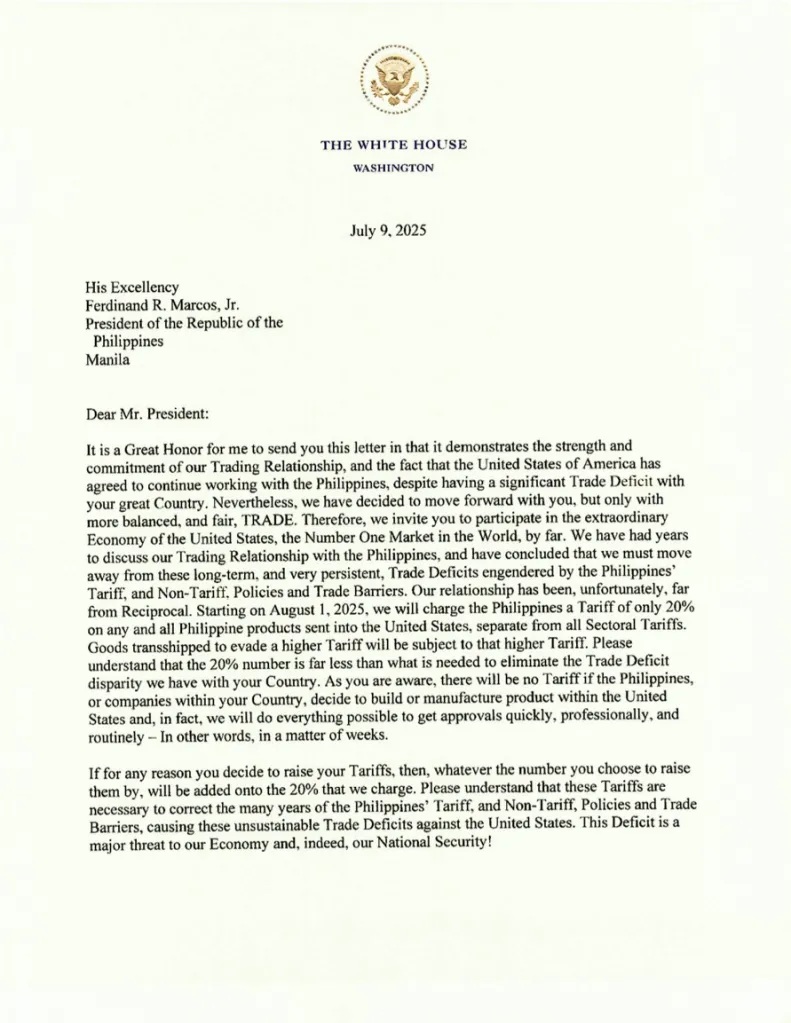
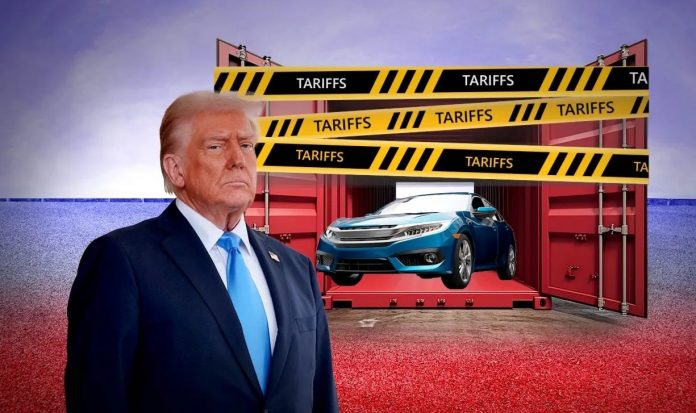
President Donald Trump has fired a fresh barrage of tariff warning letters to eight countries, warning them to reach trade agreements with the United States before August 1 or face stiff levies on their exports.

In a particularly pointed rebuke, Trump singled out Brazil for what he described as an international disgrace over the ongoing trial of former president Jair Bolsonaro, threatening a 50% tariff on Brazilian imports unless the country reverses course.

“It is a Witch Hunt that should end IMMEDIATELY!” Trump wrote in a letter to Brazilian President Luiz Inácio Lula da Silva. “The way that Brazil has treated former President Bolsonaro, a Highly Respected Leader throughout the World during his Term, including by the United States, is an international disgrace.”

The White House confirmed the letters were sent Wednesday to Brazil, the Philippines, Brunei, Moldova, Algeria, Iraq, Libya, and Sri Lanka. The letters include customized tariff threats ranging from 20% to 50% and follow through on Trump’s broader April 2 “Liberation Day” trade strategy, which called for sweeping tariffs across virtually all U.S. trading partners unless bilateral deals are struck.

Trump accused the governments involved of erecting unfair trade barriers and contributing to what he described as “unsustainable Trade Deficits” that jeopardize both the American economy and national security.

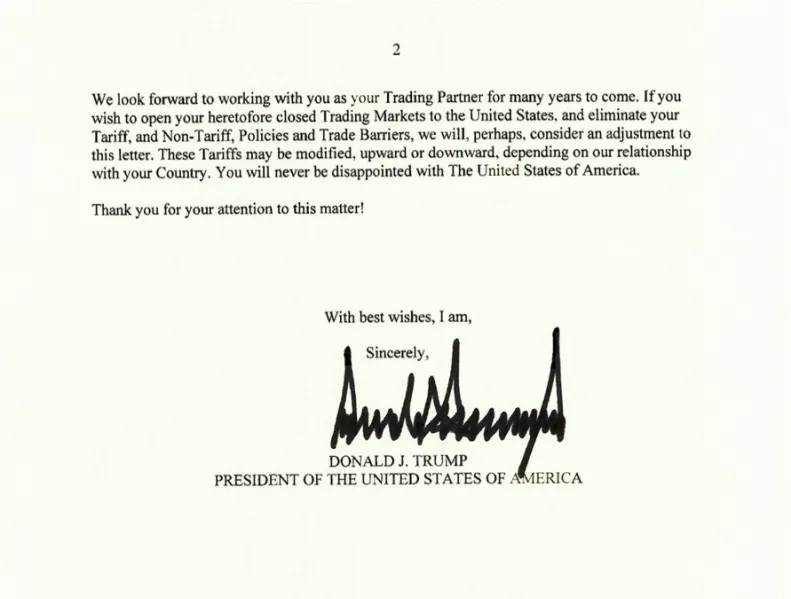
“Please understand that these Tariffs are necessary to correct the many years of Tariff, and Non-Tariff, Policies and Trade Barriers,” the letters stated. “This Deficit is a major threat to our Economy and, indeed, our National Security!”

Each letter opened with near-identical language: “It is a Great Honor for me to send you this letter in that it demonstrates the strength and commitment of our Trading Relationship.”

But the tone quickly turned confrontational, especially in the case of Brazil, which has recently placed former President Bolsonaro on trial over charges linked to election interference.

Trump, who has long maintained a close ideological alignment with Bolsonaro, framed the legal action as a political vendetta. He also used the opportunity to reassert his commitment to defending “Free Elections” and “Free Speech Rights of Americans,” tying Bolsonaro’s prosecution to broader global threats against conservative leaders.

In the same batch of letters, Trump threatened a 20% tariff on the Philippines, 25% on Brunei and Moldova, and 30% on Algeria, Iraq, Libya, and Sri Lanka. He also warned that these rates could be increased if countries retaliate or fail to engage in “good faith” negotiations.

The eight countries are just the latest on Trump’s growing list of trade targets. Earlier this week, he issued similar letters to 14 other nations, including key Asian economies like Japan, South Korea, Indonesia, and Thailand. Altogether, Trump has now publicly threatened punitive tariffs on 22 countries as part of his restructured “America First” trade agenda.

Press Secretary Karoline Leavitt defended the aggressive moves during a White House briefing, saying, “They will take the letters seriously because they have taken the president seriously… his phone rings off the hook from world leaders all the time who are begging him to come to a deal.”

Treasury Secretary Scott Bessent said the administration has identified 18 key trading partners for negotiations since the April 2 declaration, with several deals already in the works.

“We are close to several deals,” Bessent told CNN, while noting “foot-dragging on the other side.” He said announcements of major agreements could come within days.

So far, Trump has finalized provisional frameworks with the United Kingdom, Vietnam, and a ceasefire agreement with China. While the details remain limited, the UK deal reportedly retains a 10% baseline tariff. The agreement with Vietnam imposes a 20% tariff on direct exports and a much steeper 40% rate on goods believed to be transshipped from China or other third-party nations.

Trump has also reinforced 25% tariffs on automobiles, aluminum, steel, and other imports from Canada and Mexico that do not meet standards under the United States-Mexico-Canada Agreement (USMCA).

The use of trade policy to penalize countries over issues unrelated to commerce—such as Brazil’s judicial proceedings—marks a continued evolution of Trump’s diplomatic strategy. His trade doctrine now blends economic leverage with political messaging, signaling that countries that align ideologically or strategically with the U.S. will receive preferential treatment, while those seen as adversarial will pay a price.

As the August 1 deadline looms, businesses, investors, and foreign governments are scrambling to assess the real-world impact of what many see as a volatile but highly calculated trade campaign.

The Ascension of Nvidia to $4 Trillion as AI Becomes the Steel of the 21st Century

0

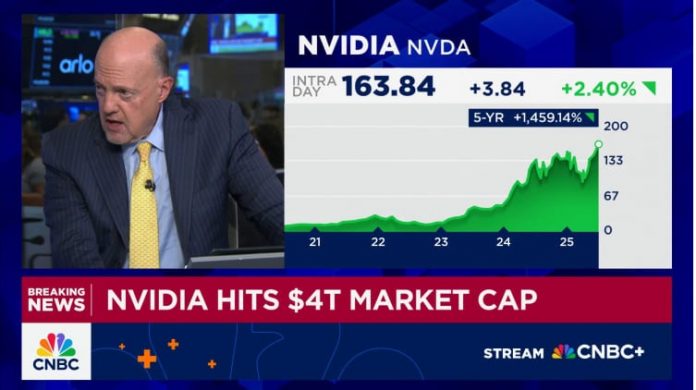
In 1907, US Steel was the most valuable company in America as steel was the core tech. In 1957, IBM was the king as the mainframe ran the show. By 1983, GE ruled. In the decade of 2010s, Apple and Microsoft took over as mobile Internet and apps defined markets. Today, this is Nvidia moment as AI infrastructure is the new steel: “Nvidia added another milestone to its meteoric rise on Wednesday, when its stock briefly pushed the company’s market value above $4 trillion during trading—making it the first company in history to achieve that valuation intraday.”

Congratulations Nvidia. The AI era is not hype; it is real. Yes, AI moment is not the same as the dotcom one because AI companies are generating revenue. As YCombinator recently noted, AI companies are the fastest growing companies on record, and the margins are the best. This implication is that our world is being redesigned and transformed. This a cambrian moment in the market and AI is powering that future.

Nvidia stands alone. The AI chipmaker became the first company to reach a market capitalization of $4 trillion on an intraday basis on Wednesday, before closing out the trading session slightly below that threshold. The world’s most valuable company surpassed Apple and LinkedIn parent Microsoft, which are the only other members of the $3 trillion club. Nvidia has ridden the AI boom to the top of the markets, making the chips that power large language models like ChatGPT. The 32-year-old company has seen the value of its shares surge fifteenfold in just the past five years.

Adeleke’s Defection: What Nigerians Are Saying

0
Osun local government

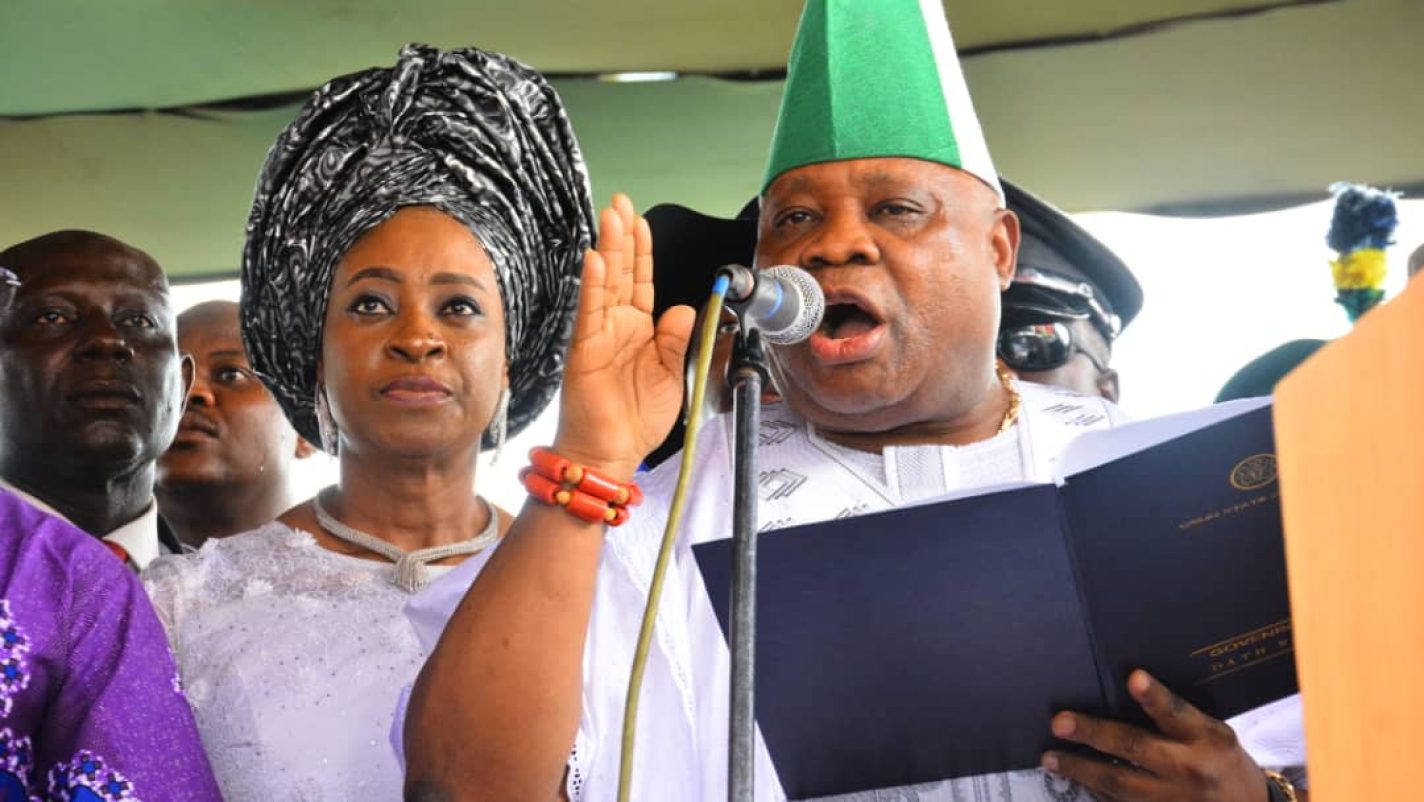
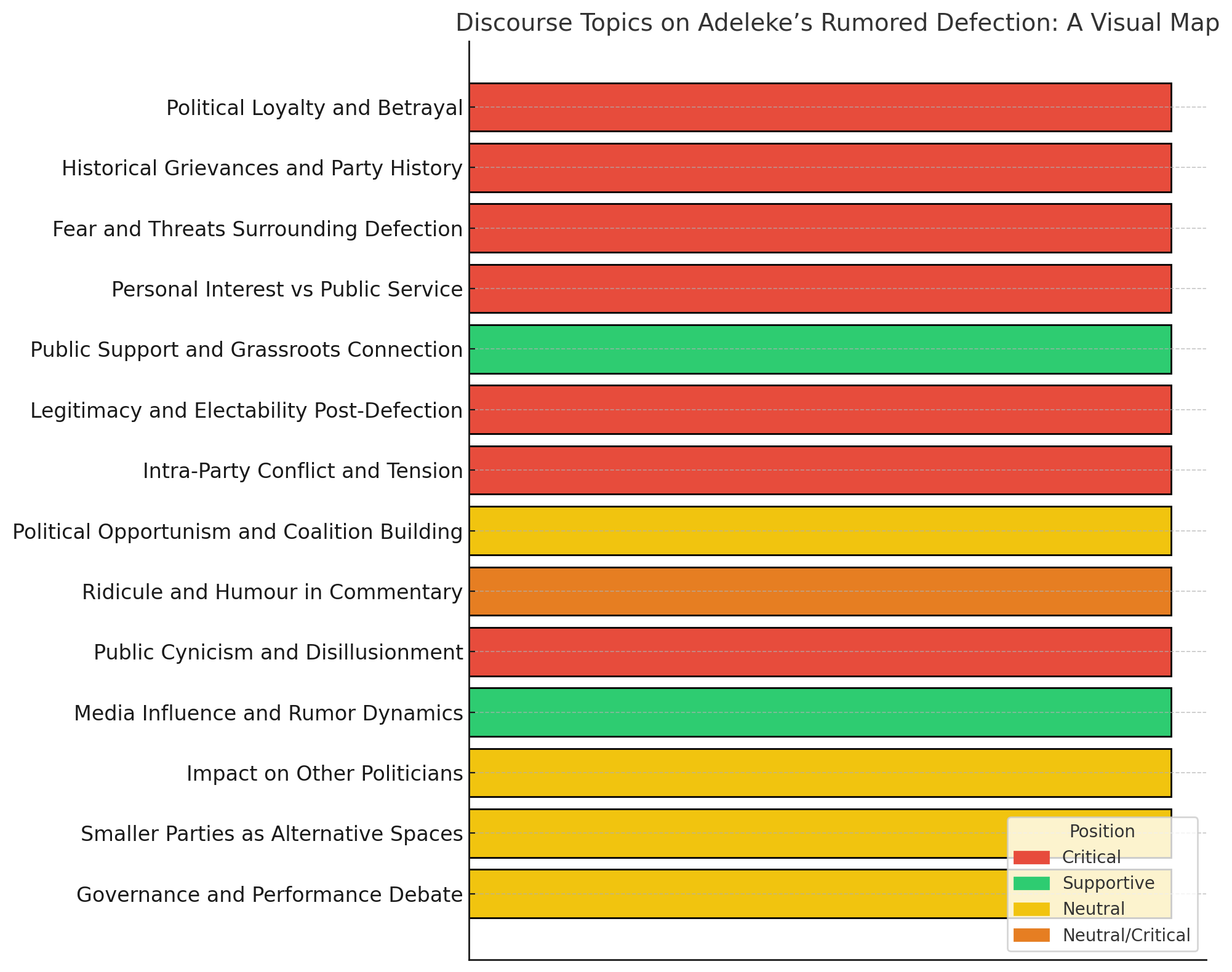
Governor Ademola Adeleke of Osun State has become the subject of an intense political debate following rumors that he may defect from the People’s Democratic Party (PDP) to the All Progressives Congress (APC). The responses from Nigerians, especially on social media, show just how politically sensitive and emotionally charged such a move would be. More than anything, the public reaction reveals a growing concern about loyalty, political identity, and the credibility of Nigeria’s political leaders.

For many, the possibility of Adeleke leaving the PDP feels like a betrayal of those who supported him when it mattered most. One commenter wrote, “Adeleke joined APC for his personal, selfish interest. Osun people won’t follow APC.” This view reflects a widely held belief that Adeleke owes his political career to the PDP and the people who stood with him when the APC, in their eyes, turned its back on him.

Some went further, recalling the political history between the Adeleke family and the APC. One post pointedly said, “APC problem started in Osun when they frustrated Adeleke’s family out of the party. PDP accepted Ademola Adeleke and gave him Senate and governorship tickets.” The message is clear: returning to the APC would not just be politically risky, but morally questionable.

Amid these criticisms, a strong emotional undercurrent runs through the public conversation. A particularly dramatic warning came from Primate Ayodele, who said, “You will lose your life if you join APC.” While extreme, this statement reflects how deeply some Nigerians view political loyalty, not just as strategy, but as a moral and even spiritual obligation.

Yet, not everyone sees Adeleke’s potential move in such dark terms. Some frame it as political realism. As one person suggested with a mix of humor and sarcasm, “APC is in advanced talks to sign marquee player in Osun State. Governor Adeleke, all paperwork has been completed… Here we go soon.” This football-style analogy shows how politics is often viewed like a high-stakes transfer market, less about ideology and more about power and survival.

Source: Social Media, 2025; Infoprations Analysis, 2025

Still, others are torn. “So will Adeleke now become a bad governor after moving to APC?” one user asked, pointing out that the quality of leadership should matter more than party labels. This view challenges the idea that changing parties automatically means changing values, or that political allegiance should define a leader’s competence.

There’s also skepticism about the entire narrative of pressure being placed on Adeleke. One respondent wrote, “Except you’re being paid to tweet that nonsense, it’s sheer foolishness for anyone to conclude that someone is pressuring Demola Adeleke to decamp to the APC.” Here, the writer questions not just the rumor itself, but the credibility of the people spreading it.

Despite the uncertainty, some believe Adeleke remains aware of his people’s preferences. As one person put it, “He remains grounded because he understands his people don’t support the APC. The connection is his strength and I expect him to stand by their choice.” This sentiment reinforces the idea that Adeleke’s political power stems not from party platforms, but from his perceived bond with ordinary Osun citizens.

The debate also brought out the tensions within both major parties. One contributor predicted that, “If Adeleke finally moves to APC, some aggrieved members of both APC and PDP will join ADC. It won’t be significant though.” While such a shift may not immediately change the political map, it speaks to a broader disillusionment with the status quo.

Perhaps the most revealing part of the public reaction is not what people are saying about Adeleke himself, but what they’re saying about Nigerian politics more broadly. Many see this as yet another example of how political actors change allegiances for convenience, not conviction. One comment summed it up: “Just because of the seized LGA funds. He’ll be making the biggest mistake of his political career.”

In the end, this is more than a story about whether Adeleke joins the APC. It’s about what Nigerians want from their leaders. They are asking whether politics should be about service or self-interest, principles or positioning. Regardless of the outcome, this moment has given Nigerians a chance to express their growing demand for transparency, consistency, and leadership that actually listens.