


One product launch keeps you busy—add five, ten, or twenty SKUs and the entire plan can skid off track. Packaging and labeling errors are a common cause of launch delays, draining teams of cash through rework and delays. Every extra variant multiplies files, barcodes, forecasts, and approvals; a single mismatch can jam lines, reroute pallets, or trigger retail chargebacks. This stage-gated product-launch packaging checklist gives you one playbook to sync data, design, compliance, and logistics before the first carton leaves the plant.
1. Draft a cross-functional launch brief
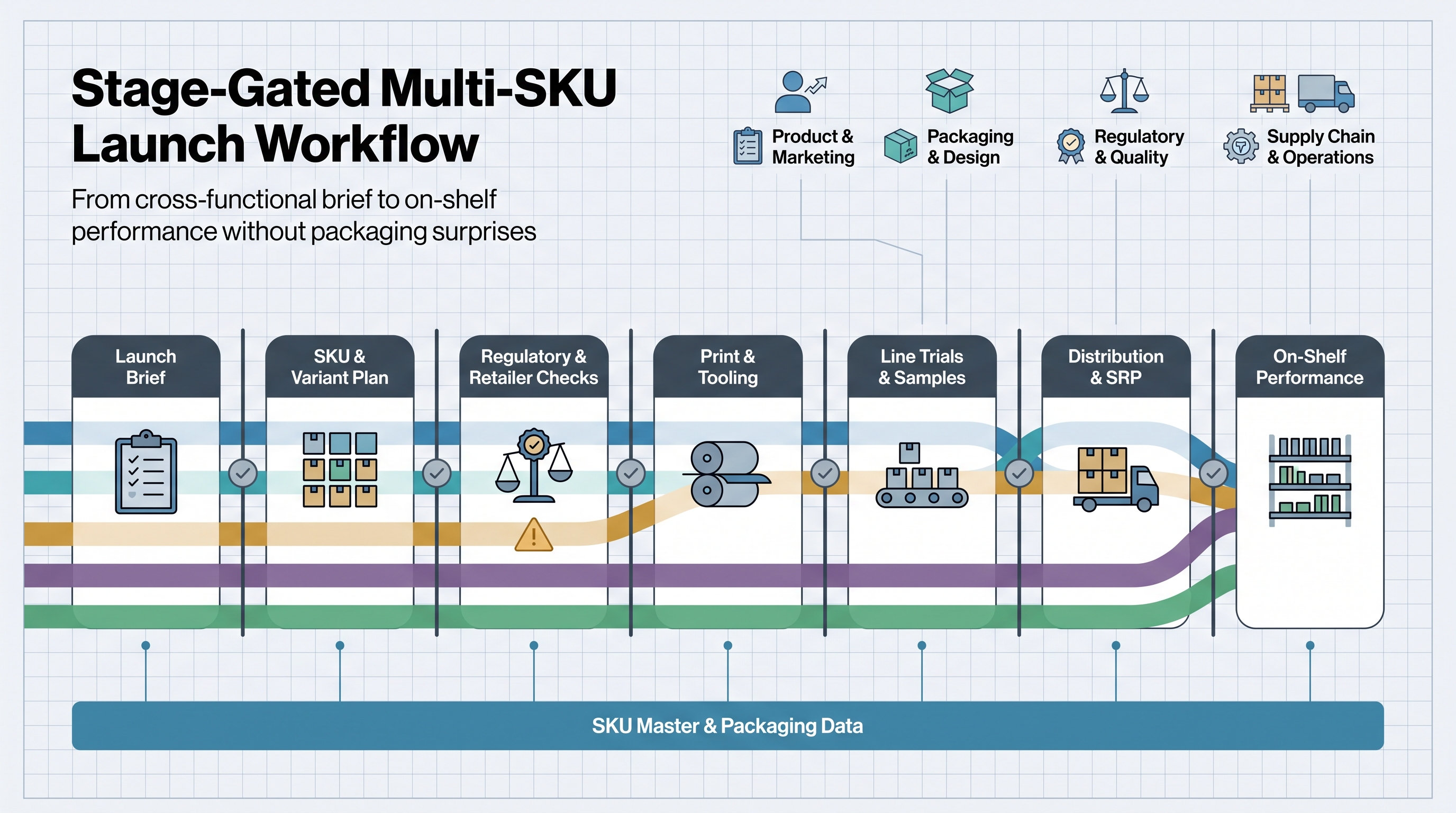
A launch brief keeps product, marketing, packaging, and supply-chain teams on the same delivery date. Packaging problems delay launches at more than half of brands: 53 percent of packaging leaders reported at least one product delay due to packaging or labeling issues, and one-third blamed miscommunication between departments (a 2026 Packaging Dive survey).
Work backward from the confirmed shelf or reset date and list the milestones that cannot slip: freight cut-offs, retailer sample windows, tooling release, artwork freeze, and final production. The gaps between those checkpoints show how much slack, if any, lives in the schedule.
Capture the essentials in one controlled document:
- Complete SKU list with forecast by variant
- Target markets and channels
- Case-pack and pallet assumptions
- Budget ceiling and contingency
- Named owner for every approval gate
- Non-negotiables such as regulatory sign-off or retailer item-setup deadlines
For a visual of how discovery, design, prototyping, and logistics interlock, see Zenpack’s guide to packaging for a new product launch.
2. Freeze the SKU list and assign each variant a clear launch role
Scope creep is the hidden expense nobody budgets for. Adding a single SKU after design work begins costs more than locking it in early, and the timeline slips while artwork, dielines, and proofs catch up.
Start by classifying every proposed variant:
- Hero SKUs carry the forecast and margin targets.
- Test SKUs probe new flavors or formats in small batches.
- Seasonal or limited editions aim for a fixed sell-through window.
- Regional or language packs satisfy local compliance or shopper preference.
- Retailer exclusives and multipacks support channel strategy.
List each SKU beside its forecast, objective, expected reorder cadence, and gross-margin contribution. Unequal numbers are healthy; a ginger-peach test run of 1,000 units should not divert cash from 50,000 vanilla units that keep the lights on.
Lock the list. Any late addition must arrive with a change form that states incremental cost, schedule slip, and an authorized owner signature. Once the trade-offs are visible, wish-list ideas often fade and the critical few stay in focus.
3. Build a country-by-country regulatory matrix
Regulatory surprises can stall a launch as surely as mechanical failures. In a 2022 Aura poll, 70 percent of senior packaging specialists said their businesses did not adhere to current or future sustainability regulations, according to Packaging Europe. A live matrix turns that blind spot into a managed task.
Start a spreadsheet that lists every SKU against every market and include, at minimum:
- Mandatory product name and legal descriptor
- Ingredient or material disclosures
- Language and type-size rules
- Net quantity statement
- Nutrition or usage panel requirements
- Allergen and warning symbols
- Packaging-material restrictions (e.g., PFAS limits)
- Extended producer-responsibility registration status
- Approval evidence and document owner
- Flag showing “law” or “proposal” so teams avoid over-engineering for rumors
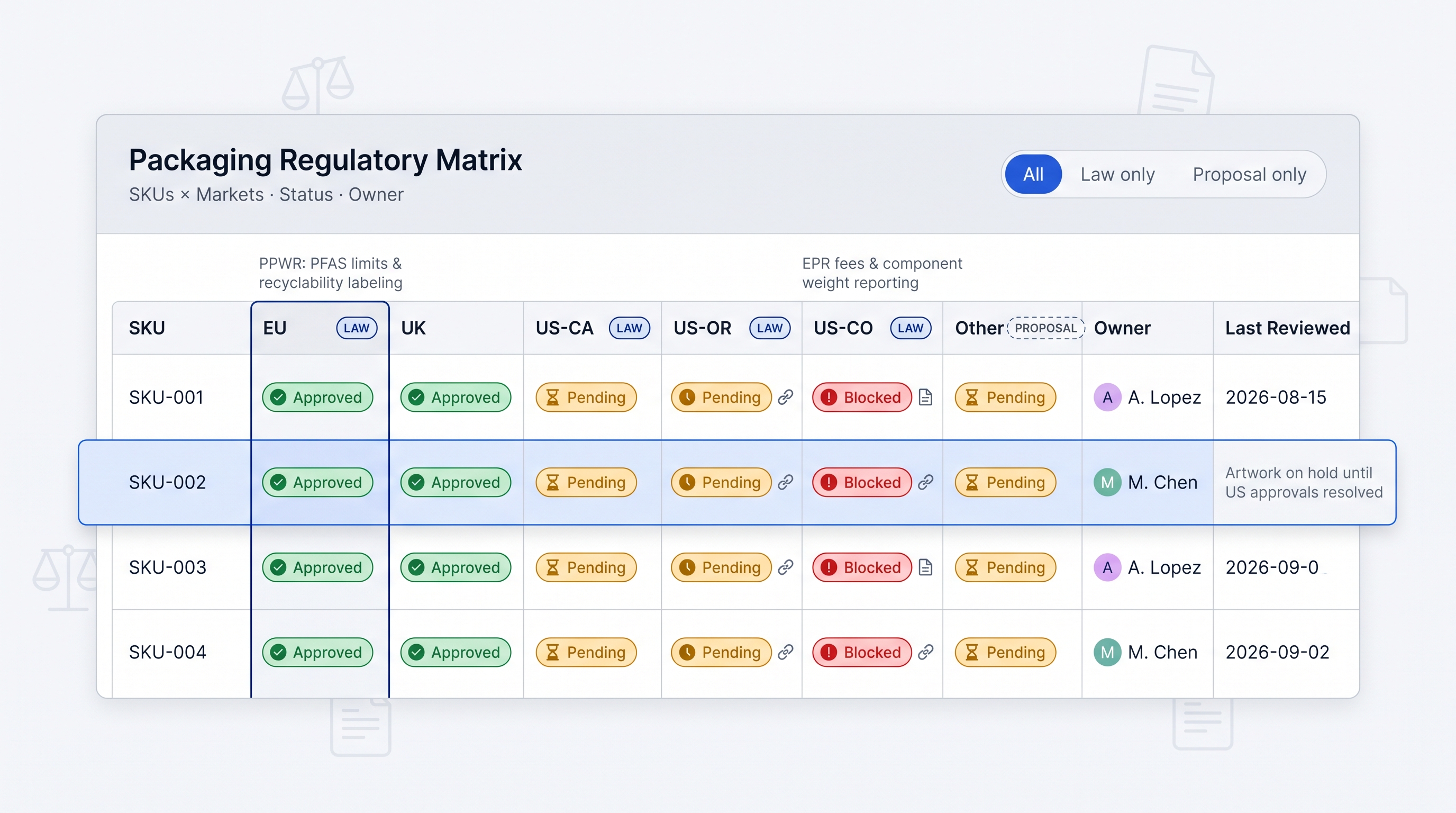
Why the urgency? The EU Packaging and Packaging Waste Regulation began to apply on 12 August 2026, banning food-contact packs that exceed strict PFAS limits, with EU-wide harmonized sorting labels to follow in 2028, while packaging already accounts for 40 percent of European plastics and 50 percent of paper use, according to the European Commission. In the U.S., packaging EPR laws in Oregon and Colorado already require producers to report the packaging they supply and pay fees, and California’s first fee invoices follow in January 2027.
Populate each cell with a hyperlink to the official citation, then assign one accountable owner per country. When artwork teams see a green “approved” check, they proceed; a red cell stops print. Visible data turns regulatory risk from roulette into project management.
4. Pull the retailer vendor guide before freezing structures
Retailers publish the rules that keep their DCs moving: case counts, maximum weights, barcode zones, pallet heights, routing windows. Miss one line and the invoice shrinks; suppliers and brands lose 5 to 7 percent of their revenue to retailer chargebacks, according to SPS Commerce.
Download the current guide for every target account during the same week you lock structural concepts, and treat each figure as a design input rather than a post-print audit. When the manual says “maximum case weight = 30 lb” or “tear-away must leave a 2-inch front lip,” build those numbers into the dieline and board grade, not a slide deck.
Summarize the essentials on one page: unit and case dimensions, weight limits, shelf-ready opening, label and barcode placement, pallet pattern, routing, sustainability clauses. Circulate it to design, engineering, and logistics so creativity stays anchored to reality.
Version-stamp the PDF and set a calendar reminder to check for updates until tooling is released; retailers revise their guidelines without much notice. A two-minute check today beats re-stickering 500 cases tomorrow.
5. Create the identifier architecture for every pack level
Mis-scanned or unlabeled cases drive costly deductions. Under Walmart’s Supplier Quality Excellence Program (SQEP), a barcode defect is the Phase 2 defect that costs suppliers the most, and fines run to a $200 administration fee per purchase order plus $1 per affected case or unit, according to SupplyPike. A clear identifier map stops those leaks.
Work from the retail unit outward:
- Retail unit – unique GTIN (still a linear UPC) plus a GS1 Digital Link or Data Matrix if you are ready for connected packaging.
- Inner pack – ITF-14 or GS1-128 when DCs pick inners.
- Master case – scannable case code and human-readable GTIN-14; align with each retailer’s label spec.
- Pallet – SSCC that ties to the advance ship notice.
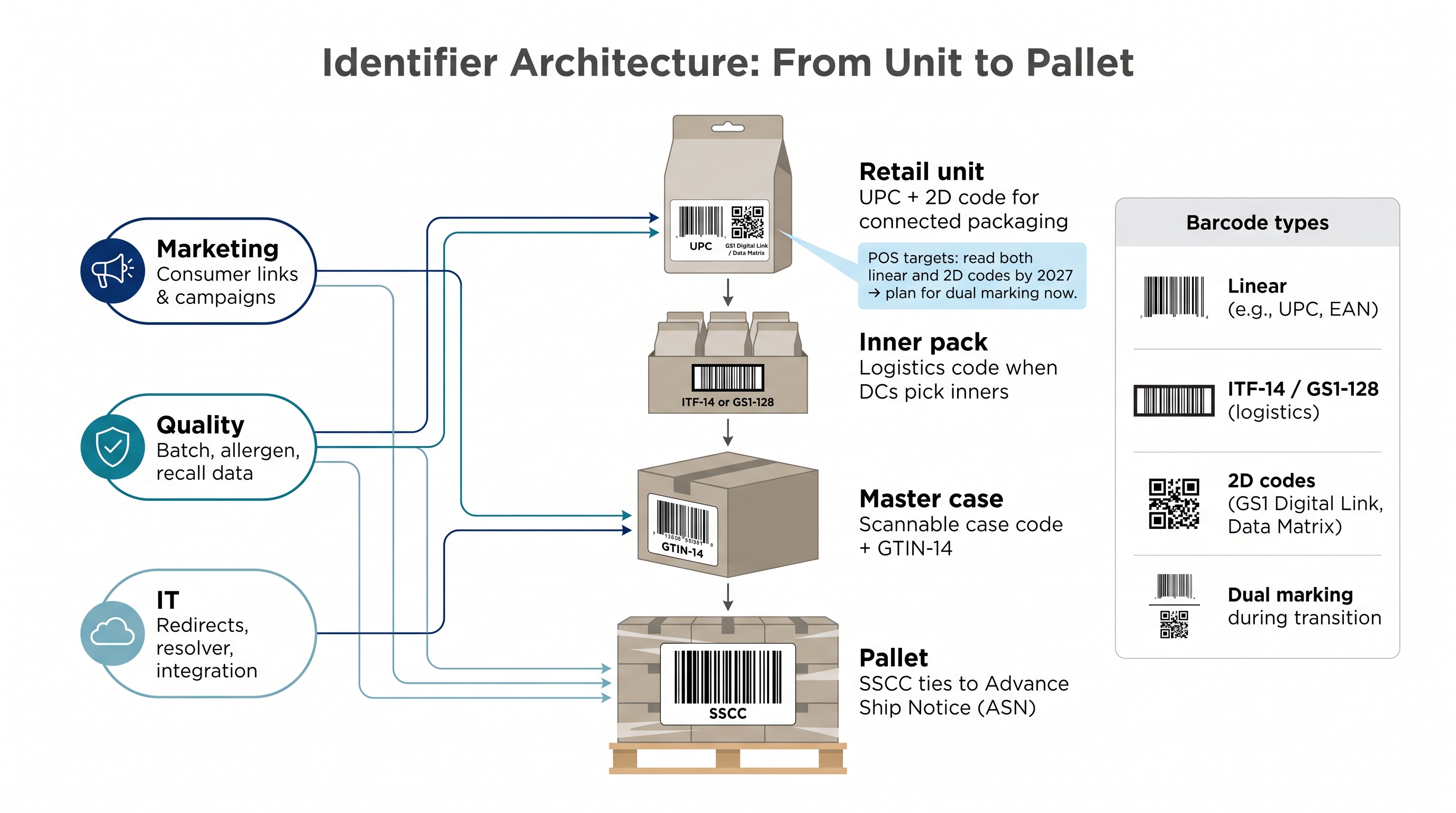
Industry aims for all POS systems to read both linear and 2D codes by the end of 2027, according to GS1. Until then, plan for dual marking and test both symbols on production substrate under real store lighting.
Decide now who owns each data layer: marketing for consumer links, quality for batch and allergen data, IT for redirects. Lock those rules in the SKU master. Before artwork freeze, run live scans of every symbol against the database field it should populate. One chirp, one correct record, then you print.
6. Separate what can be shared from what must vary
Platform first, decorate later. Standardizing structures across an SKU family trims packaging cost and shortens lead times. The payoff comes from using one dieline, one zipper, and one board grade, multiplied across every recipe.
Build a simple “S / V” grid: rows for structure, closure, barrier, base art, claims, barcode, language block, finish; columns for each SKU. At a glance you can see, for example, that one pouch, one zipper, and one foil layer can serve six flavors while only the color band and nutrition panel change.
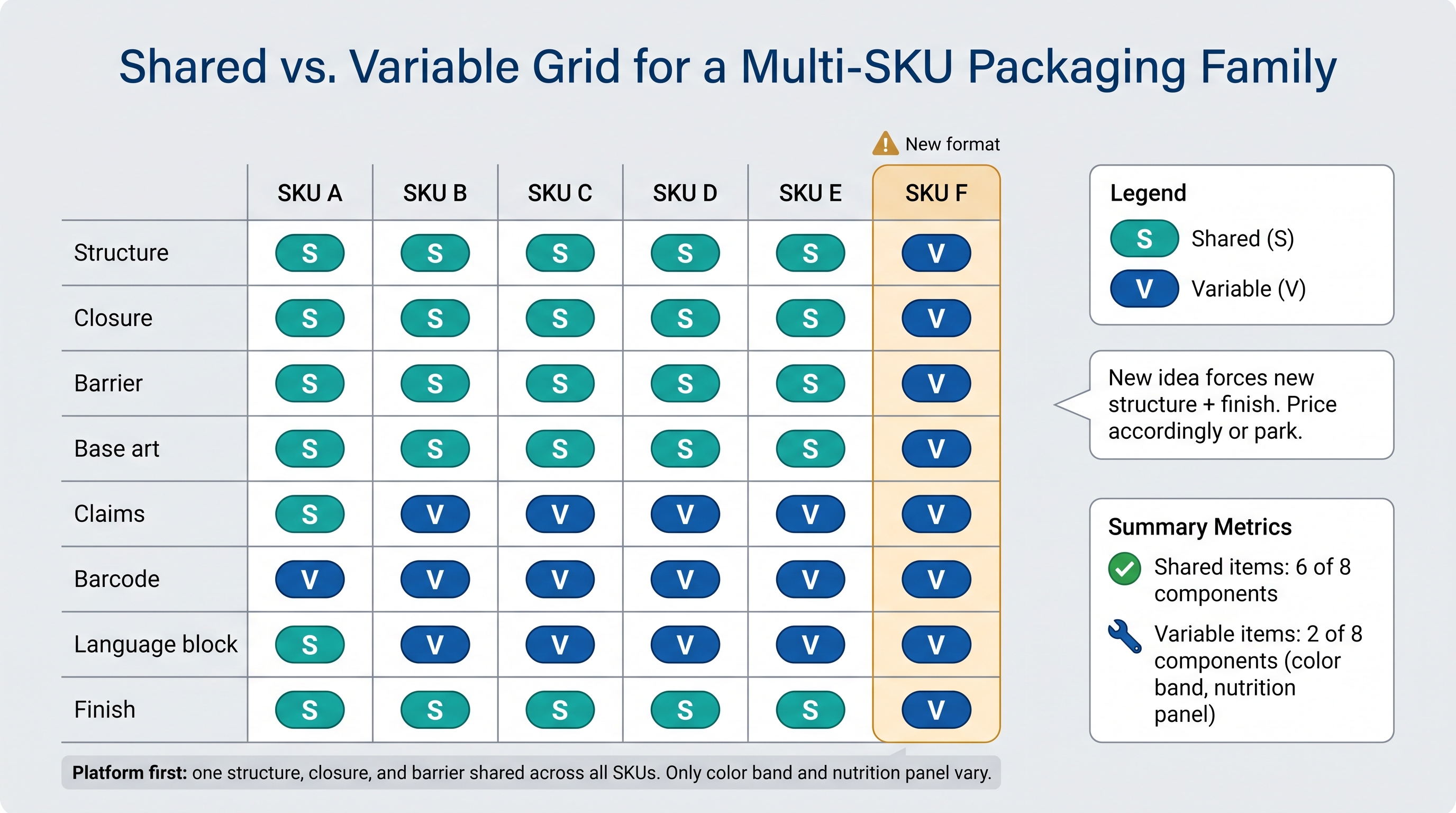
Keep the file active. When R&D proposes a gluten-free line or marketing wants a holiday wrap, check the grid first. If the idea forces a new structure, new tooling, and a small forecast, either price it accordingly or park it. Let the numbers decide so complexity earns its keep.
7. Make variants easy to spot in stores and warehouses
Look-alike SKUs slow pickers and confuse shoppers. WERC’s 2008 DC Measures study showed that a 2.4-point gap in order-picking accuracy (97 percent vs. 99.4 percent) separates general manufacturing from retail DCs—small on paper but costly in returns and rework.
Use at least two signals together: bold flavor color plus a large variant name, or icon plus pattern. Then repeat the cue on the top panel and case label so it stays visible in trays and stacked pallets.
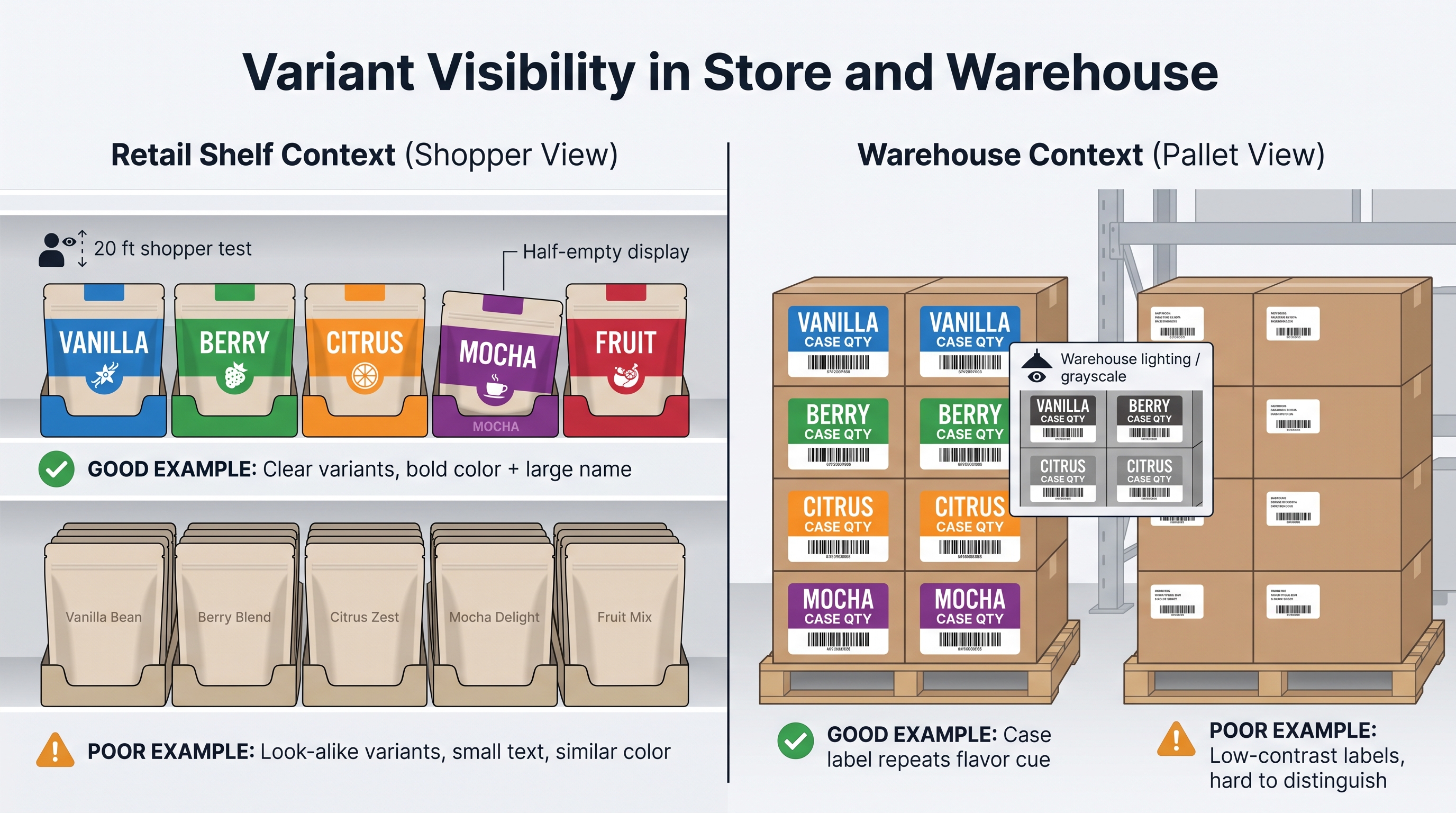
Test recognition in three quick sprints:
- Shopper distance (20 ft). Can someone grab the right flavor without pausing?
- Half-empty display. Do pouches slump and hide the cue?
- Warehouse lighting. Does the label still stand out in grayscale for color-blind staff?
If anyone hesitates, amplify the cue with a wider color band, bigger type, or a high-contrast symbol until identification feels automatic. Clear differentiation trims mis-picks, speeds shelf work, and builds shopper confidence in one stroke.
8. Pick the right print and tooling strategy for real demand
Print is where money turns into board, film, and ink, so match the press to forecasted units, not family totals.
HP puts the break-even between its Indigo 200K digital press and flexo for flexible packaging at about 3,000 m², and the exact point shifts with color count, coverage, and plate costs. Below that run length, digital’s plate-free setup and near-zero make-ready waste usually win even if the per-unit ink cost is higher.
Use this three-step check:
- Quantity per SKU. Heroes at 100 k units favor flexo or offset; a 5 k seasonal run stays digital.
- Artwork stability. If claims, nutrition, or language may change inside 12 months, keep the job digital a little longer.
- Finish and lead time. Metallic inks or tactile varnish narrow the supplier pool and can add weeks; reserve them for SKUs with proven margin.
Share tooling wherever geometry allows. One die line across five flavors saves plate cost, but only if height and gusset stay consistent. Run a quick break-even: divide plate plus make-ready cost by expected units; if the answer tops the digital premium, stay digital.
Hybrid presses (digital plus flexo) can bridge the gap: use analog white or metallic lay-downs, then drop in digital variable graphics. This mix keeps brand consistency while holding MOQs low.
Build change fees into your business case. A single late artwork tweak can mean new plates and schedule slip, which is cheap insurance compared with scrapping two pallets of mislabeled print.
9. Calculate the true cost of SKU complexity
Every extra variant looks harmless until the bill arrives.
To see whether each flavor earns its shelf spot, build a fully loaded cost line:
- Visible costs. Components, tooling, setup, freight, customs.
- Hidden costs. Regulatory reviews, golden samples, QC inspections, warehouse space, pick errors, retailer chargebacks.
- Capital drag. Cash leaves when you pay for plates and inventory; it returns only after the slowest-moving unit sells.
Run a quick test:
gross margin – (full packaging cost ÷ expected turns) = cash contribution
If a variant barely breaks even, or worse, soaks cash for prestige, either raise the price, move it to digital print with lower MOQs, or cut it. Complexity stays only when it pays its way.
10. Establish one controlled SKU source of truth
Duplicate spreadsheets breed label errors. A single, permissioned record ends the confusion.
At minimum, the master should include:
- Internal SKU and retail GTIN
- Product name, variant, regulatory descriptor
- Artwork and dieline revision codes
- Ingredient list or bill of materials
- Net quantity and pack dimensions
- Case pack and pallet pattern
- Claims, certifications, and market approvals
- Shelf life and storage requirements
- Approved golden-sample date with photo link
Choose a home such as a PIM, PLM, or a locked sheet in a version-controlled repository, and grant edit rights sparingly. Every change logs who, what, when, and why. The file flips from “Approved” to “Obsolete” the moment a new artwork revision publishes. Suppliers receive one filename only. Data integrity stops being paperwork and becomes launch insurance.
11. Lock file naming, version control, and change management
Wrong files are more than annoying; they trigger recalls. Esko reported in 2026 that nearly 40 percent of product recalls stem from labeling errors, and it names version-control failures among the causes. A disciplined naming and approval flow keeps the right PDF on press and the wrong one in the trash.
Use one readable pattern
Brand_SKU_Component_Market_Rev_Status_Date.pdf
Example: FIZZ_VAN_12oz_CAN_US_R2_APPROVED_2026-03-15
Limit status codes
Draft ? Internal-review ? Regulatory-review ? Approved ? Released ? Obsolete
Control the change
- Every revision rides a short form: what changed, why, cost, schedule, approvers.
- Obsolete files leave the supplier folder within 24 hours.
- The printer must echo the exact filename and status before imaging plates.
Protect the record
Store files in a permissioned repository: designers can upload, QA can approve, suppliers can view but not edit. The system logs who touched which file and when, so root-cause analysis takes minutes, not days.
Tight version control costs pennies; one mislabeled batch can cost millions.
12. Pre-flight every SKU, not just the hero design
Label mistakes fuel recalls, as the Esko figure above shows. A disciplined, SKU-level preflight keeps those errors off press.
Run four quick passes for each final PDF:
- Data match. Automated text-compare confirms product name, ingredient list, nutrition facts, net quantity, claims, and GTIN against the master record.
- Layout integrity. Visual diff flags shifted logos, missing allergen triangles, or artwork creeping into quiet zones.
- Physical mock-up. Print at 100 percent, cut, fold, and place on the sample pack. Check date-code clearance, barcode orientation, and sealing jaws.
- Sign-off. The packaging engineer initials the checklist, quality uploads it to the SKU master, and only the stamped file moves to the supplier folder.
Skip a single step and the file stays in “Hold.” Five extra minutes in preflight beats five truckloads of rework.
13. Confirm product-package compatibility and line fit
Every minute your line sits idle drains cash, and many stoppages trace back to out-of-tolerance materials or a package that slips, jams, or leaks.
Run three fast loops with production-intent components and the real product:
- Cold fit. Check dimensions, tolerances, and friction. Does the bar slide into the flow-wrapper pocket? Does headspace stay within spec?
- Hot run. Fill, seal, torque, and label at target speed. Log sealing temperature, dwell time, jaw pressure, glue bead, and cap torque.
- Stress test. Invert pouches for 30 seconds, drop filled cartons from belt height, and freeze-thaw if the product faces a cold chain. Record leaks, channel seals, delamination, or ink bleed.
Document each parameter in the line-setup sheet, then have the packaging engineer sign the run card before scale-up. A five-case trial today keeps you from a five-hour shutdown tomorrow.
14. Use three sample gates to catch errors early
Sampling is cheaper than recalls. In 2016, Mars recalled chocolate bars in 55 countries after one piece of plastic turned up in a single Snickers bar. Three deliberate pauses protect you from that headline.
| Gate | Purpose | Must-pass checks | Sign-off |
| White sample | Validate structure before graphics | Fit, stack height, machine erectability | Packaging engineer |
| Decorated prototype | Confirm artwork, color, and barcode readability | Pantone match, scan test, varnish integrity | Marketing + Quality |
| Golden sample | Approve full production spec | Real substrate, filled product, drop/temperature tests | Quality manager |
Store one golden sample per SKU in a controlled cabinet. Future batches must match that sample; otherwise the line stops before thousands of faulty units reach the truck.
15. Test distribution, shelf, and consumer-use conditions
Damage in transit erodes profit fast.
| Track | Simulated hazards | Pass benchmark | Sign-off |
| Transit | ISTA 3-Series drop, vibration, and compression on fully packed pallets | No primary-pack failures; ?5 percent cosmetic carton damage | Packaging engineer |
| Shelf life | 4-week light exposure, 0 °C–40 °C cycling, 85 percent RH | Product meets taste/appearance spec; ink and adhesives intact | Quality manager |
| Consumer use | 10 open-pour-reseal cycles, barcode scan on scuffed film, readability of date code under kitchen light | All samples pass without zipper failure or scan error | Marketing + QA |
Run tests on the final pack-out (unit, inner, case, pallet, and stretch wrap) so hidden weak points surface before launch. Document results and corrective actions; production can start only when every row shows “Pass.”
16. Validate shelf-ready and multi-SKU displays in every state
Shelf-ready packs promise one-touch merchandising, but the savings disappear if trays collapse after the third facing sells.
| Stage | What to check | Pass benchmark | Sign-off |
| Closed shipper | Can a picker lift the case without tearing perforations? Barcode faces out for scan? | No torn perforations after five lifts; barcode scans on the first try | DC operations |
| Conversion | Store staff open the tray in 10 seconds or less, no knife | Tear strip removes cleanly; front lip intact | Store operations |
| Full shelf | Graphics align, variants remain visible, products stand upright | Correct facings in planogram; no product sag | Merchandising |
| Half-empty / near-empty | Tray holds its shape; last unit reachable without disassembly | Tray walls stay upright; zero hidden units | Retail QA |
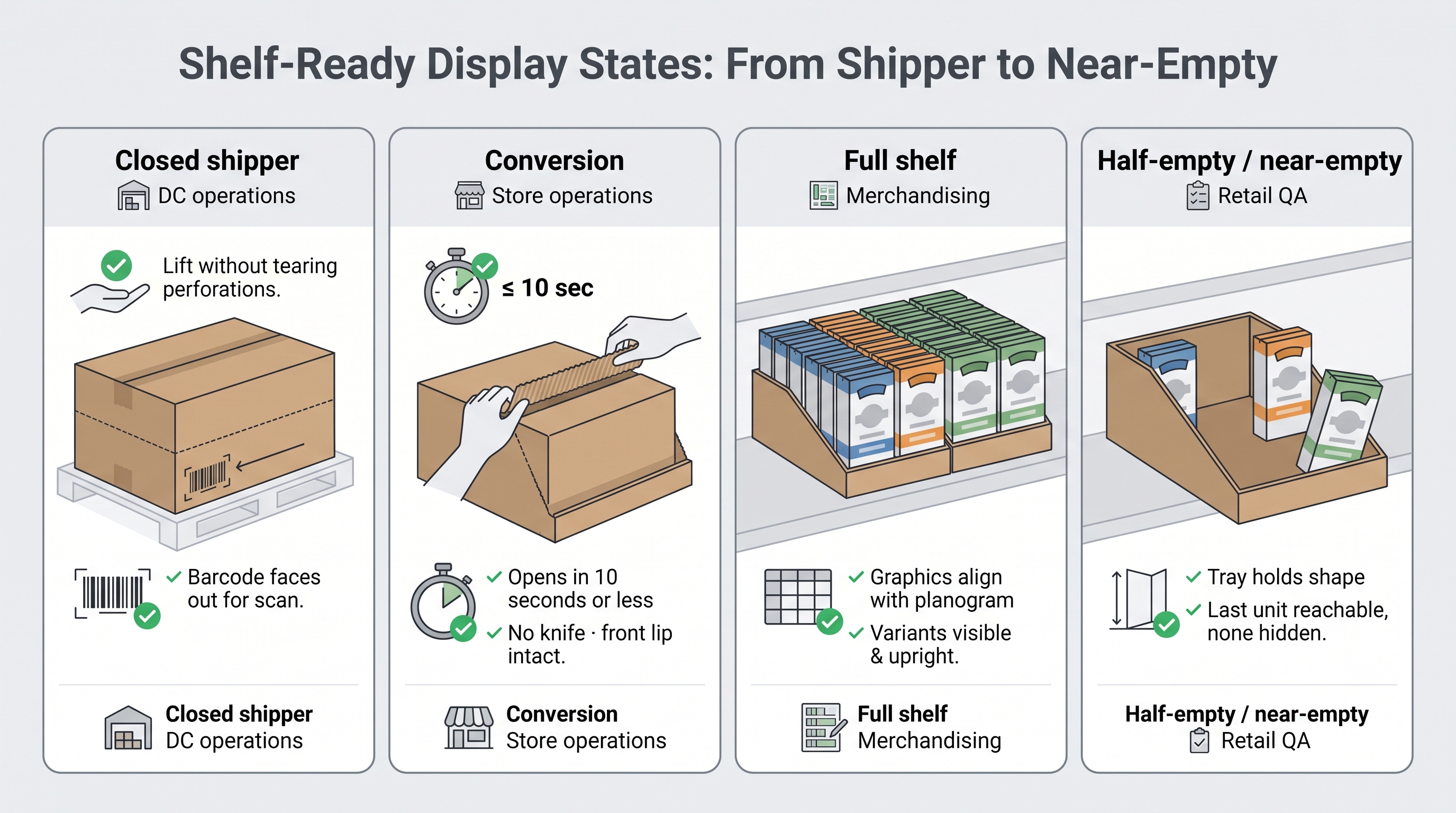
If any stage fails, adjust score lines, add corner supports, or recalc case counts before print tools harden. A 15-minute bench test here saves hours of back-room stickering later.
17. Qualify suppliers and critical materials up front
Supplier problems can sink a launch as fast as design errors. Vet partners early and systematically.
| Criterion | Target benchmark | Evidence to collect | Weight |
| Capacity | Monthly output at least two times the launch forecast | Time-stamped production reports | 25 percent |
| Lead time | Raw material to ship in 45 days or less | Historic OTIF data | 20 percent |
| Quality system | ISO 9001 and food-contact certs; defect rate one percent or lower | Audit checklist, CAPA logs | 20 percent |
| Continuity | Dual tooling or backup plant ready within 72 hours | BCP documents | 15 percent |
| Geographic risk | Ocean transit 20 days or less or a regional alternative | Freight lane analysis | 10 percent |
| Cost | Within target COGS plus or minus five percent | Quotation and costed BOM | 10 percent |
Score every critical component. Suppliers below the 80-point pass line either improve or wait for the next launch.
Assign one sourcing lead to lock contracts no later than the structure-freeze gate; any delay ripples straight into tooling and production slots. With qualified partners booked and backups in place, operations can meet every promise the pack makes on shelf.
Conclusion
Following this 17-step checklist gives cross-functional teams a clear, controlled path from concept through compliance and logistics. Lock the SKU list, keep one source of truth for data and files, preflight every variant, test packs on the line, in transit, and on shelf, and qualify suppliers early. Then every SKU can launch on time, on budget, and on shelf.