

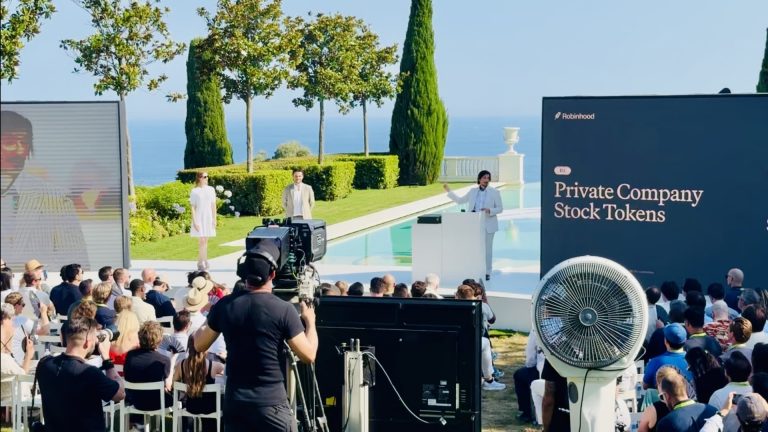
Robinhood stock surged 10% on Monday to reach an all-time high after the trading platform announced its entry into tokenized private equity, offering users in the European Union access to shares of OpenAI and SpaceX.
The move marks the company’s most aggressive push yet into the crypto space and could signal a broader challenge to how access to private markets is structured globally.
During its product showcase in Cannes, Robinhood unveiled a suite of blockchain-enabled products, including over 200 tokenized stocks and ETFs now tradable on its EU crypto app — all commission- and spread-free, available 24/5. But the spotlight fell squarely on its decision to tokenize equity in OpenAI and SpaceX, two of the most tightly held private companies in the world.
Register for Tekedia Mini-MBA edition 20 (June 8 – Sept 5, 2026).
Register for Tekedia AI in Business Masterclass.
Join Tekedia Capital Syndicate and co-invest in great global startups.
Register for Tekedia AI Lab.
While neither OpenAI nor SpaceX is publicly listed, Robinhood’s crypto division is leveraging blockchain to democratize access to equity markets that have traditionally been the domain of venture capitalists and high-net-worth individuals.
“We wanted to make sure we were giving access,” said Johann Kerbrat, Robinhood’s general manager of crypto. “What we discussed on stage was how to address the inequality between people who’ve historically had access to these kinds of companies — and everyone else. That’s the really exciting part: now everyone will be able to get it.”
The company is marking the launch with a marketing campaign offering €5 worth of OpenAI and SpaceX tokenized shares to every eligible EU user who registers to trade stock tokens before July 7. To back this campaign, Robinhood has set aside $1 million worth of OpenAI tokens and $500,000 worth of SpaceX tokens.

This rollout is Robinhood’s first step into tokenizing private companies, a feat made possible largely due to the EU’s relatively liberal regulatory environment. Unlike in the United States, there are no accredited investor rules in the European Union restricting who can invest in private equity — meaning anyone qualified to trade tokenized stocks in the EU can now own a slice of some of the world’s most coveted tech companies.
“The goal with tokenization is to let anyone participate in this economy,” Kerbrat said.
Why Not in the U.S.?
For now, this opportunity is exclusive to European users, with Robinhood signaling that U.S. investors shouldn’t expect similar access in the near future. Strict U.S. regulations — particularly those around who qualifies as an accredited investor — remain a barrier to broader participation in private equity markets.

Robinhood CEO Vlad Tenev has previously called for regulatory reform, urging U.S. authorities to adopt a more modern approach that recognizes the role of blockchain in expanding economic access. But the U.S. Securities and Exchange Commission (SEC) has remained wary of crypto-related equity innovations.
Nevertheless, Robinhood’s U.S. user base isn’t being left behind entirely. The company announced that American users will now have access to staking for Ethereum and Solana, a major milestone after months of regulatory uncertainty that had kept such offerings off the table.
Building the Infrastructure
The tokenized stock launch is supported by Robinhood’s newly unveiled Layer 2 blockchain built on Arbitrum, a scaling solution that enables faster and cheaper crypto transactions. The blockchain is integrated with the company’s custody wallet, where the tokenized shares are delivered to users.
This infrastructure is intended to form the backbone of Robinhood’s decentralized financial offerings and could eventually support everything from synthetic assets to smart contract-based investing strategies.
Robinhood’s pivot to tokenized private equity is more than a product launch — it’s a strategic bet on financial inclusion through crypto. Tokenized assets have long been hyped as a way to open up access to previously restricted investment classes, from real estate to venture capital.
Robinhood is pushing the boundaries of how people think about ownership and access in modern finance by making private equity tradable around the clock without commission. In doing so, it’s not just expanding its product line — it’s trying to rewire the rules of the game.
The challenge, however, is ensuring these moves gain traction amid regulatory scrutiny and technical complexity. As of now, no indication has been given on whether the tokenized shares represent real equity or derivative exposure, nor whether OpenAI or SpaceX have approved or endorsed the offering.
However, Monday’s announcement electrified investor sentiment, sending Robinhood shares climbing to their highest point yet and reinforcing the company’s pivot from meme stock facilitator to global fintech disruptor.
The move, for now, plants Robinhood firmly in the middle of a growing global experiment: can tokenized finance deliver on its promise to broaden economic opportunity — or will it remain a niche tool for crypto-native investors?