

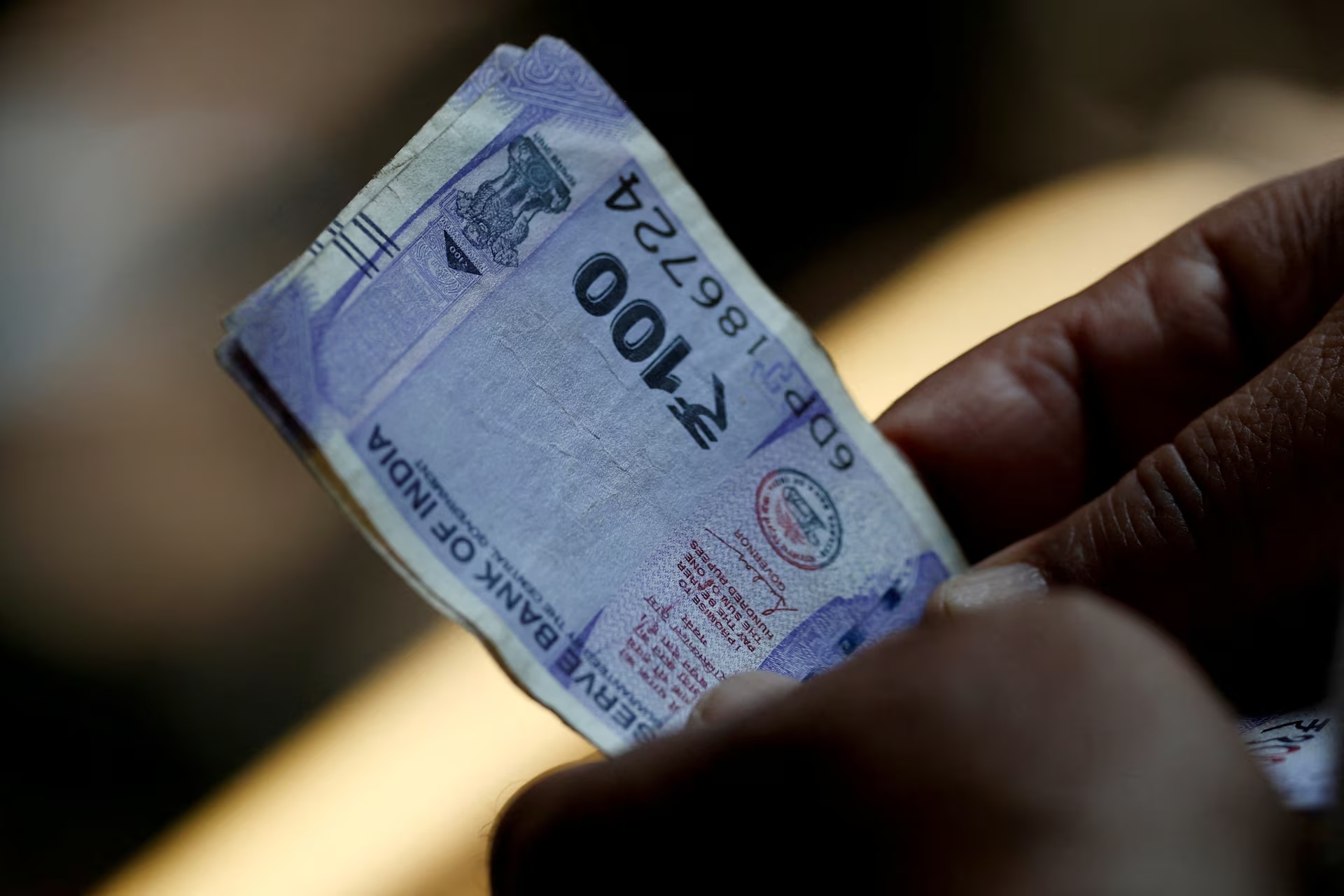
The Indian rupee enters the new trading week at a critical juncture, with investors weighing the benefits of lower oil prices against a resurgent U.S. dollar and growing uncertainty surrounding the implementation of the fragile U.S.-Iran peace agreement.
After posting its strongest weekly gain in nearly three months, the rupee’s next move is likely to be dictated less by crude oil and more by global risk sentiment, U.S. economic data, and the trajectory of the Federal Reserve’s monetary policy. Meanwhile, Indian government bonds are expected to remain supported by robust foreign inflows, although renewed geopolitical tensions could cap further gains.
The rupee advanced 0.8% last week to close at 94.32 per dollar, marking its best weekly performance in 11 weeks. The currency briefly strengthened to 94.18, its highest level since early May, benefiting from a sharp decline in oil prices after Washington and Tehran announced a framework agreement aimed at ending months of conflict and reopening the Strait of Hormuz.
Register for the next Tekedia Mini-MBA.
Register for Tekedia AI in Business Masterclass.
Join Tekedia Capital Syndicate and co-invest in great global startups.
For India, one of the world’s largest crude importers, lower oil prices provide immediate relief by easing pressure on the trade balance, reducing imported inflation risks, and improving demand for the rupee.
However, that tailwind began to fade almost as quickly as it emerged.
The U.S. dollar regained momentum after the Federal Reserve adopted a more hawkish tone than markets had anticipated. Policymakers signaled growing concern about inflation, prompting investors to reassess expectations for future rate cuts and even price in the possibility of another rate increase later this year. That shift helped lift the dollar index by 1.1% last week to its highest level in a year, while U.S. two-year Treasury yields climbed sharply.

According to Kunal Kurani, vice president at Mecklai Financial, oil had been the dominant driver of rupee movements in recent weeks, but attention is now returning to U.S. economic fundamentals.
“Oil had been the dominant driver for the rupee for some time. Now, the dollar is back in focus, which means you have to pay attention to incoming U.S. data,” he said.
The week ahead is packed with indicators that could reshape expectations for U.S. interest rates, including durable goods orders, GDP figures, jobless claims, and the closely watched Personal Consumption Expenditures (PCE) inflation index, the Federal Reserve’s preferred inflation gauge.

Any signs that inflation remains stubbornly high could further strengthen the dollar and place renewed pressure on emerging-market currencies, including the rupee.
Complicating matters further is the growing uncertainty surrounding the U.S.-Iran peace process. While markets initially welcomed the agreement reached between Washington and Tehran, questions are already emerging about whether the deal can survive the difficult implementation phase.
Switzerland confirmed that talks between U.S. and Iranian negotiators scheduled for Friday at the Burgenstock resort would no longer take place after U.S. Vice President JD Vance abandoned plans to travel there.
Although the talk was reportedly held later, the cancellation has raised concerns that negotiations may not yield the needed result.
“The logistics of these negotiations have never been simple or predictable,” a White House spokesperson said.
For global foreign exchange markets, the peace agreement may have reduced immediate fears of a major energy shock, but it has not eliminated geopolitical risk. The uncertainty surrounding implementation means traders remain reluctant to fully unwind defensive dollar positions. Any setback in negotiations could reignite volatility in oil markets, strengthen safe-haven demand for the dollar, and pressure emerging-market currencies.
The situation is particularly important for Asia, where many economies remain heavily dependent on imported energy.
For the rupee, therefore, the outlook remains highly sensitive to both geopolitical headlines and oil prices. A durable peace could help sustain lower crude prices and support further gains. But any indication that negotiations are faltering could quickly reverse those benefits.
Bonds in Focus
Indian government bonds, meanwhile, continue to attract foreign interest. The benchmark 10-year government bond yield ended last week at 6.8533%, down five basis points and marking its fourth consecutive weekly decline.
The rally has been supported by falling oil prices and strong overseas demand following measures introduced by the Reserve Bank of India earlier this month to facilitate foreign investment. Foreign investors have purchased 213.5 billion rupees ($2.26 billion) worth of Indian bonds so far this month, the highest monthly inflow in 15 months. Most of those purchases occurred after the RBI announced steps aimed at boosting foreign participation in the debt market.
Although bond yields recovered slightly on Friday as investors booked profits, market participants still see room for further support.
Anurag Mittal, senior executive vice president and head of fixed income at UTI AMC, believes yields may edge lower in the near term but is cautious about the extent of any rally.
“While government bond yields could move lower in the near term, we do not expect a material or sustained decline,” he said.
Most traders expect the 10-year yield to remain within a range of 6.80% to 6.90% this week, with movements likely driven by oil prices, foreign flows, and developments in global markets.
India continues to benefit from a relatively attractive position within global fixed-income markets.
According to Wontae Kim, portfolio manager at Western Asset Management, India remains one of the most attractive investment-grade bond markets in Asia because of its relatively high yields, deep liquidity, and improving settlement infrastructure.
“Although geopolitical uncertainties and concerns about inflation have impacted investor sentiment, the recent developments are likely to give bond investors a cause for reconsideration,” Kim said.
Still, the biggest risk for both the rupee and Indian bonds remains the same: uncertainty. While lower oil prices have provided temporary relief, markets are increasingly recognizing that the U.S.-Iran accord is only the beginning of a much more complicated diplomatic process.
As a result, global currencies are likely to remain vulnerable to abrupt swings in sentiment. Investors may have moved past the immediate crisis phase of the conflict, but they are not yet prepared to price in a durable peace.
For the rupee, that means last week’s impressive gains could face a tougher test in the days ahead as geopolitical risks, Federal Reserve policy expectations, and global dollar strength once again compete for control of currency markets.