

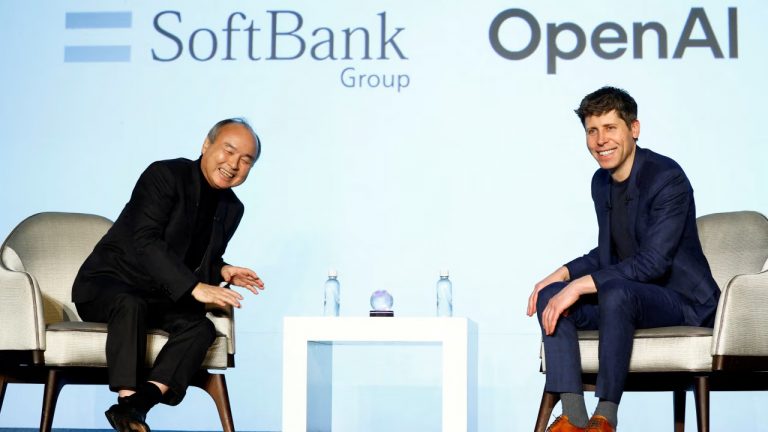
SoftBank Group Corp. has reportedly approved the release of a second installment worth $22.5 billion to complete its $30 billion investment in OpenAI, according to a report by The Information on Saturday.
The Japanese investment giant’s board gave the green light on the condition that OpenAI finalizes a major corporate restructuring, a move designed to prepare the artificial intelligence company for an eventual initial public offering (IPO). The restructuring would shift OpenAI from its current capped-profit model to a fully for-profit structure — a requirement SoftBank had set before unlocking the final tranche of its funding.
According to the report, the approval would bring OpenAI’s ongoing financing round to $41 billion, one of the largest private capital raises ever recorded in the tech industry.
Register for Tekedia Mini-MBA edition 20 (June 8 – Sept 5, 2026).
Register for Tekedia AI in Business Masterclass.
Join Tekedia Capital Syndicate and co-invest in great global startups.
Register for Tekedia AI Lab.
The first part of SoftBank’s $30 billion commitment — $10 billion — was approved in mid-April. The second installment completes the agreed package that SoftBank had initially tied to OpenAI’s internal restructuring and governance overhaul. If the restructuring were to fall through, SoftBank’s total investment would be reduced to $20 billion, as previously indicated by the company.
The investment is largely seen as part of SoftBank’s determination to solidify its position as a dominant global backer of artificial intelligence ventures. The conglomerate, led by Masayoshi Son, has in recent years refocused its Vision Fund strategy away from unprofitable startups toward companies at the heart of the AI revolution.
Son has repeatedly described AI as the “next stage of human evolution” and the centerpiece of SoftBank’s long-term investment thesis. The company has been actively backing firms involved in generative AI, semiconductor design, and data infrastructure, with Son personally emphasizing his ambition to make SoftBank the “capital provider for the AI era.”

OpenAI, best known for creating ChatGPT, has emerged as the most prominent AI company in the world, valued at $500 billion in secondary market transactions early this month. The firm has received funding from major investors, including Microsoft, which owns a significant stake and provides the computing backbone for OpenAI’s AI models through its Azure cloud service.
Restructuring for Public Markets
OpenAI’s restructuring is expected to create a more traditional corporate hierarchy that aligns with public market requirements. Under the proposed plan, OpenAI’s non-profit parent would hold a reduced controlling interest, while the for-profit subsidiary — which houses the ChatGPT and GPT model operations — would assume clearer financial accountability to shareholders.
The transition is seen as crucial to enabling future large-scale fundraising and potentially paving the way for an IPO, which SoftBank’s approval hints could come in the next two to three years.

It is believed that the restructuring would also streamline OpenAI’s partnership arrangements with major stakeholders such as Microsoft and Thrive Capital, and could ease mounting regulatory scrutiny over its complex governance model.
A Lifeline for OpenAI’s Expanding Operations
The financing round is expected to give OpenAI a significant liquidity boost as it races to expand its global operations and develop its next generation of multimodal AI systems. The company has been aggressively hiring across research, infrastructure, and enterprise sales divisions while simultaneously scaling its data center footprint through collaborations with chipmakers like NVIDIA and AMD.
The infusion of capital will help fund the development of GPT-6 and potentially new hardware ventures — including AI-optimized devices OpenAI has reportedly been prototyping in partnership with former Apple designer Jony Ive.
Some analysts believe that the new round could also accelerate OpenAI’s push toward financial self-sufficiency. Despite its massive global reach, the company’s operating costs remain high, particularly in computing and cloud resources. The addition of SoftBank’s investment may help the company move closer to breaking even by 2026, according to estimates from market research firm CB Insights.
SoftBank’s Broader AI Expansion
For SoftBank, this investment marks its largest single commitment since its $100 billion Vision Fund days. It also signals the firm’s renewed confidence after years of turbulent losses from earlier tech bets.
In 2023, SoftBank’s Vision Fund unit posted its first profit in nearly three years, buoyed by the rebound in tech valuations and its holdings in AI-related firms such as Arm Holdings, which went public last year in one of the most successful tech listings of the decade.
The OpenAI investment follows Son’s pledge to “go all in on AI” and represents what could become a defining move in SoftBank’s post-Vision Fund era. The move is believed to position the Japanese conglomerate as a major counterweight to Microsoft and other institutional investors shaping OpenAI’s governance and growth trajectory.
But the timing of the restructuring, and whether it satisfies SoftBank’s preconditions, remains critical. If completed successfully, the deal would not only secure OpenAI’s largest-ever funding round but also help stabilize the company’s balance sheet as it prepares for long-term expansion.