

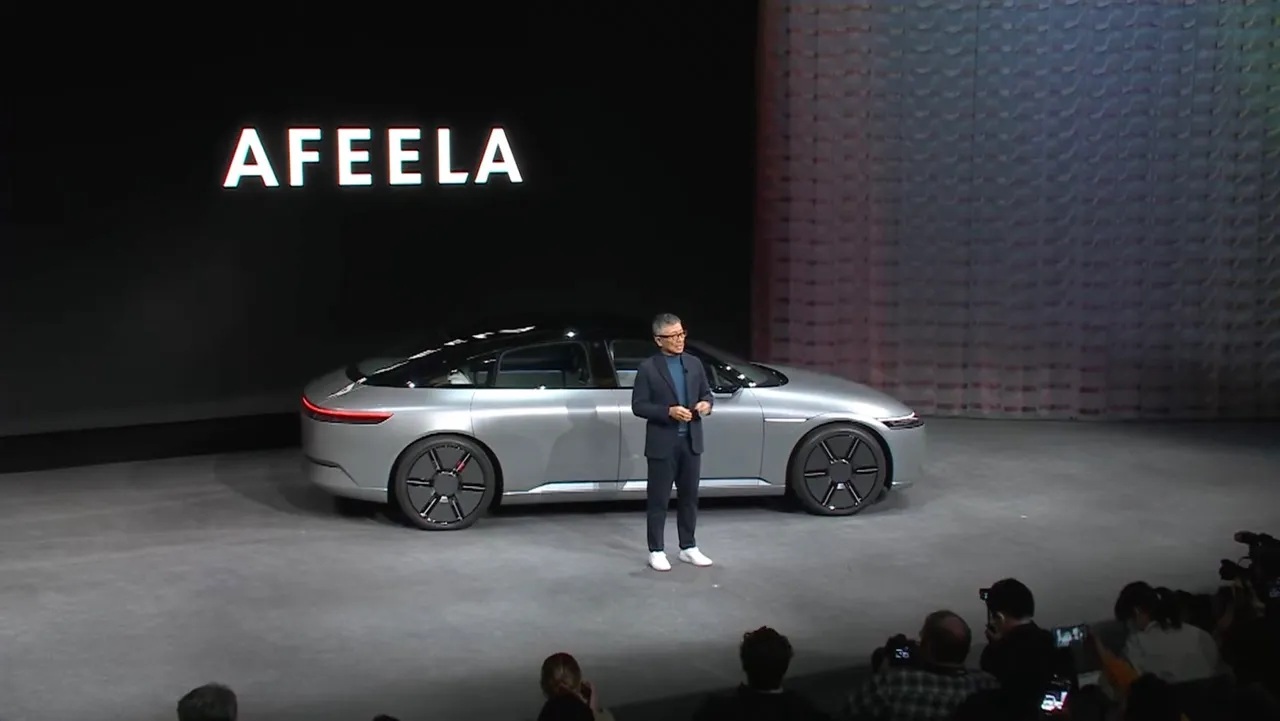
Sony Honda Mobility stepped onto the CES stage in Las Vegas with a message that cut against the prevailing mood in the U.S. auto industry: it is still pressing ahead with electric vehicles, even as many rivals retreat.
The electric vehicle joint venture between Sony Group and Honda Motor unveiled its latest prototype at the Consumer Electronics Show on Monday, reaffirming plans to bring its first production model, the Afeela 1, to U.S. customers. Chief executive Yasuhide Mizuno said deliveries in California are expected to begin late this year, with a broader U.S. rollout of a model based on the Afeela prototype targeted as early as 2028.
The appearance was striking in a year when CES featured fewer splashy automotive debuts. Several U.S. and global automakers have scaled back EV ambitions, delayed new launches, or paused production altogether, citing weakening demand, rising costs, and policy uncertainty. Against that backdrop, Sony Honda’s presence underscored a longer-term bet that the EV market, while cooling in the near term, will eventually reward companies that can differentiate through software and user experience.
Register for Tekedia Mini-MBA edition 20 (June 8 – Sept 5, 2026).
Register for Tekedia AI in Business Masterclass.
Join Tekedia Capital Syndicate and co-invest in great global startups.
Register for Tekedia AI Lab.
The Afeela 1, priced from $89,900, positions the venture firmly in the premium segment. That pricing reflects both its technology-heavy pitch and the reality that mass-market EV adoption in the United States has proven more difficult than many automakers expected. Consumers have grown wary of high sticker prices, charging infrastructure gaps, and concerns about resale values, challenges that have become more visible as incentives have been reduced.
Policy changes under the Trump administration have added to the pressure. The rollback of EV-friendly measures, including the removal of a $7,500 federal tax credit, has made electric vehicles less attractive to price-sensitive buyers. Automakers say the shift has slowed showroom traffic and forced a reassessment of production volumes, especially for models aimed at the middle of the market.
Tariffs on imported vehicles and auto parts have further complicated the picture, raising costs at a time when companies are already struggling to protect margins. As a result, CES 2026 unfolded with a noticeably more cautious tone from carmakers, many of whom opted to focus on incremental technology updates rather than full vehicle launches.

Sony Honda Mobility’s strategy appears deliberately insulated from some of those pressures. Formed in 2022, the joint venture was built on a clear division of strengths: Honda contributes decades of experience in vehicle engineering, manufacturing, and safety, while Sony brings software, sensor technology, entertainment, and gaming ecosystems. The companies have repeatedly framed Afeela not simply as an electric car, but as a software-defined platform designed to evolve over time.
At CES, that positioning was again front and center. The Afeela concept emphasizes advanced driver-assistance systems, immersive in-car entertainment, and deep integration with digital services. Sony has previously highlighted the use of imaging and sensing technologies derived from its consumer electronics and gaming businesses, as well as the potential for over-the-air updates to continuously add features.
That focus reflects a broader shift in the auto industry, where software is increasingly seen as a key battleground. Traditional automakers are racing to build in-house software capabilities or partner with technology firms, while newer entrants argue that the vehicle is becoming another connected device. Sony Honda is attempting to bridge those worlds, betting that consumers are willing to pay a premium for a seamless digital experience as much as horsepower or range.

Still, the road ahead is far from smooth as entering the U.S. market at the luxury end puts Afeela in direct competition with established EV brands and legacy automakers that already have scale, charging partnerships, and brand loyalty. Delivering on promises around software reliability, autonomous features, and user experience will be critical, particularly as consumers grow more skeptical of grand claims following years of delays and missed targets across the industry.
Timing also remains a risk. While Sony Honda expects initial deliveries in California later this year, its broader ambition to roll out a production model by 2028 means navigating several years of uncertain demand, evolving regulations, and rapid technological change. Battery costs, charging standards, and consumer expectations could all shift significantly before then.
Even so, the decision to press ahead sends a signal. At a moment when many automakers are pulling back to reassess, Sony Honda Mobility is choosing visibility and momentum. Its CES unveiling suggests confidence that the current slowdown is cyclical rather than structural, and that a carefully positioned, technology-led EV can still find an audience in the United States.
Some analysts believe the bet paying off will depend not just on policy or market conditions, but on execution. But currently, the Afeela stands as one of the few new EV programs still moving forward at a time when the industry is hitting the brakes.