

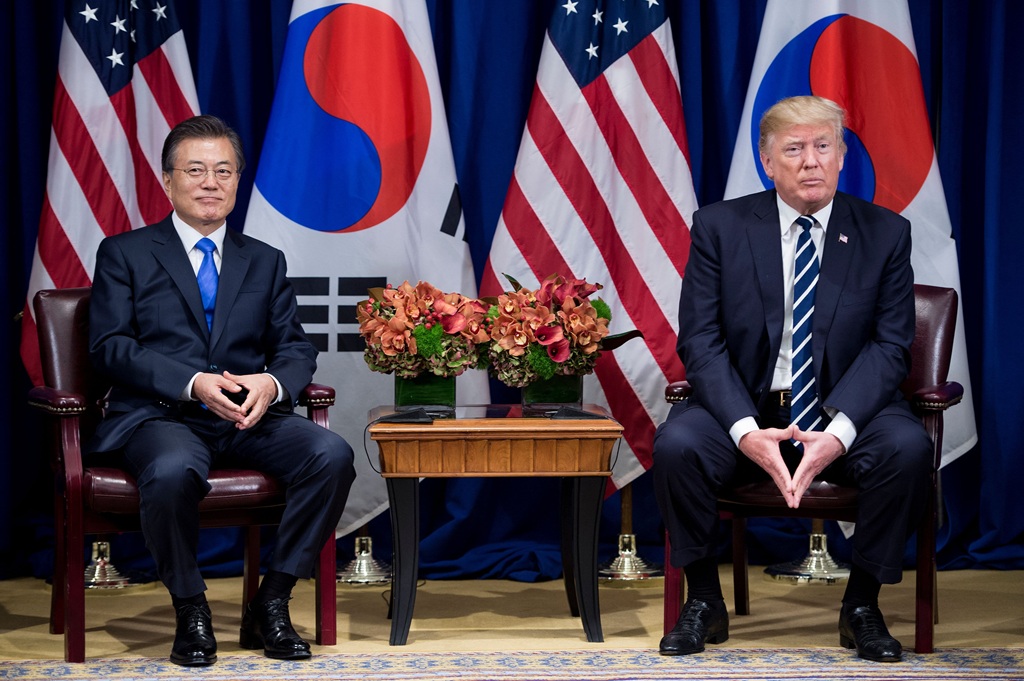
South Korea announced a broad slate of investment plans spanning shipbuilding, nuclear energy, aerospace, energy, and critical minerals during a summit on Monday between U.S. President Donald Trump and South Korean President Lee Jae Myung in Washington, D.C.
The country’s business lobby group said South Korean companies would channel $150 billion into U.S. projects, marking one of the largest commitments by a foreign partner under Trump’s administration. The plans, which encompass both new and previously announced projects, span sectors such as artificial intelligence, semiconductor chips, biotechnology, shipbuilding, and nuclear power.
The investment push, however, comes against the backdrop of ongoing trade friction. Trump said during the summit that a 15% tariff on imports from South Korea will remain in place, despite Lee’s high-profile visit to Washington. In July, the two countries struck a trade deal that allowed Seoul to avoid a more punishing 25% tariff, but tensions over the agreement have persisted.
Register for Tekedia Mini-MBA edition 20 (June 8 – Sept 5, 2026).
Register for Tekedia AI in Business Masterclass.
Join Tekedia Capital Syndicate and co-invest in great global startups.
Register for Tekedia AI Lab.
The new investment drive represents South Korea’s attempt to ameliorate the pressure of Trump’s tariffs while reinforcing its role as a leading investor in the U.S.
$150 Billion Investment Plans
According to officials, the $150 billion commitment is equivalent to about six times South Korea’s U.S. foreign direct investment in 2024 if fully delivered. Presidential adviser Kim Yong-beom noted that the pledge includes previously announced projects such as Samsung Electronics’ new chip factory in Texas, Hyundai Motor’s car plant in Georgia, and Hanwha’s expansion of its U.S. shipyard.
Aerospace: One of the largest single announcements came from Korean Air, which confirmed the purchase of 103 Boeing aircraft worth $36.2 billion, alongside a $13.7 billion deal with GE Aerospace for engines and maintenance services. The deal marks the airline’s largest contract in its history, separate from an earlier order this year for up to 50 Boeing jets and GE engines.

Hyundai Motor Group announced it would raise its U.S. investment plan to $26 billion, up from $21 billion, covering 2025 to 2028. The new plan includes building a steel mill in Louisiana, expanding Hyundai and Kia’s U.S. auto production capacity, and creating a robotics hub with an annual output of 30,000 units.
Shipbuilding: Trump highlighted shipbuilding as a key area of cooperation, pledging that the U.S. would buy ships from South Korea while also working with Seoul to revive America’s domestic shipbuilding industry.
HD Hyundai, together with Korea Development Bank, signed an MOU with U.S. investment firm Cerberus Capital to create a multibillion-dollar joint fund aimed at boosting U.S. maritime capacity, including shipbuilding. Meanwhile, Samsung Heavy Industries and Vigor Marine Group struck a preliminary deal covering maintenance of U.S. Navy support ships, shipyard modernization, and joint vessel construction.

LNG: On the energy front, state-run Korea Gas Corp reached long-term agreements with Trafigura and others to import 3.3 million tonnes of liquefied natural gas (LNG) annually for 10 years starting in 2028, largely supplied by U.S. exporters such as Cheniere.
Nuclear Energy: South Korea’s Korea Hydro & Nuclear Power (KHNP) and Doosan Enerbility signed agreements with U.S. partners X-energy and Amazon Web Services to cooperate on small modular reactor (SMR) design, construction, and supply chains.
Doosan also struck a deal with Fermi America to supply nuclear and SMR equipment for a Texas-based AI project, while KHNP and Samsung C&T signed a separate MOU with Fermi on construction. Additionally, KHNP agreed with Centrus on a joint investment in a U.S. uranium enrichment facility.
Critical Minerals: Korea Zinc agreed with Lockheed Martin to supply germanium from 2028 under a long-term contract and expand cooperation in rare metals critical to defense and aerospace supply chains.
$350 Billion Investment Fund
Alongside the $150 billion corporate pledge, the two governments also moved forward on a broader financing initiative. As part of the July trade deal, South Korea had committed to pursuing $350 billion in investment funds to help blunt U.S. tariff pressure. On Monday, Seoul and Washington agreed to a non-binding deal to structure and steer this fund.
According to Kim, the “financial package” would be directed toward strategic industries, including key minerals, batteries, chips, pharmaceutical products, artificial intelligence, and quantum computing.