

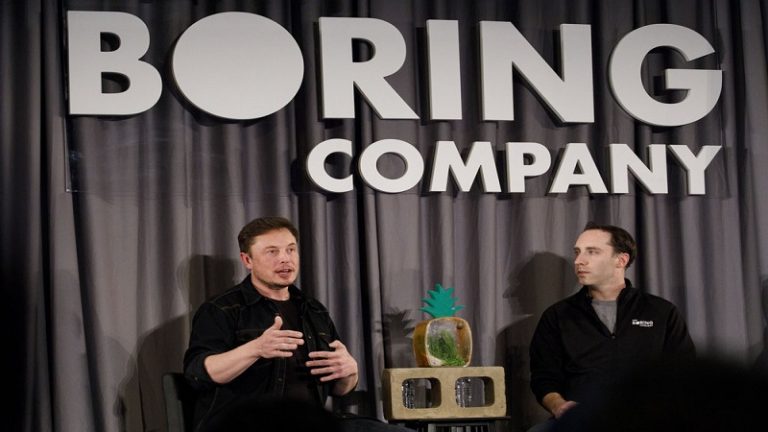
SpaceX recorded a $561 million investment gain from its stake in Elon Musk’s tunneling company, The Boring Co., during the third quarter, underpinning the growing financial links between businesses controlled by the billionaire entrepreneur.
The gain accounted for more than half of SpaceX’s “other income” during the period and helped lift its net income to just over $4 billion, according to the company’s quarterly filing with the US Securities and Exchange Commission.
The disclosure comes as The Boring Co. attracts fresh capital at a valuation of $23 billion, while SpaceX and Tesla are separately considering a potential merger. SpaceX also reported purchasing $151 million worth of Tesla’s Megapack energy storage systems during the quarter, adding another layer to the commercial relationships among Musk’s companies.
Register for the next Tekedia Mini-MBA.
Register for Tekedia AI in Business Masterclass.
Join Tekedia Capital Syndicate and co-invest in great global startups.
Together, the transactions show that investments, equipment purchases and potential corporate combinations are linking businesses operating across space transportation, electric vehicles, energy storage and underground infrastructure.
The Boring Co. was created within SpaceX in 2017 before becoming an independent company a year later. Its stated mission is to transform transportation through underground tunnels and stations that allow passengers to board and exit vehicles.
Last month, the company raised $3 billion at a $23 billion valuation, attracting backing from the United Arab Emirates and a group of investors who have supported Musk’s other ventures.
That valuation provides important context for SpaceX’s reported investment gain. As the value assigned to a privately held company rises, investors holding stakes in it may recognize gains in their financial statements, depending on the accounting treatment applied. Such gains can increase reported income without generating equivalent cash proceeds from operating activities.
SpaceX’s filing did not, in the information provided, establish that the $561 million gain represented cash received from The Boring Co. Rather, it was an investment gain that contributed to SpaceX’s reported earnings.
That matters when assessing the quality and sustainability of earnings. SpaceX’s net income of just over $4 billion included a substantial contribution from the appreciation of an investment in another Musk-controlled business. Investment gains can be financially significant, but they do not necessarily recur at the same level in subsequent quarters.
The Boring Co.’s $23 billion valuation also depends on investors’ expectations for a business whose commercial footprint remains limited relative to its announced ambitions.
The company has publicized roughly a dozen city projects, but its only tunnels currently open for public use are in Las Vegas. There, passengers travel in Tesla vehicles through the Las Vegas Convention Center Loop, connecting the convention center with various casino resorts.
The gap between its project pipeline and operating infrastructure remains central to evaluating whether its valuation can be supported by future commercial activity. Announced projects and fundraising commitments indicate investor interest, but they do not by themselves demonstrate that the company can deliver extensive tunnel networks profitably or on schedule.
Nashville and Dubai Projects Face Execution Challenges
The Boring Co.’s expansion plans extend beyond Las Vegas, including projects in Nashville, Tennessee, and the United Arab Emirates.
In July last year, the company reached an agreement to build approximately 20 miles of tunnels in Nashville. The proposed Music City Loop is designed to transport paying passengers between downtown and the airport in Tesla vehicles.
The project was fast-tracked through a process that triggered a partisan dispute and has since attracted renewed scrutiny over safety. Sinkhole risks emerged as a concern this week, putting attention on the engineering and oversight challenges associated with underground transport infrastructure.
Those issues could affect the pace of construction, regulatory approvals and public acceptance. A project’s commercial viability depends not only on securing political backing and financing, but also on managing construction risks, demonstrating safety and attracting enough passengers to justify the cost of the infrastructure.
In the UAE, The Boring Co. plans to build more than 150 kilometers, or 93 miles, of tunnels. The programme includes the Dubai Loop, announced in February last year, and represents a substantially larger proposed network than the company’s existing public operations.
Delivering projects at that scale would require the company to translate its tunneling concept into repeatable construction and operating capabilities across multiple locations.
For investors, the contrast between a $23 billion valuation and a relatively small operating base raises questions about how much future growth is already reflected in the company’s price. The valuation suggests significant expectations, although the available disclosures do not provide enough detail to determine how those expectations are distributed across individual projects.
Tesla Purchases and Merger Talks Add to Interconnected Corporate Structure
SpaceX also disclosed that it purchased $151 million worth of Tesla Megapack energy storage systems during the third quarter. The transaction adds to the financial connections between the two companies, which operate in different sectors but share Musk as their chief executive.
Megapacks are designed for large-scale energy storage. SpaceX’s purchase demonstrates a commercial relationship between the companies, although the disclosed amount alone does not establish the equipment’s intended applications or its contribution to either company’s future earnings.
The purchase comes as Musk has publicly entertained a possible merger between SpaceX and Tesla. During SpaceX’s earnings call on Tuesday, he described a combination as a “good idea” and said both companies had established special committees to discuss a potential transaction.
The creation of special committees indicates that the possibility is being examined, but it does not establish that a merger has been agreed or that one will proceed. Any combination would raise questions about valuation, financing, governance, and the interests of shareholders in each business.
A merger would also bring companies with distinct operations and capital requirements under one corporate structure. SpaceX’s launch and space-related activities differ substantially from Tesla’s vehicle manufacturing and energy businesses. Combining them could create new commercial opportunities, but it would also require investors to assess how resources and management attention would be allocated across the enlarged group.
The Boring Co. investment gain adds another dimension to that discussion. SpaceX’s reported earnings benefited from the rising value of a Musk-linked private company, while its purchases from Tesla and the prospect of a merger demonstrate the extent of transactions among businesses within Musk’s wider corporate network.
Such relationships are not inherently unusual for companies with shared investors or commercial interests. However, they make clear disclosure and independent oversight important, particularly when valuations are based partly on private-market assessments and when transactions involve companies controlled by the same individual.