

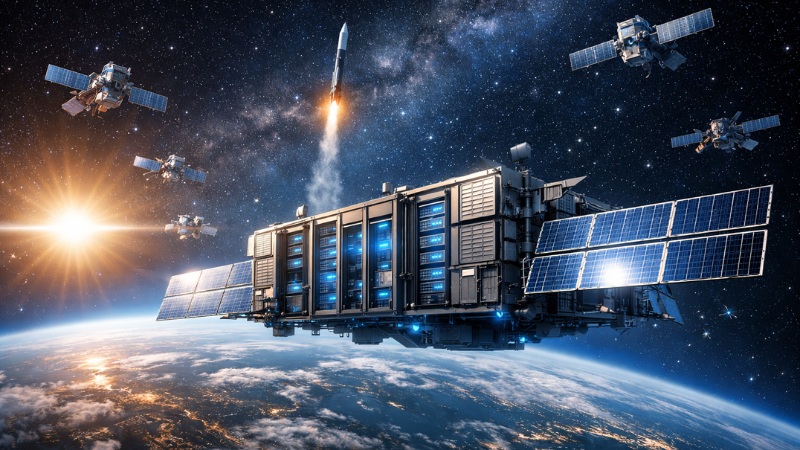
SpaceX is pushing aggressively into space-based artificial intelligence infrastructure, with executives telling investors the company aims to launch initial demonstration missions of orbital computing systems by late 2027 — ahead of the “as early as 2028” timeline outlined in its IPO filing.
The orbital-compute initiative sits at the heart of SpaceX’s long-term growth narrative as it prepares for what could be the largest public offering in history. In presentations to investors ahead of the IPO, President Gwynne Shotwell and CFO Bret Johnsen described early deployments as technology demonstrators designed to validate the concept before any larger-scale commercial rollout, according to two people familiar with the meetings.
According to sources cited by Reuters, SpaceX has requested regulatory approval to launch up to 1 million space-based data-center satellites, a scale that would dwarf its current Starlink constellation and position the company as a potential leader in off-world computing. While the IPO filing highlighted 2028 as a possible start for deployments, the updated internal timeline shared with investors suggests growing confidence in execution, though it still leaves room for Starship-related delays.
Register for the next Tekedia Mini-MBA.
Register for Tekedia AI in Business Masterclass.
Join Tekedia Capital Syndicate and co-invest in great global startups.
One attendee interpreted the more conservative public timeline as providing management flexibility amid the technical complexities of reusable heavy-lift vehicles and satellite manufacturing at unprecedented scale.
SpaceX is scheduled to begin trading on the Nasdaq on Friday under the ticker SPCX, with shares targeted at $135 each for a $1.75 trillion valuation.
Musk’s Vision: Overcoming Earth’s Compute and Energy Limits
The push into orbital AI data centers aligns with Elon Musk’s broader philosophy that humanity must expand beyond Earth to solve some of its most pressing constraints. In IPO materials and recent comments, SpaceX argues it is “the only company with a commercially viable path to building orbital AI compute at scale.” The company claims this could unlock a potential $23 trillion market opportunity by addressing limitations in terrestrial electricity generation and computing capacity, particularly as the U.S. lags behind China in scaling large infrastructure projects.

In a video released Monday, Musk emphasized that building orbital data centers is not an insurmountable engineering challenge, noting that much of the required technology already exists within the Starlink network. The first version of these AI satellites is expected to use Nvidia chips, with computing power equivalent to an Nvidia GB300 rack.
This strategy represents a logical evolution for SpaceX. Starlink has already proven the viability of large-scale satellite constellations for global connectivity. Extending that expertise into high-performance computing in orbit could solve critical bottlenecks: access to abundant solar power in space, reduced latency for certain applications, and relief from Earth-based energy and land constraints.
Starship as the Critical Enabler — and Risk
The entire vision hinges on Starship, SpaceX’s fully reusable heavy-lift rocket. While Starship has achieved several successful test flights, it remains years behind Musk’s original timelines and has yet to demonstrate the rapid reusability and high launch cadence needed for economic viability at the scale required for massive orbital data centers.

Michael Monaghan, partner and portfolio manager at Founder ETFs, noted that while many of Musk’s projects involve open-ended challenges, orbital data centers have clearer technical boundaries.
“I think that orbital data centers, while a difficult problem, have some bounds on it, which to me gives greater confidence that the timelines laid out will be hit,” he said.
Still, any meaningful delays in Starship development could push back the orbital compute roadmap, a risk implicitly acknowledged by the more conservative public timeline in the IPO filing.
The orbital AI pitch is central to justifying SpaceX’s ambitious valuation. With Starlink as the current cash cow, the company is asking investors to underwrite a future where space infrastructure becomes foundational to global AI capabilities. This narrative has clearly resonated, with the IPO drawing roughly $150 billion in demand — double the $75 billion targeted.
The all-primary offering structure, significant retail allocation (up to 30%), and Musk’s 366-day lock-up further signal confidence. Proceeds will fund the expansion of both Starlink and AI-related infrastructure.
Growing Investors’ Interest
Investors are increasingly showing faith that SpaceX’s move into orbital computing could reshape the AI infrastructure landscape. By bypassing terrestrial constraints, the company aims to offer massive, scalable compute capacity with potentially lower marginal energy costs. This positions it uniquely against traditional hyperscalers facing power shortages, regulatory hurdles, and land constraints on Earth.
Besides challenges ranging from regulatory approval for such a large constellation, technical reliability in the harsh space environment, latency for certain applications, and competition from other players exploring space-based solutions, SpaceX appears good to go.
The strong demand for the IPO suggests many are willing to look well beyond near-term profitability and toward a future where orbital assets become critical infrastructure for the AI economy.