

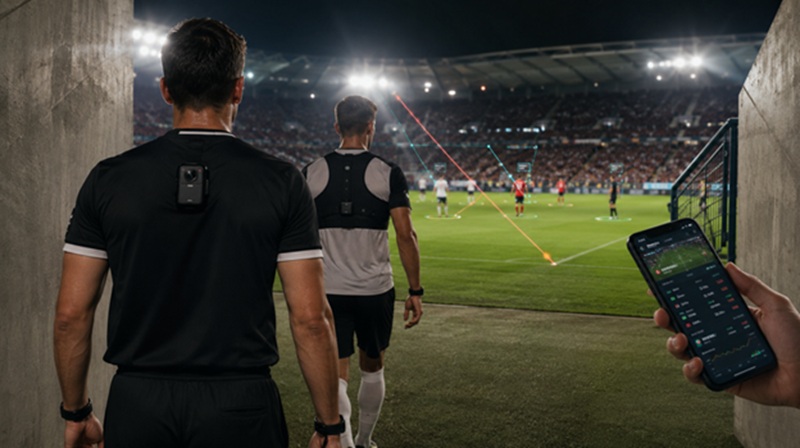
Sport is now argued frame by frame. A tight offside at Qatar 2022, a player-tracking possession in a WNBA arena, and a referee body-cam angle at the 2025 FIFA Club World Cup all sit inside the same dispute: which evidence should fans trust? The 2026 World Cup schedule has stretched the sport across 104 matches and 16 host cities. The screen no longer waits for halftime.
Offside Lines Became a Data Problem
FIFA’s semi-automated offside system uses 12 tracking cameras under the stadium roof to follow the ball and up to 29 data points on each player, 50 times per second. The connected match ball used at Qatar 2022 added an inertial sensor that sent ball data to the video operation room 500 times per second, helping officials identify the kick point. That still leaves human validation: VAR officials check the proposed line and touch point before the referee receives the decision. The gain is repeatability, especially when a striker’s knee or shoulder decides whether a goal survives.
The Referee’s View Has Entered the Feed
The IFAB approved an extension of referee body-camera trials at the professional level on July 30, 2025, after tests at the FIFA Club World Cup. The footage gives broadcasters a view from the referee’s running lane, which is different from the high tactical camera that fans usually see. A shoulder charge near the touchline can look cleaner or rougher depending on bodies blocking the angle. The camera adds context, not innocence.
Mobile Sport Has Merged Odds, Clips, and Live Data
For many fans, the phone is now where the game happens: whether it’s a Champions League night, a UFC card, or a World Cup match watched on a train, in a bar, or during a late shift. Live betting markets shift quickly with red cards, substitutions, corner pressure, takedown attempts, and injury stoppages often faster than studio analysts can react. MelBet apk sits alongside live scores and team news as a tool for adults already keeping an eye on line movement and bankroll exposure. The basics still matter most: KYC checks, stake limits, suspended markets, and tracking how odds move.
Tracking Cameras Are Rewriting Scouting Reports
The WNBA announced in March 2024 that Genius Sports’ Second Spectrum system would bring league-wide 3D tracking data to every WNBA arena from the start of that regular season. The system collects player pose and ball-tracking data, giving teams information on shot quality, paint touches, contest quality, maximum speed, and distance covered. That changes coaching language. A missed closeout can be measured by distance, angle, and timing rather than reduced to a vague bench complaint after the possession.
Athletics Is Testing the Shape of Events
World Athletics tied its research and development work to the Pioneering Change 2024-2027 strategy after launching an R&D unit at the 2023 World Championships in Budapest. The governing body has tested ideas around competition flow, predictive modeling, instant measurement, viewer behavior, and discipline formats. Its long-jump take-off zone work is still best treated as experimentation, not a settled rulebook rewrite. In field events, speed matters because waiting for measurements can drain tension from a stadium session before the next athlete even starts the run-up.
Apps Turn Access Into a Product Decision
Sports platforms now compete on how quickly a user can move from the fixture list to a live market, account screen, or cash-out status during a 90-minute match. That speed matters when a football game shifts after a 62nd-minute red card or a UFC bout turns after one clean calf kick in Round 1. Downloading the MelBet (French: telecharger MelBet) is part of that access equation, since the app can cut down the steps between registration, verification, pre-match odds, and in-play markets. It’s not just about download speed, though; users should also look at licensing details, payment options, account limits, and how clearly the market rules are explained before placing a bet.
The Machine Still Needs a Judge
Technology has made sport more accountable, but it hasn’t smoothed everything out. Semi-automated offside can catch the slightest lean, yet it still struggles with messy moments in a packed penalty area. A body camera might show the referee’s angle, but it won’t hush the roar. What comes next will likely be tools that sharpen decisions while still leaving room for the human call.