

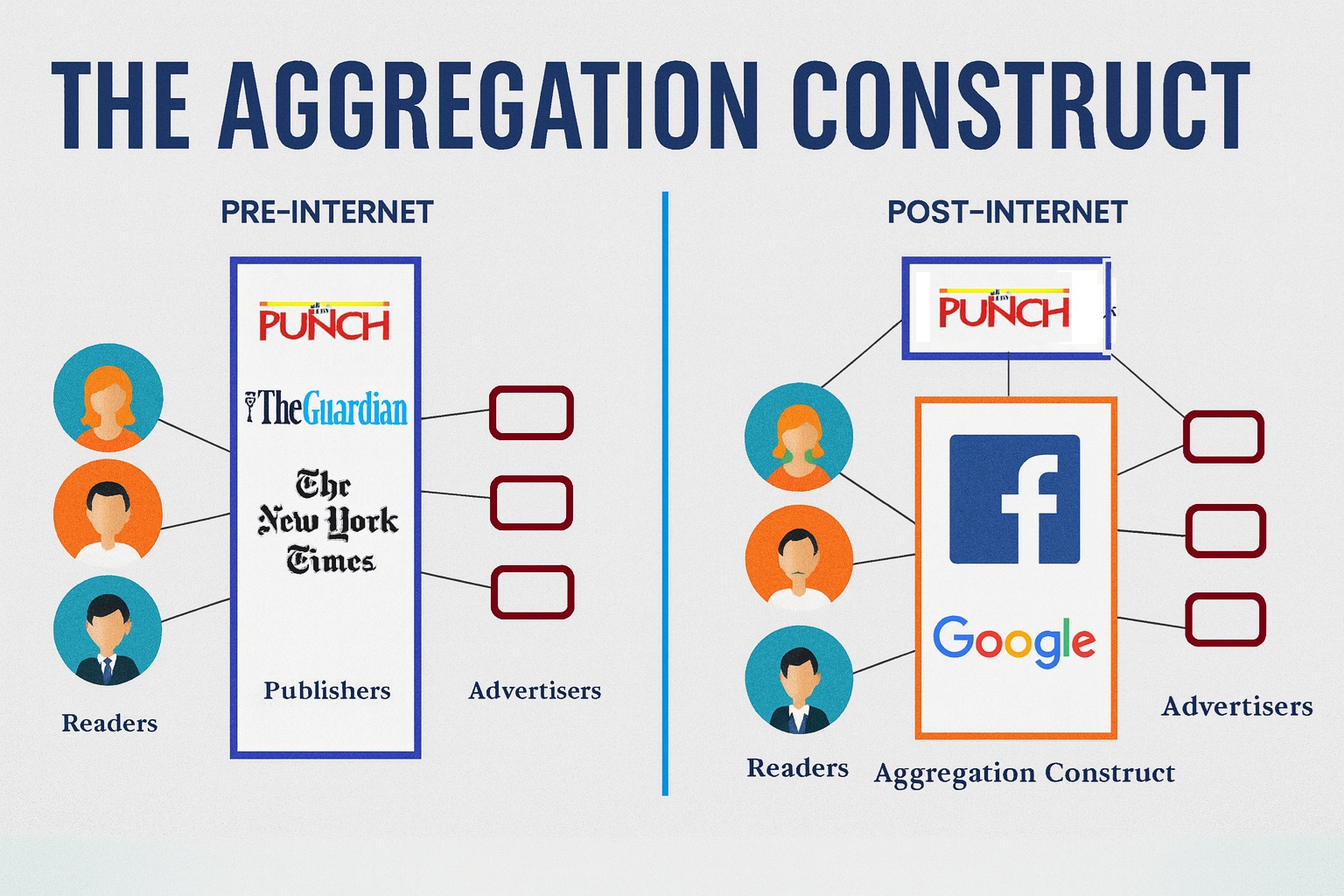
In the architecture of modern commerce, a silent redesign is taking place, one that shifts power away from producers and hands it to digital platforms. I have called this redesign the Aggregation Construct, a foundational pillar for understanding how value is created, migrated, and captured in the digital economy.
Before the Internet, the market equation was straightforward: those who produced controlled distribution, pricing power, and customer relationships. For example, newspapers wrote stories and sold them directly to readers. In this world, producers sat at the center of value creation.
But the arrival of the Internet collapsed the distance between producers and consumers. It democratized access, opened distribution, and introduced abundance. Yes, an abundance of information, options, and channels. Yet, instead of empowering producers, this abundance created a new scarcity: attention. And the companies that mastered attention became the new landlords of commerce.
Register for Tekedia Mini-MBA edition 20 (June 8 – Sept 5, 2026).
Register for Tekedia AI in Business Masterclass.
Join Tekedia Capital Syndicate and co-invest in great global startups.
Register for Tekedia AI Lab.
This is where aggregation emerges. In the post-Internet era, entities like Google, Facebook, Airbnb, and Uber have become aggregators, platforms that do not necessarily produce the core product but aggregate users, data, and demand in such high concentration that they become the new centers of gravity in their industries.
Google does not write the news, yet it distributes more journalism than any newspaper in Nigeria. Netflix does not produce most of its films, yet it dominates viewership. Uber owns no vehicles, yet it commands mobility ecosystems across continents. In each of these cases, the aggregator captures the value while the producer bears the cost.
Here are four forces that make aggregation inevitable:
First is demand accumulation. Aggregators gather immense user bases, creating digital plazas where everyone converges. Where people converge, money follows.

Second is frictionless distribution. Aggregators eliminate the need for users to visit multiple websites, stores, or platforms. A single interface delivers the entire world’s options, reducing search and matching costs dramatically.
Third is data advantage. Every click, view, and transaction enriches the aggregator with data, data that becomes the fuel for personalization, prediction, and market dominance. This data flywheel compounds advantage in a way traditional producers cannot replicate.
Fourth is disintermediation. Once distribution is captured by a platform, producers lose their direct connection to customers. And once that connection is lost, pricing power and strategic leverage evaporate. The producer becomes a dependent participant in an ecosystem controlled by the aggregator.

My central thesis is clear: in the digital economy, the entity that controls demand, not supply, wins. This is the inversion of the industrial age, where scarce supply conferred power. Today, abundant supply and distributed access mean that the scarce asset is attention, and the companies that capture and organize attention become the new monopolies.
The consequences of this shift are profound. Producers must rethink their business models. Content creators, retailers, manufacturers, banks, and even governments must redesign how they deliver value in a world where distribution is no longer theirs. Nations must recognize that without indigenous aggregators, they risk economic dependence on foreign digital platforms. And industries must adopt platform thinking, moving from isolated production to ecosystem orchestration.
In summary, the Aggregation Construct explains the physics of modern markets. Aggregators, by mastering users, data, and convenience, reshape industries and capture outsized economic reward even when they do not produce the underlying product. It is one of the most important ideas in contemporary business strategy. In the digital era:
Whoever controls the user controls the value.
---
Connect via my
LinkedIn |
Facebook |
X |
TikTok |
Instagram |
YouTube
The next thing to be resolved in the Aggregation era is whether the platforms should be public led or private led. There can only be few aggregators per country or continent, so determining who should control what becomes consequential. Platforms that serve nations and continent are super expensive to build and maintain, and that is why who owns what matters.