

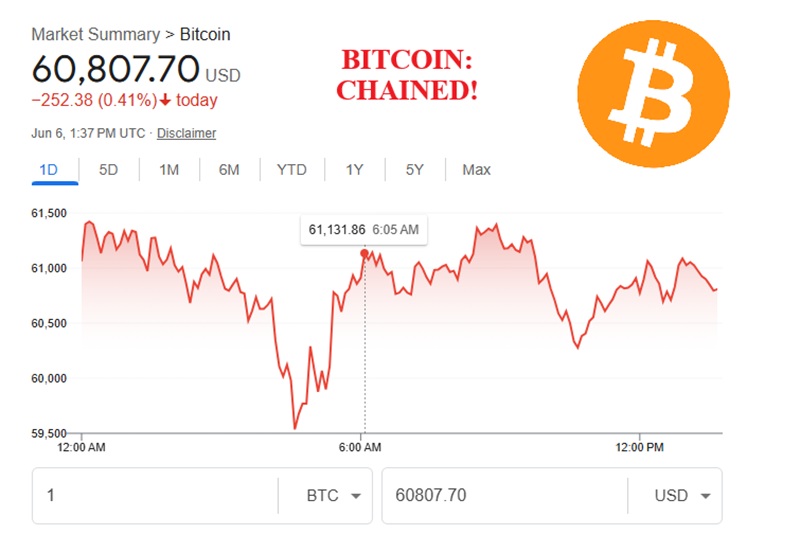
In the Igbo Nation, elders say that wisdom is like a bag: every person can hang his or her own wherever the hand can reach it. In other words, everyone is entitled to a perspective. So let me share mine on Bitcoin.
I am not a Bitcoin enthusiast, even though I admit that I wish I had joined the party much earlier. Yet one question continues to puzzle me: can Bitcoin truly be decoupled from the real-world financial system governed by central banks and governments?
To acquire Bitcoin, you typically need dollars, naira, euros, etc. Those currencies are issued, regulated, and managed by centralized institutions. The ease or difficulty of obtaining those currencies inevitably affects the ability of people to purchase Bitcoin. If interest rates rise, capital becomes more expensive. If liquidity tightens, speculative assets often feel the impact. Whether one likes it or not, the bridge into Bitcoin remains largely controlled by the traditional financial system. If US adds one million jobs next month, BTC may crash to $40k because the Fed will not cut interest rates!
Register for the next Tekedia Mini-MBA.
Register for Tekedia AI in Business Masterclass.
Join Tekedia Capital Syndicate and co-invest in great global startups.
Many argue that Bitcoin is decentralized. Technically, that is correct. The protocol itself is decentralized. But markets are not governed solely by protocols; they are governed by flows of capital. For the small investor purchasing US$100 worth of Bitcoin, decentralization may feel complete.
But the investors who move markets like funds, institutions, ETFs, family offices, and asset managers, typically operate through regulated exchanges, regulated custodians, regulated banking systems, and regulated investment vehicles. A fund managing hundreds of millions of dollars is not buying Bitcoin under a tree somewhere. It is interacting with the same financial architecture supervised by governments and regulators. That is why I struggle with the notion that Bitcoin exists entirely outside traditional finance.
Last year, I argued that Bitcoin reaching US$600,000 per coin, implying a market capitalization approaching US$12 trillion, would present an interesting challenge. My concern was not technological. It was economic. We have rarely seen a non-productive asset attain that level of valuation. At some point, the amount of traditional capital required to support such valuations becomes a legitimate question. This does not mean Bitcoin cannot hit $1M one day. Markets can surprise everyone.

Good People, I come in peace, not to challenge the HODL spirit, nor to discourage anyone from their convictions; I am only saying “shine your eyes”.
Comment on Feed
Comment: BlackRock held similar sentiments before the launch of the Bitcoin ETF
Today, they hold close to 1 million BTC, and they accumulated most of that position in less than a year

So, there is very little in your argument that Bitcoin skeptics haven’t said before.
That said, I do agree with one thing:
Bitcoin is not currently living up to the original vision of being independent of traditional banking
Most Bitcoin enthusiasts acknowledge this.
In fact, many of us no longer hold Bitcoin solely because it is a replacement for tradional banking
We hold it because:
- It has a fixed supply. Unlike fiat currencies that can be printed infinetly, Bitcoin’s supply is capped at 21 million coins. Basic economics suggests that when demand rises against a fixed supply, value tends to appreciate over time.
- It enables borderless value transfer. You can send millions of dollars across continents within minutes without needing approval from a bank, government, or intermediary. Today, we have stable coins like USDT thanks to Satoshi Nakamoto for inventing Bitcoin
- It is highly portable. Unlike gold, you don’t need vaults, trucks, or security escorts. You can carry substantial wealth with nothing more than a wallet and a seed phrase.
- It is increasingly being adopted as a store of value. Just as gold evolved from being primarily a medium of exchange to a store of wealth, Bitcoin appears to be following a similar path in this digital age.
- Institutional adoption is accelerating. What was once dismissed as a speculative experiment is now being accumulated by asset managers, corporations, and even governments. That shift matters.
Will Bitcoin succeed? Nobody knows with certainty
But the idea that Bitcoin has no value proposition because it hasn’t fully achieved its original purpose ignores how technologies often evolve beyond their initial use cases.
The internet wasn’t built for streaming movies. Yet here we are
My Response: “But the idea that Bitcoin has no value proposition” – I did not say that. It has value since you need REAL money to buy it!
---
Connect via my
LinkedIn |
Facebook |
X |
YouTube