

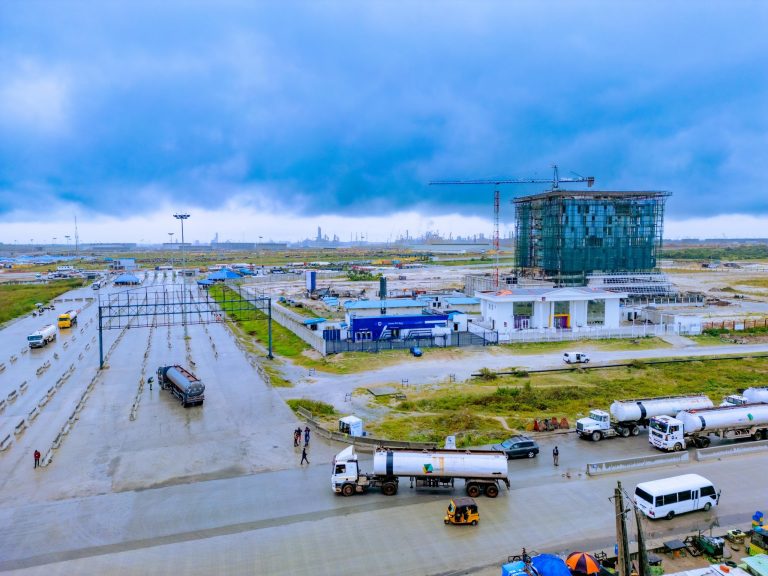
What began as a business decision aimed at cutting inefficiencies in Nigeria’s fuel supply chain has spiraled into a bitter confrontation between Dangote Refinery and two of the country’s most powerful unions. At stake is not just the smooth running of Africa’s biggest refinery but the stability of Nigeria’s oil supply, the welfare of millions of households, and even the country’s economic outlook.
The trigger came in mid-June when Dangote Refinery, still in the early months of rolling out operations, announced a bold new distribution strategy. On June 15, the company announced the purchase of 4,000 compressed natural gas (CNG)-powered tankers, a move it argued could slash transport inefficiencies and save Nigeria over N1.7 trillion annually. By June 29, the company introduced a nationwide petroleum distribution scheme built around the new fleet.
But what Dangote saw as modernization was interpreted as provocation by the unions. The Nigeria Union of Petroleum and Natural Gas Workers (NUPENG), whose members dominate tanker operations, accused the refinery of sidelining existing drivers by planning to recruit new operators barred from union membership. To NUPENG, this was a brazen violation of Section 40 of Nigeria’s Constitution, which guarantees freedom of association, as well as international labor conventions ratified by Nigeria.
Register for Tekedia Mini-MBA edition 20 (June 8 – Sept 5, 2026).
Register for Tekedia AI in Business Masterclass.
Join Tekedia Capital Syndicate and co-invest in great global startups.
Register for Tekedia AI Lab.
The Petroleum and Natural Gas Senior Staff Association of Nigeria (PENGASSAN) soon joined the fray. Its leaders alleged that Dangote was not just restructuring logistics but actively undermining workers’ welfare and threatening their means of livelihood. The unions declared that if Dangote pressed ahead, they would block supplies — crude, gas, and refined products — from reaching the refinery.
The tension escalated on September 25, after Dangote Refinery terminated the contracts of some workers, who joined the unions, citing “sabotage” and safety risks. In a sternly worded letter, the company insisted the decision was necessary to protect the refinery from internal threats that had “dire consequences on human life and operational efficiency.” The refinery stressed that only a small number of staff were affected and that more than 3,000 Nigerians remain employed in the facility.
But PENGASSAN quickly retaliated. On September 26, it issued a circular directing its members at TotalEnergies, Seplat, Chevron, Shell, Oando, and NGIC to halt crude and gas deliveries to the refinery. The union framed its action as a defense of workers’ rights, accusing Dangote of misinformation and propaganda.

“You are hereby directed to cut off gas supply to NGIC effective immediately. All crude oil supply valves to the Refinery should be shut. The loading operation for vessel headed there should be halted immediately. NGIC Chairman, ensure that gas supply to the Refinery is cut off effective immediately,” the circular issued by PENGASSAN read in part.
Dangote hit back hard, calling the order “lawless” and “criminal.” The company insisted PENGASSAN had no legal authority to disrupt contracts between the refinery and suppliers. It warned that halting fuel and gas flows would not only destabilize operations but also constitute “economic sabotage.”
“There is also no law in our statute books that would support or enable the PENGASSAN branches having to “cut off” gas and crude oil supplies to Dangote Refinery or at all,” the refinery said in a statement on Saturday.

A Familiar Battle
The unions’ position can be traced to a precedent in the not distant past. In 2007, NUPENG pressured then-President Umaru Musa Yar’Adua into reversing the sale of government-owned refineries to private investors, a move that many now see as a setback for Nigeria’s refining capacity. It is believed that this history is repeating itself, with unions once again attempting to strong-arm a private operator that has invested billions into what government-owned facilities repeatedly failed to deliver.
Energy economist Kelvin Emmanuel pointed out that Nigerian labor law lays out a clear dispute-resolution process: from ministerial mediation to arbitration and ultimately industrial court adjudication. None of these steps, he argued, were followed before the unions resorted to blocking trucks or directing crude cut-offs. In his words, “That’s the law. Now tell me, which of these processes did NUPENG follow before it took trucks to block the entrance and exit to the Dangote Refinery?”
The Economy At the Mercy of It All
Some analysts see this as not just a labor dispute but a test of whether Nigeria can create the kind of investment climate that attracts and sustains multibillion-dollar projects. Dangote’s $20 billion refinery is not just a private business; it is a national strategic asset. It has already begun to ease Nigeria’s dependence on imported refined products, stabilized foreign exchange pressures by reducing fuel import demand, and reassured investors that private capital can succeed where state-led refineries collapsed.
Against this backdrop, economists warn that disrupting Dangote Refinery amounts to economic sabotage.
“Dangote bought NNPC refineries. Local unions said no. Dangote left and built his own refinery. Now unions want to move into his refinery. If you can’t see danger from 100km, you can’t see danger from 1km,” financial analyst Kalu Aja argued.
“So that tomorrow, one guy wearing a facecap will say PENGASSAN will strike over another issue, and Aliko will shut down his $15b refinery. Will the union pay the $ loan? Not only the union, also demand that workers get 10% equity for free, abi (right)?” he added.
This faceoff, meanwhile, means different things for everyone. For the unions, the fight is about preserving influence in a sector where automation and modernization are threatening long-held privileges. For Dangote, it is about protecting a fragile investment from being held hostage. For Nigerians, it is about whether the pumps run dry, whether transport costs spike, and whether hard-won gains in foreign exchange stability evaporate.
However, while the refinery may not solve all of Nigeria’s oil sector problems, it has brought a measure of stability to fuel supply and the naira. Undermining it through prolonged labor hostilities would be self-defeating. As many economists agree, crippling Dangote Refinery’s operation in any form is not just a business quarrel — it is economic sabotage.