

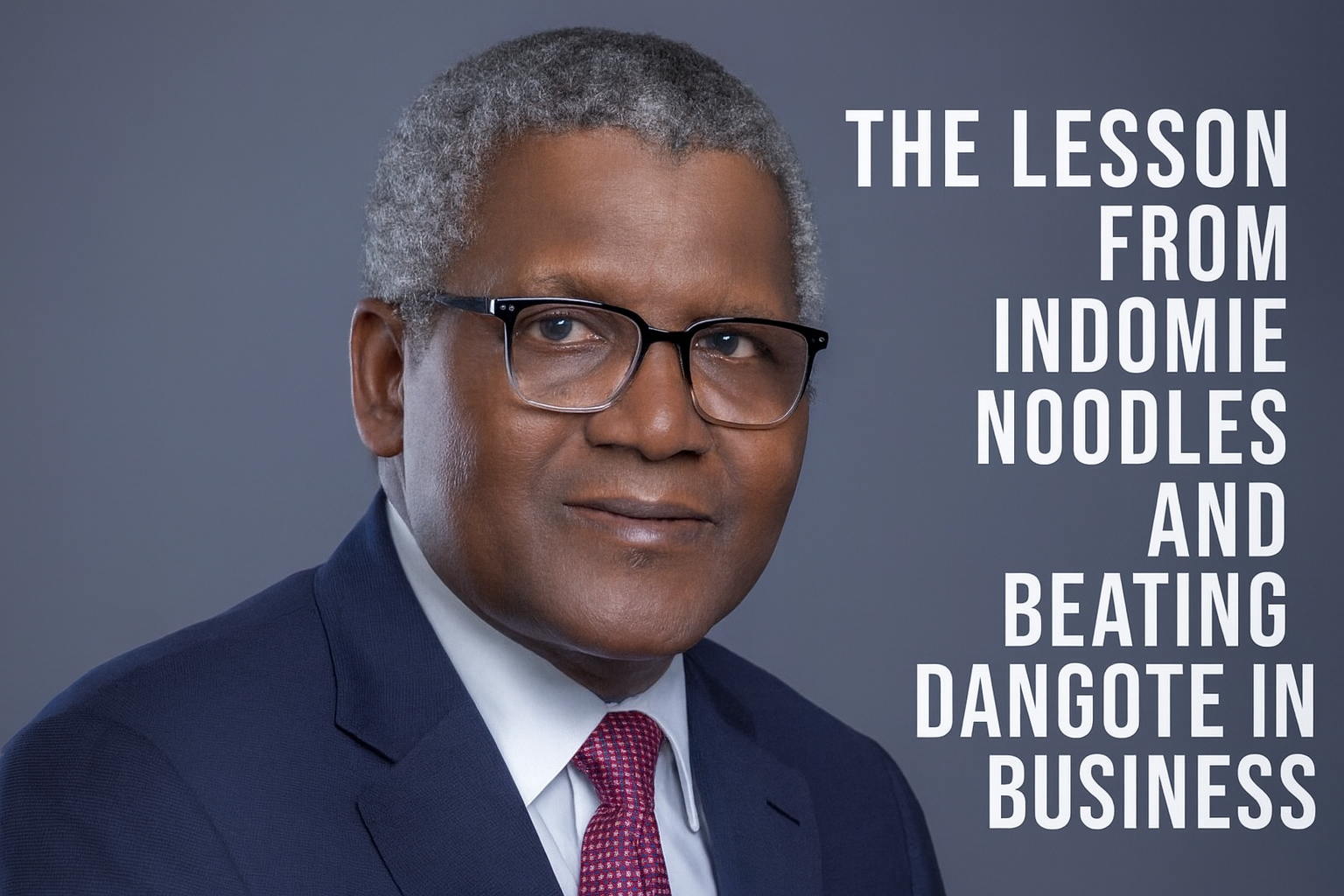
In the chronicles of African capitalism, Aliko Dangote sits at the apex — a man who built empires out of commodities, transformed industries through vertical integration, and defined what it means to accumulate capability as a moat. Across sugar, cement, and flour, he mastered the art of compounding competitive advantages not by slogans but through control of everything from power plants to trucks.
His group’s playbook is simple but formidable: own the upstream, dominate the midstream, and manage the downstream with relentless efficiency. That model has worked flawlessly — except once. And that “once” holds a timeless lesson for anyone who wants to compete with the Dangote Group.
When Dangote Group launched its noodles business, many assumed the battle was already over. The company’s tradition of vertical integration meant it could control costs, generate its own electricity, train its own workforce, and leverage its vast logistics network to deliver speed and quality unmatched by competitors. But Dufil Prima Foods — the makers of Indomie Noodles — had long built the same fortress in the same terrain. Unknown to many, Indomie had already mastered the Dangote playbook years earlier.
Register for Tekedia Mini-MBA edition 20 (June 8 – Sept 5, 2026).
Register for Tekedia AI in Business Masterclass.
Join Tekedia Capital Syndicate and co-invest in great global startups.
Register for Tekedia AI Lab.
Dufil’s strategy was an accumulation of capabilities, just like Dangote’s. The company invested heavily and owned the value chain. It wasn’t merely making noodles; it was engineering an ecosystem. So when Dangote entered the market, there was no inefficiency left to exploit, no gap to close, and no advantage to leverage. The master met his reflection — and this time, efficiency neutralized efficiency.
Magically, Dangote’s usual strength — superior quality at lower prices — could not find traction. Indomie was already efficient and beloved. The result was inevitable: Dangote Noodles could not gain the market share it desired, and in a remarkable twist of business irony, the subsidiary was eventually sold to Indomie’s parent company.
LESSON: The Dangote–Indomie case offers a profound business insight. You do not beat a master of accumulation by appealing to emotion or shallow marketing. You beat him by building equal or superior capability at the upstream — the foundation layer where efficiency, not advertisement, wins. To challenge a company like Dangote, your capital must be patient, your structure vertically integrated, and your leadership supremely excellent. There is no shortcut. Those who depend on distribution tricks or brand noise will perish when the real competitors control energy, logistics and production.

So, how do you beat Dangote? You rise to his level or higher. You do not play in the downstream when he controls the upstream. You don’t react; you re-engineer. Dufil did not fight with discounts or posters; it fought with systems, factories and control. That is the essence of modern competition — mastery, not just marketing. Dufil did, and for once, Dangote met his match.
---
Connect via my
LinkedIn |
Facebook |
X |
TikTok |
Instagram |
YouTube