

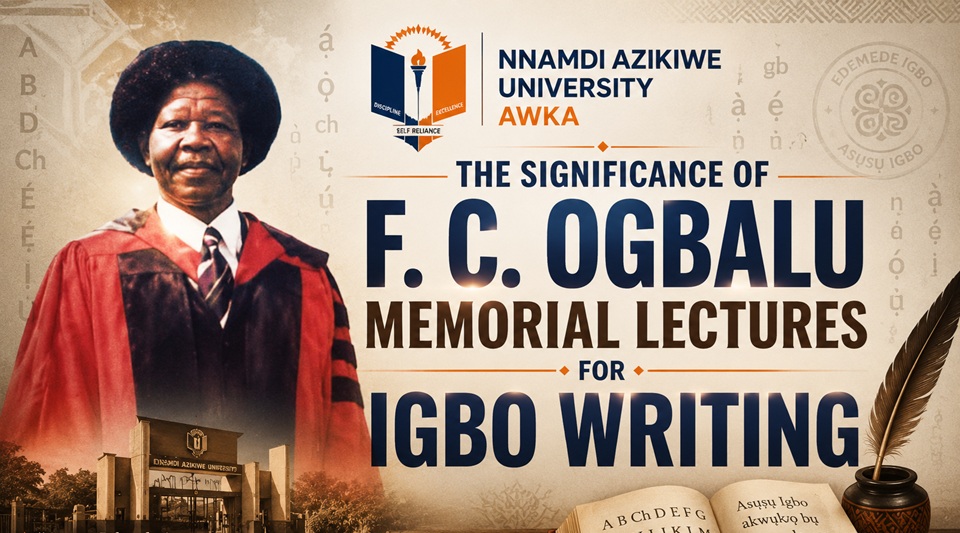
Let me commend Nnamdi Azikiwe University for honoring Dr. F. C. Ogbalu by hosting academic lectures in his memory. Few individuals have contributed as profoundly to the development and standardization of the Igbo language as Ogbalu. For many of us, his work shaped our understanding of Igbo long before we fully appreciated the magnitude of his contribution.
In senior secondary school, my Igbo teacher, Papa Iyke, shared his Master’s thesis with us as part of a class assignment. The thesis examined the evolution and development of Igbo writing (edemede Igbo). As I read through it, one name appeared repeatedly: F. C. Ogbalu. He was central to the efforts that culminated in the 1978 Igbo Convention and the subsequent modernization and standardization of written Igbo. My junior secondary school teacher, Mrs. Odumuko, had introduced some of the transitions taking place in the language, but it was Papa Iyke who helped us understand the intellectual debates and scholarly work behind the movement from older orthographic systems to the modern format we use today.
The work of those scholars was consequential. Through conferences, debates, publications, and painstaking scholarship, they simplified and harmonized the language, helping to establish Igbo Izugbe (Standard Igbo). The movement was not merely about grammar or spelling; it was about creating a common linguistic platform that could unite speakers across dialects while preserving the richness of the language.
Register for the next Tekedia Mini-MBA.
Register for Tekedia AI in Business Masterclass.
Join Tekedia Capital Syndicate and co-invest in great global startups.
Take the English expression, “The man is a fox.” In English, the fox symbolizes cunning, craftiness, and strategic intelligence. A literal translation into Igbo would describe the man as “nkita ohia” (fox). But that would miss the cultural meaning because, within Igbo folklore and worldview, the animal most closely associated with cunning and cleverness is not the fox but the tortoise (mbe). Accordingly, a culturally intelligent translation would render the expression as “Nwoke ahu bu mbe” (“The man is a tortoise”). The words change, but the meaning remains intact.
This was one of the significant contributions of the language reformers: they helped move Igbo translation beyond word-for-word conversion toward meaning-for-meaning communication, ensuring that the richness of both languages could be preserved while remaining faithful to their respective cultures.
Years later, when I arrived at Federal University of Technology Owerri (FUTO) to study engineering, I continued to observe how scholars and intellectuals shaped the future of Igbo through the Ahiajoku Lectures. Many distinguished thinkers contributed to the discourse, including the venerable Chinua Achebe. In some of his interventions, Achebe reflected on the relationship between his Ogidi dialect and the emerging Igbo Izugbe, while also proposing ways to strengthen the language. Through Okike, the literary journal he edited, Achebe continued that intellectual mission. I read every edition of Okike I could find, and truly pained that no one could sustain that publication!

As we honor F. C. Ogbalu, let me also remember another giant of Igbo literature: Tony Ubesie. In my view, Ubesie remains the greatest novelist to have written in the Igbo language. His works, particularly Isi Akwu Dara N’Ala and Ukwa Ruo Oge Ya O Daa, remain masterpieces of African literature. Tragically, he died young in a motor accident, but his literary legacy endures. Institutions such as the University of Nigeria, Nsukka should continue to celebrate and preserve the memory of this extraordinary writer.
When one reads Isi Akwu Dara N’Ala, one encounters a remarkable blend of romance, tragedy, ambition, conflict, and redemption. Through the lives of Chike and Ada, Ubesie chronicled human struggles and aspirations with unusual depth and elegance. After the devastation of war, opportunities reopened, and Chike found prosperity through what Ubesie metaphorically described as “Osisi Na Ami Ego”, a tree that produces money as leaves.
For organizing this lecture series, I thank Nnamdi Azikiwe University. We need more forums where scholars, writers, intellectuals, and non-political leaders can engage society and shape the minds of young people. The old Ahiajoku Lectures became intellectual landmarks not because politicians delivered them, but because thinkers did. Our universities must continue to create such spaces where ideas, culture, language, and civilization can be examined, preserved, and advanced for future generations.

---
Connect via my
LinkedIn |
Facebook |
X |
YouTube