

In 1776, Scottish philosopher and economist Adam Smith published his magnum opus, An Inquiry into the Nature and Causes of the Wealth of Nations. By a stroke of historical coincidence, the United States adopted its Declaration of Independence the same year, severing ties with the British Empire. Since then, America has eclipsed the former British Empire in nearly every facet of human endeavor. Figuratively speaking, the Americans were discipled by Dr. Smith; they embraced his vision of the free market, arguing that capitalism, more than any other economic structure, would best serve mankind. By laying this foundation at the dawn of the Industrial Revolution, Smith established the pillars of modern economics.
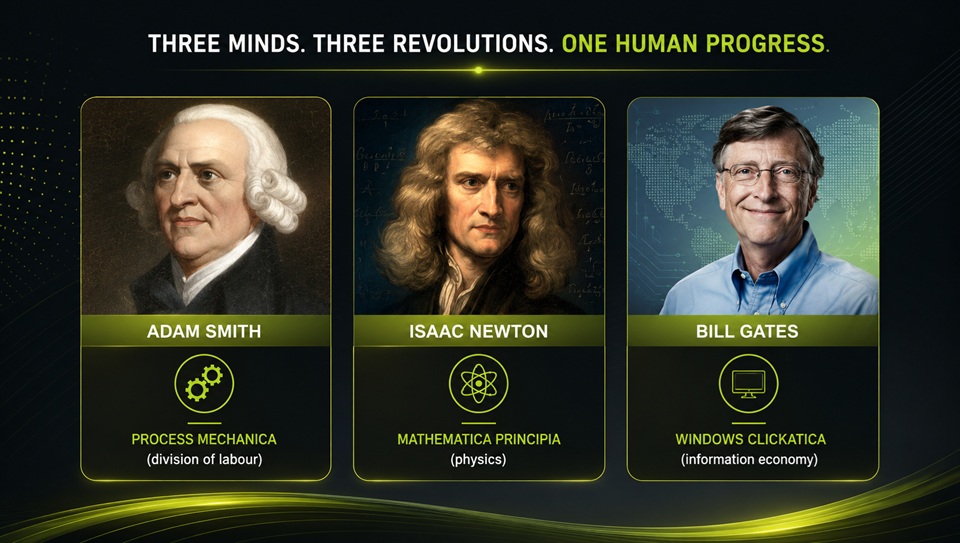
Smith’s advocacy for the “invisible hand” served as a warning against monopolies and excessive government interference, asserting that prudent resource allocation is impossible under state domination. To understand the necessity of his “free market” argument, one need only look at the colonial-era American farmer: he could grow cotton but was forbidden from processing it, forced instead to send raw material to England and import the finished product back at a premium. Smith’s thesis was clear, influential, and provided a structural foundation for economics comparable to Isaac Newton’s Principia Mathematica for physics, or in modern terms, Bill Gates’ Windows for the information economy.
Reading The Wealth of Nations today, one must admire the intellectual rigor Smith applied to an era before global technological penetration. He observed that nations once competed on par in agricultural productivity because subsistence farming lacked the division of labor. A farmer in Africa and a plantation worker in Alabama operated with similar inefficiency because they were generalists, performing every task on their own.
Register for the next Tekedia Mini-MBA.
Register for Tekedia AI in Business Masterclass.
Join Tekedia Capital Syndicate and co-invest in great global startups.
However, the Industrial Revolution changed everything. The British Empire became an engine of wealth creation through automation and the division of labor. While Smith noted that agricultural productivity remained relatively flat due to a lack of specialization, other industries thrived by organizing workers into specific roles – bricklayers, carpenters, and painters – thereby boosting output.
Fast-forward to the 21st century, and it is evident that technology has become the primary driver of structural change. It has introduced new business models like outsourcing, which is essentially a modern evolution of the division of labor. Today, wealth creation is inextricably linked to technology. Nations that prioritize the creation, diffusion, and penetration of technology consistently lead the global stage.
Largely, it is difficult to separate the health of a modern economy from its technological infrastructure; advanced nations are technology juggernauts, while the least developed economies struggle with low technology penetration. And history proves that major scientific breakthroughs beget great civilizations. Whether it was the geometry used to master agriculture along the Nile in Ancient Egypt or the logistical constructs that powered the Roman Empire, knowledge has always been the precursor to dominance. The steam engine defined the Industrial Revolution, just as the transistor transformed the 20th century and continues to fuel today’s innovation.

Good People, technology defines our competitive space. While wealth is the primary byproduct of technological advancement, it is not always the initial driver; many of the world’s most powerful technologies, such as the internet and radar, originated from military necessity rather than commercial pursuit. To understand modern national competitiveness therefore, we must view it through a technological lens. If we replace Dr. Smith’s concept of “wealth” with “technology,” we arrive at a new framework: The Technology of Nations. If Smith gave us process mechanica and Newton gave us mathematica, Gates has certainly pioneered clickatica.
Today, Bill Gates’ ‘clickatica’ is evolving into the ultimate realization of Pythagoras’ principle: that the universe is, at its core, numbers. My hope is to see a child from Africa take the lead in this next phase of human evolution. We must determine how to secure that position, for whoever commands this era will define the future for their people
---
Connect via my
LinkedIn |
Facebook |
X |
YouTube

Every era has its driving force. It used to be Philosophy. We can also look at Education of Nations; Energy of Nations, etc. Technology on its own cannot make a nation powerful, since the ones with great military and energy sources can still invade and destroy everything. The problem we have is that we take these things in isolation, instead of as whole. For all your Technology greatness, if you lack the military might to secure your space, you remain extremely vulnerable to external influences.
You cannot be a giant of anything, until you first secure your freedom to think and act as you wish. It’s fundamental.