

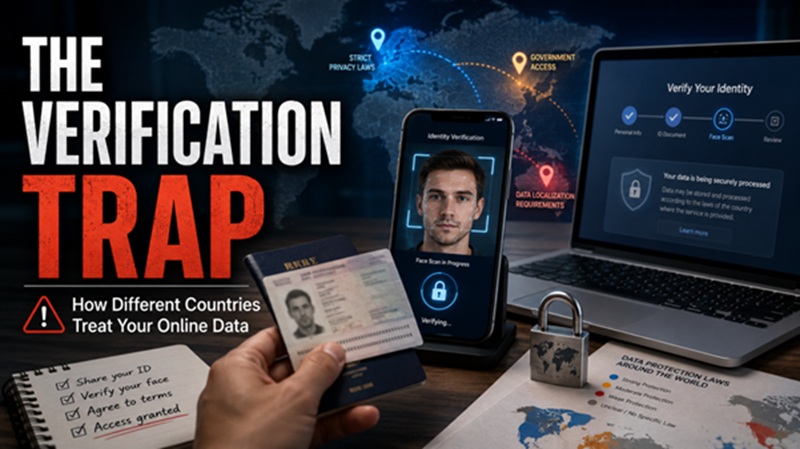
A reader in Lagos opens a new casino account and is asked for a BVN, an NIN, a utility bill, and a selfie holding the ID. The same user, signing up from London, hits a GDPR consent screen plus a passport scan plus a proof of address. From Manila, the same operator may want only an email and a phone number. Three jurisdictions, three completely different data footprints, all for the same activity.
This is the modern verification economy, and most online users walk into it without thinking about what they are handing over. Each platform asks for a slightly different bundle of personal information, stores it on its own servers, and treats it according to its own policies. The cumulative exposure, across the dozen or so accounts a typical adult signs up for in a year, is large enough that the risk is no longer abstract.
The verification gradient, country by country
Verification rules are not set globally. They are set jurisdiction by jurisdiction, and they vary more than most users realise.
The European Union runs the strictest framework, where GDPR plus the latest Anti-Money Laundering directive plus operator licensing make serious verification mandatory across financial and gambling platforms.
The United States is more fragmented, with state-level gambling regulators each running their own KYC rules on top of federal AML requirements.
Nigeria uses a tiered approach under Central Bank guidelines. The documentation required depends on transaction size and platform category, and rules around the National Identification Number (NIN) and Bank Verification Number (BVN) have tightened sharply since 2023.
The GCC sits in its own category. The UAE leans on Emirates ID and UAE Pass for digital identity, and Saudi Arabia runs Absher and Nafath under SAMA’s KYC framework. Because gambling itself is illegal across the region, residents who play online tend to do so through offshore crypto platforms that ask for none of these documents.
Outside the regulated world, the picture changes again. Crypto-native platforms operating under offshore licences from Curacao or Anjouan often require nothing more than an email and a wallet address at signup. Social platforms sit somewhere in the middle: less asked upfront, far more harvested later from behaviour and metadata.
A breakdown of how online gaming login systems work in Nigeria shows how layered onboarding has become for licensed operators, with biometric checks now standard on most regulated platforms.
The lighter-verification middle ground
For users who want to genuinely reduce the document trail they leave online, there is now a viable category of platforms designed around minimal verification. These are not workarounds for the regulated system. They are platforms that operate under jurisdictions where heavy KYC is not mandated, and which have built their business around that fact.
In gambling specifically, a growing segment of crypto-native operators offers play with little or no identity verification, accepting wallet-based deposits and withdrawals and asking for nothing more than an email at signup. Users looking to compare their options can find sites offering No KYC Crypto Casinos – Anonymous accounts that operate under offshore licensing and do not require document uploads. The trade-off is real. In exchange for reduced data exposure, users typically lose some of the consumer-protection mechanisms baked into more regulated environments. There is no free lunch on the privacy axis, only choices to make consciously.
Why this is not paranoia
It is easy to wave off privacy concerns as theoretical. They are not. The track record on data breaches and regulatory failures is now extensive enough that the risks have hard numbers attached, and Nigeria has produced two of the most visible recent examples.
Last year, the Nigeria Data Protection Commission imposed a N555.8 million fine on Fidelity Bank for data privacy violations, a marker that the regulatory teeth are now real and the scale of corporate failure on this front is widespread. The Meta case is bigger. The social media giant recently moved toward settlement with the Nigerian regulator over a $32.8 million data privacy fine, showing that even the largest global platforms cannot consistently keep user data within the bounds that local law requires.
When you upload your ID, your selfie, your utility bill, and your bank details to a platform, you are betting that the operator will store, secure, and eventually delete those files responsibly. The base rate on that bet is worse than most users assume.
What every user can actually do
The practical responses are not glamorous but they work. The first move is treating every signup as a deliberate decision. Use a dedicated email address for entertainment and gambling accounts, separate from your primary email and your financial accounts. Use a password manager so that every account gets a unique strong password, and turn on two-factor authentication wherever it is offered. Tools like Have I Been Pwned let you check whether your email address has already turned up in known breaches, which is usually the first signal that an old account has gone bad.
Read the data retention policy before you sign up, not after. Most operators publish how long they hold documents after account closure, and the answer is often longer than users expect. Where the policy is vague, that itself is a signal. Finally, where a platform asks for documents, check whether the same documents are required by law or only by the platform’s preferred process. The two are not always the same thing.
The line each user has to draw
The verification trap is not a problem any single user can solve alone. Regulators, banks, and platform operators each have their own incentives to expand the document footprint they require. What every individual user can do is treat the question seriously every time. Decide what information you are willing to hand over to which kind of operator, and accept that the answer should not be the same across all of them. The data you do not share cannot be breached.