

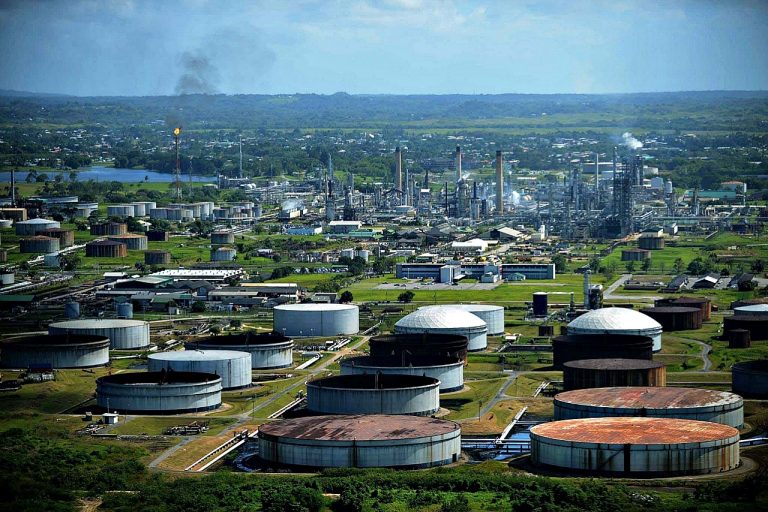
President Donald Trump announced Tuesday that India’s Reliance Industries — operator of the world’s largest single-site refining complex — will back construction of a new 168,000 barrels per day (bpd) refinery at the Port of Brownsville, Texas, designed specifically to process light, sweet U.S. shale crude.
The project, led by startup America First Refining, aims to address a perceived mismatch between domestic production and Gulf Coast refining capabilities while reducing the U.S. trade deficit with India.
“Thank you to our partners in India, and their largest privately held Energy Company, Reliance, for this tremendous Investment,” Trump posted on Truth Social.
Register for Tekedia Mini-MBA edition 20 (June 8 – Sept 5, 2026).
Register for Tekedia AI in Business Masterclass.
Join Tekedia Capital Syndicate and co-invest in great global startups.
Register for Tekedia AI Lab.
The announcement comes amid spiking gasoline prices driven by the ongoing U.S.-Israeli conflict with Iran, now in its second week, and as midterm elections approach in November 2026, with control of Congress hanging in the balance.
America First Refining stated the refinery will “offset $300 billion in the trade deficit with India” through long-term product offtake and economic impact. Reliance has signed a binding 20-year offtake term sheet committing to purchase the refinery’s output, a move that could help narrow India’s trade surplus with the U.S. — a persistent grievance for Trump.
Reliance, which did not respond to requests for comment, operates the 1.4 million bpd Jamnagar complex in Gujarat — the world’s largest single-location refinery — and reported $125 billion in revenue last year. The company has aggressively expanded into new energy, retail, digital services, and media while maintaining its core refining and petrochemical strength.

America First founder and chairman John V. Calce said: “For the first time in half a century, the United States will build a new refinery designed specifically for American shale oil.”
Many Gulf Coast facilities, configured over the past four decades to run lower-cost heavy, sour crude from imports, struggle to efficiently process the light, sweet crude produced from U.S. shale plays. The Brownsville refinery would fill that gap, targeting domestic shale feedstocks.
A “global supermajor” has made a “9-figure investment” at a “10-figure valuation,” America First said, identifying Reliance as the partner.

Construction is slated to break ground in Q2 2026.
Industry Skepticism on Need and Timing
Analysts expressed caution about some aspects of the deal. John Auers, managing director at Refined Fuels Analytics, said that “Initial announcements like this by the Trump administration have a lot of hyperbole.” He questioned the necessity of new Gulf Coast capacity, noting the region already hosts eight of the country’s 10 largest refineries, with total U.S. capacity at 18.4 million bpd at the end of 2024.
Tom Kloza, principal analyst at Kloza Advisors, suggested the Brownsville location points to an export-oriented facility.
“If Brownsville is indeed the location for the build, I would assume that they are looking at an export refinery. There is not much local demand and there are not pipeline connections to take Brownsville product elsewhere,” he said.
He noted Gulf Coast refineries benefit from low-cost natural gas, hydrogen, and domestic crude, making them competitive suppliers of motor fuel and heating oil to South America. Recent closures of two California refineries (combined 284,000 bpd) due to state fossil-fuel regulations have tightened West Coast supply, but Gulf Coast capacity remains robust. Construction costs for new refineries or expansions have averaged ~$40,000 per barrel of capacity in the past decade, implying a ~$6.7 billion price tag for the Brownsville project.
Geopolitical and Economic Backdrop
The announcement arrives amid volatile oil markets driven by the U.S.-Israeli war with Iran. Brent crude traded above $104 per barrel on Monday, with the Strait of Hormuz effectively closed after Iranian threats. India — importing 85% of its crude (4.2 million bpd) — faces higher import costs and rupee pressure, while U.S. gasoline prices have spiked, contributing to inflation concerns ahead of midterms.
The refinery deal aligns with Trump’s “America First” agenda: boosting domestic energy production, reducing trade deficits, and creating jobs in Texas. Reliance’s offtake commitment could help stabilize U.S. exports while giving India a reliable long-term source of refined products less exposed to Middle East disruptions.
While the project promises economic benefits, analysts remain skeptical about execution and the needs. Permitting, environmental reviews, pipeline connectivity, and securing financing in a high-interest-rate environment will be key hurdles. The 168,000 bpd capacity, modest compared to modern complexes, suggests a focused, export-oriented design.
The refinery could process light shale crude more efficiently than legacy Gulf Coast plants, potentially improving U.S. energy security and export competitiveness. For Reliance, it diversifies its refining footprint beyond Jamnagar and strengthens ties with the U.S. to tackle future global energy volatility.