

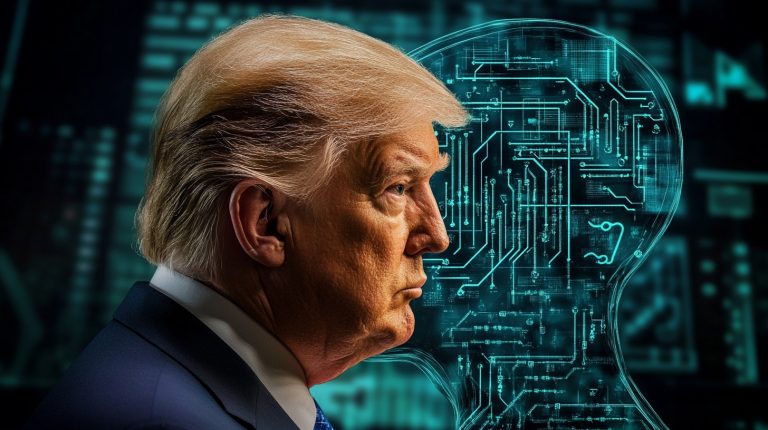
President Donald Trump has voiced strong optimism about artificial intelligence, declaring that the technology will create millions of jobs and help cure diseases.
In a recent interview with GB News host Bev Turner, Trump pushed back against concerns that AI could lead to widespread job losses, insisting the overall impact will be positive.
“AI is going to be positive,” Trump said. He acknowledged that some negatives exist but added that those issues will be straightened out. When the interviewer noted estimates that AI could eliminate millions of jobs particularly roles involving laptops and routine computer work Trump pushed back on the idea.
Register for the next Tekedia Mini-MBA.
Register for Tekedia AI in Business Masterclass.
Join Tekedia Capital Syndicate and co-invest in great global startups.
“I think it’ll create millions of jobs because it’s going to create business and people, you know, computers and things have to be created in some form. And they’re created by man. They are created, but they’re created by us. It’s going to always start with us,” he explained. “And so far, I’m right, because it’s creating millions and millions of jobs. And these are construction jobs.”
Trump pointed to the rapid buildout of data centers and related plants as key drivers of employment and wealth. He described these facilities as “fabulous,” saying they generate tremendous jobs with rising salaries and boost property values in the communities that host them.
He also dismissed recent critical coverage of data centers, suggesting some of the negative press may have been influenced by China due to the strategic importance of the infrastructure.

“If you go to most communities where they have data centers, they’re wealthy. The jobs are incredible. Their homes are more valuable,” he said.
The rapid development of artificial intelligence is no doubt triggering a massive expansion of data-center infrastructure around the world, as technology companies race to secure the computing power needed to train and operate increasingly sophisticated AI models.
Data centers have traditionally supported cloud computing, websites, financial services and digital applications. However, the emergence of generative AI has dramatically increased the scale of computing required.

Training large AI models and serving millions of AI queries require powerful GPUs, extensive networking equipment, and enormous amounts of electricity, pushing companies to build increasingly large, AI-optimized facilities.
According to Stanford University’s 2026 AI Index Report, the United States had 5,427 data centers in 2025, more than ten times the number in any other individual country.
The country remains at the center of this expansion. Northern Virginia has emerged as the world’s largest data-center cluster, while Texas, Ohio, Oregon and Iowa are also becoming major destinations for hyperscale infrastructure. Texas, in particular, has experienced rapid growth, with data-center capacity reportedly increasing by 71% over the past year.
On the medical front, Trump highlighted AI’s potential to accelerate scientific discovery. He noted that the technology is already helping uncover cures and treatments for problems and diseases that might otherwise have taken decades or even a century to identify.
This aligns with broader administration efforts to apply AI to biomedical research, chronic disease, and drug discovery. Trump framed the United States as leading the world in AI development and emphasized the need to keep advanced infrastructure and innovation at home.
His comments come amid ongoing debates about AI’s economic disruption, energy demands from data centers, and long-term societal effects. While critics continue to warn of potential job displacement in white-collar sectors, the president presented a counter-view focused on new construction, manufacturing, business creation, and medical breakthroughs.
Looking ahead, the rapid expansion of artificial intelligence and data-center infrastructure is expected to remain a major driver of investment, employment, and economic activity.
As AI models become more advanced and adoption spreads across industries, demand for computing capacity is likely to increase, encouraging technology companies and investors to build more large-scale facilities