

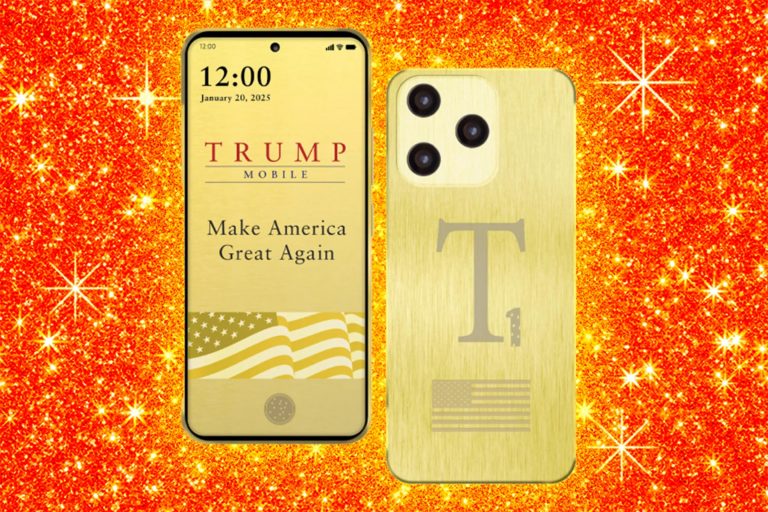
The Trump Organization’s latest venture, Trump Mobile, has ignited a media storm and public curiosity—not just because it’s a Donald Trump-branded wireless service, but because it comes bundled with a new $499 smartphone called the T1.
Unveiled Monday at Trump Tower, the phone was pitched as an American-made alternative to foreign-dominated devices and mobile networks. However, early scrutiny of the product’s specifications and marketing raises far more questions than answers.
According to the Trump Mobile website, the T1 phone will be released in September and supports a subscription plan pegged at $47.45 per month—an on-the-nose reference to Trump’s second tenure as the 47th U.S. President. The wireless service is being promoted with calls to “take back control” from Big Tech and coastal elites, echoing Trump’s populist tone.
Register for Tekedia Mini-MBA edition 20 (June 8 – Sept 5, 2026).
Register for Tekedia AI in Business Masterclass.
Join Tekedia Capital Syndicate and co-invest in great global startups.
Register for Tekedia AI Lab.
But despite the nationalistic messaging and a flashy launch, the T1’s feature list has already sparked skepticism and even derision among tech analysts and journalists.
The Phone Specs: Ambitious or Absurd?
Here’s what Trump Mobile claims the T1 offers:
- A 6.78-inch AMOLED display with a punch-hole selfie camera
- 120Hz refresh rate
- Triple rear camera setup: 50MP main sensor, 2MP macro, and 2MP depth sensor
- 16MP front-facing camera
- 5,000mAh battery
- 256GB of storage and 12GB of RAM
- In-display fingerprint reader and face unlock
- Android 15
- 3.5mm headphone jack
- USB-C charging port
The specs put the T1 in a peculiar position—not quite a flagship device but also not entry-level. While similar features can be found on higher-end Android phones like the Asus ROG Phone 9 or even the Samsung Galaxy S23 Ultra, those devices typically retail for significantly more than $499. Critically, the Trump Mobile website leaves out one of the most important details of any smartphone: the processor.

Without information on the chip powering the phone, it’s impossible to verify whether the T1 can truly deliver the performance its specs imply. There’s also no mention of durability, water resistance, or other basic features typically listed for a modern device at this price point.
The phone’s promo image—which has been called out for clumsy Photoshop work—further clouds the issue. Observers note visual inconsistencies such as misaligned camera sensors and poorly rendered bezels that do not resemble any known phone design.
Made in America? Not Likely
The Trump Organization claims the phone is “Made in the USA,” a claim many industry experts view as improbable. Nearly every smartphone sold in America today is assembled overseas due to high labor costs and entrenched supply chains. Even U.S.-based tech companies like Apple and Google rely on Chinese, Indian, and Vietnamese factories to build their phones.

Tech analyst Paolo Pescatore dismissed the made-in-America pitch as “highly unlikely,” noting there is virtually no smartphone manufacturing infrastructure in the U.S.
“Even small-scale assembly for niche phones takes years to build and validate,” he said.
A Cloud of Uncertainty
Beyond the hardware, the Trump Mobile ecosystem raises additional concerns. The T1 phone is branded under a trademark license, and the Trump Organization is not directly involved in its engineering or manufacture. That leaves questions about who actually built it, who owns the data, and how the carrier operates.
Trump Mobile’s wireless service is almost certainly piggybacking on an existing U.S. network—most likely through a mobile virtual network operator (MVNO) arrangement with T-Mobile, Verizon, or AT&T. But no such partnerships have been disclosed.
Meanwhile, DTTM Operations, which manages Trump’s trademarks, has filed applications for broader telecom uses of the “Trump” and “T1” brands. These cover accessories, mobile services, and even retail stores, hinting at broader ambitions—but also raising the possibility of a business-driven more by branding than by tech chops.
A Phone Full of Questions
Critics are already drawing comparisons to vaporware—products hyped before they exist, often to capture political or financial momentum. Among the many unanswered questions:
- Will the T1 actually ship by September?
- Is it water-resistant or rugged?
- Why are the rear cameras oddly spaced?
- Will it ship with Trump-themed wallpapers, pre-installed apps, or crypto-related bloatware?
- And most pressing: what phone model is it really based on, if any?
The Verge, in its breakdown, described the T1 as “as vapor-y as it gets,” warning that the promotional render “bears no resemblance to any existing phone on the market.” The website also joked about the oddly titled “T1 Phone 8002,” asking, “What happened to the first 8,001 tries?”
Political Branding in a Saturated Market
The launch of Trump Mobile and the T1 smartphone is part of a broader trend in conservative commerce—ideologically aligned products and platforms for voters who distrust mainstream institutions. But while the branding may appeal to Trump’s base, it’s entering a brutally competitive market where specs, performance, and trust matter.
The U.S. smartphone market is dominated by Apple and Samsung, who together account for the vast majority of phone sales. And with most telecom traffic handled by three national carriers—Verizon, AT&T, and T-Mobile—Trump Mobile may struggle to find a competitive edge beyond its name.
Unless more details emerge confirming the viability and origin of the T1 phone, many in the industry will continue to view it with skepticism. This means that it remains a branding gamble in a market where political loyalty might not be enough to carry a tech product.