

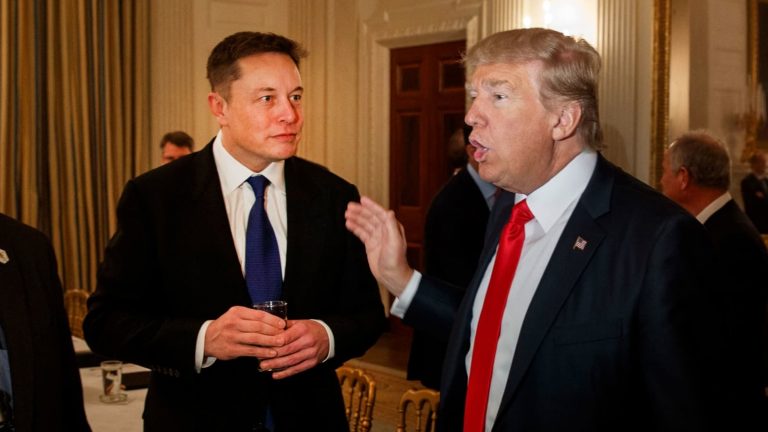
The feud between President Donald Trump and Elon Musk exploded into full public view Thursday, deepening a rift that has been quietly growing between the two powerful figures over a sweeping domestic tax and spending bill—and exposing a simmering personal tension rooted in policy differences, ego, and campaign history.
Trump, speaking to reporters during a joint appearance with German Chancellor Friedrich Merz at the White House, expressed disappointment in Musk after days of blistering attacks from the Tesla and SpaceX chief over the controversial “One Big Beautiful Bill Act,” which narrowly passed the House last month.
“I’m very disappointed with Elon,” Trump said. “He knew this bill better than anyone and he only developed a problem when he found out I would cut the EV mandate.”
Register for Tekedia Mini-MBA edition 20 (June 8 – Sept 5, 2026).
Register for Tekedia AI in Business Masterclass.
Join Tekedia Capital Syndicate and co-invest in great global startups.
Register for Tekedia AI Lab.
The remark followed Musk’s claim that Trump was being untruthful about the bill’s contents and timeline, insisting he had never been shown the legislation before its overnight passage. On X, Musk declared, “False, this bill was never shown to me even once and was passed in the dead of night so fast that almost no one in Congress could even read it!”
Musk’s criticism of the bill has centered on its projected $3 trillion impact on the national deficit over the next decade, as estimated by the nonpartisan Congressional Budget Office. He has accused lawmakers of slashing electric vehicle incentives while preserving fossil fuel subsidies, calling the legislation a “mountain of disgusting pork.”
But beyond policy, the clash has taken on a personal edge—one many observers saw coming.

Trump has long been known for his intolerance of criticism, often lashing out at even his closest allies when they step out of line. When Senator Rand Paul voiced concerns about the bill’s deficit impact, Trump wasted no time rebuking him publicly.
“He doesn’t understand the tremendous GROWTH this bill will generate,” Trump posted on Truth Social.
Yet despite Musk’s far more aggressive and sustained critique, Trump initially refrained from attacking him—prompting speculation over whether the president was trying to preserve a relationship with one of his most prominent donors.

That restraint ended Thursday. Following the fierce exchange between the two, Musk posted: “Without me, Trump would have lost the election,” adding, “Dems would control the House and the Republicans would be 51–49 in the Senate.” In another post, Musk lamented what he viewed as betrayal, writing: “Such ingratitude.”
Trump wasted no time dismissing Musk’s influence and campaign contributions. “I would have won Pennsylvania regardless of Elon,” he said, brushing aside Musk’s claim that his support helped swing the 2024 election.
Musk has been on a “kill the bill” campaign, rallying GOP members not to approve the spending bill, which he believes will shoot the U.S.’s deficit to an unsustainable level.
On Wednesday, Musk quoted a tweet made by Trump in 2012. The tweet said: “No member of Congress should be eligible for re-election if our country’s budget is not balanced—deficits not allowed!”
Musk used the post to underscore what he saw as Trump’s hypocrisy in pushing a bill that blows open the federal budget. He then floated the idea of an entirely new political movement.
“Is it time to create a new political party in America that actually represents the 80% in the middle?” Musk asked his X followers in a poll that drew millions of votes within hours.
The online blitz came just weeks after it was revealed that Musk had spent more than $250 million backing Trump’s 2024 campaign and affiliated political groups—making him one of the most influential financial forces behind the president’s re-election effort.
But the policy divide between the two men has widened since Trump’s return to the White House. Musk has reportedly grown increasingly frustrated with what he sees as the administration’s anti-environmental policies, particularly the dismantling of emissions standards, climate accords, and now, incentives for electric vehicles and solar power.
The public fallout has not been without consequences. Tesla shares plunged more than 8% Thursday, as investors reacted to the clash between the electric carmaker’s CEO and the sitting U.S. president, who remains a dominant force in Republican politics and U.S. regulatory policy.
Meanwhile, the bill itself—the so-called “One Big Beautiful Bill Act”—faces an uncertain fate in the Senate, where several Republican fiscal hawks remain uneasy about its projected long-term cost. The legislation extends Trump’s 2017 tax cuts, boosts spending on the military and border security, and slashes funding for federal assistance programs.
Trump insists the bill will generate massive economic growth and claims the opposition is either uninformed or driven by personal interests.
Musk said his opposition to the bill has nothing to do with his EV business. In a thread Thursday night, he wrote: “This isn’t just about EV tax credits or deficits. It’s about truth, responsibility, and the future of governance in America.”
It is not clear whether the two men can ever patch things up. Although long-anticipated, the Trump-Musk alliance that helped shape 2024 is in open collapse.