

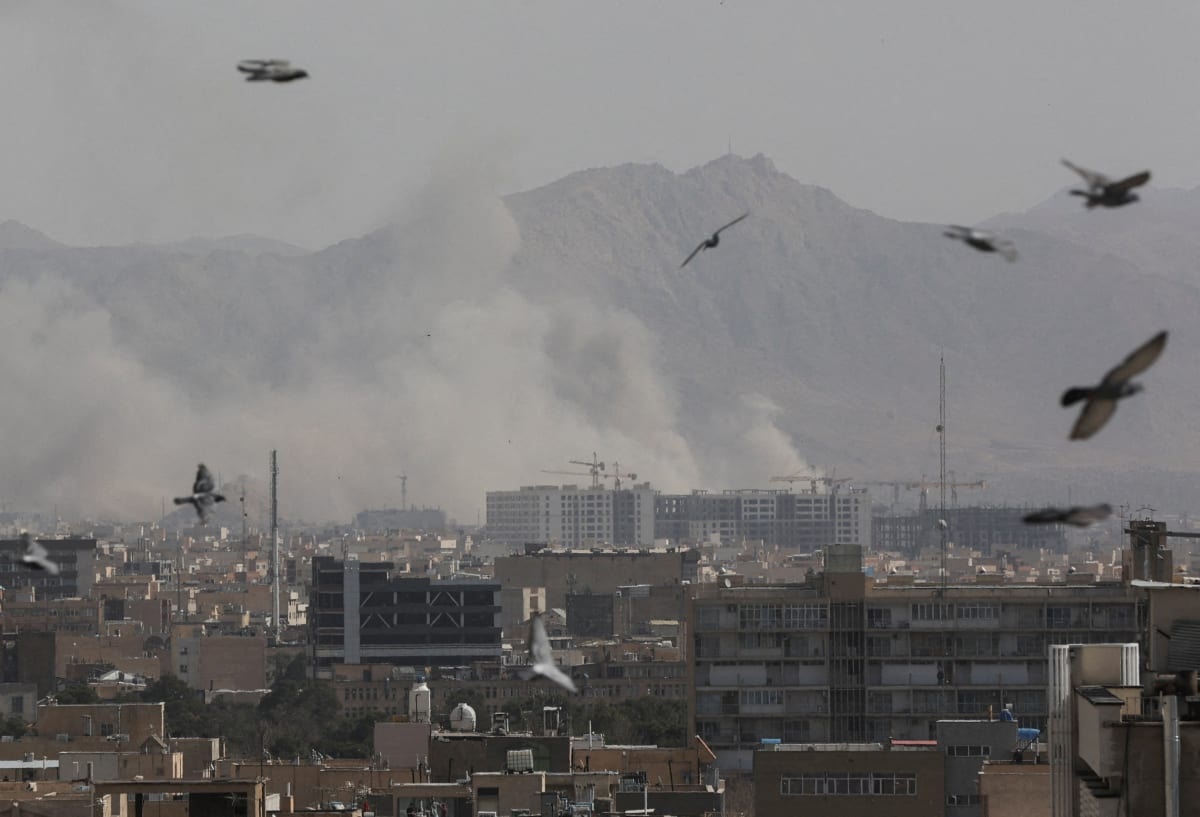
U.S. President Donald Trump has sharply raised the stakes around the still-fragile U.S.-Iran ceasefire, declaring that American military assets will remain deployed in and around Iran until Tehran fully complies with what he described as the “real agreement.”
He also warned that any breach would trigger an even larger military response.
In a late-night post on Truth Social, Trump said: “All US ships, aircraft, and military personnel… will remain in place in, and around, Iran, until such time as the REAL AGREEMENT reached is fully complied with.”
Register for Tekedia Mini-MBA edition 20 (June 8 – Sept 5, 2026).
Register for Tekedia AI in Business Masterclass.
Join Tekedia Capital Syndicate and co-invest in great global startups.
Register for Tekedia AI Lab.
He then added an explicit threat: “If for any reason it is not… the ‘Shootin’ Starts,’ bigger, and better, and stronger than anyone has ever seen before.”
The language indicates that what was initially presented as a two-week ceasefire is increasingly being treated by Washington as a conditional military pause rather than a settled diplomatic breakthrough.
Markets had initially welcomed the ceasefire, with global equities rallying and oil prices falling on expectations that energy shipments through the Strait of Hormuz could resume. But Trump’s latest statement, coupled with renewed violence in Lebanon and contradictory interpretations of the deal’s terms, has reintroduced significant geopolitical risk into the equation.

Brent crude, which had fallen sharply after the ceasefire announcement, resumed its climb on Thursday, rising to about $97.08 per barrel, while U.S. West Texas Intermediate advanced to $97.55, as traders reassessed the durability of the truce and the likelihood of sustained supply disruptions.
At the heart of the uncertainty is a widening divergence in how the parties interpret the agreement. Trump has insisted that the arrangement includes a long-standing understanding that Iran will not develop nuclear weapons and that the Strait of Hormuz will remain open and safe for commercial shipping. But Iranian officials have signaled a markedly different reading.
According to Reuters, Iran’s parliamentary speaker said uranium enrichment remains permitted under the ceasefire terms, directly contradicting Trump’s assertion that Tehran had agreed to halt enrichment.

This is not a minor discrepancy as it strikes at the core issue that has defined tensions between Washington and Tehran for years: the future of Iran’s nuclear programme. If both sides are operating under fundamentally different assumptions, the ceasefire may be less an agreement than a temporary suspension of hostilities pending further negotiations.
That risk is also compounded by developments in Lebanon. Although Pakistan’s mediation had initially been described by some parties as covering all fronts, including Lebanon, the White House has since moved to narrow that interpretation.
JD Vance said Tehran’s negotiators had mistakenly believed Lebanon was covered by the ceasefire, adding that “the ceasefire included Iran and U.S. allies, including Israel and the Gulf Arab states,” but “it just didn’t” include Lebanon.
That clarification directly contradicts comments attributed to Pakistani Prime Minister Shehbaz Sharif, who had indicated the truce extended to Lebanon as well.
The contradiction has already had real-world consequences. Israel launched what has been described as its harshest offensive in Lebanon since the conflict began in February, with reports indicating at least 182 fatalities on Wednesday alone. Those strikes have sharply increased pressure on the ceasefire framework and prompted Iranian threats that it would be “unreasonable” to proceed with permanent peace talks under current conditions.
This places Friday’s expected talks in Islamabad under considerable strain. Diplomatically, the central issue is now whether the two-week pause can be converted into a formal settlement before the expiry window closes.
Trump’s rhetoric suggests Washington is using continued military deployment as leverage. His statement that the U.S. military is “loading up and resting, looking forward, actually, to its next conquest” adds a coercive tone that may complicate negotiations, particularly with Tehran already accusing Washington and Israel of acting in bad faith.
The Strait of Hormuz remains the key economic pressure point. Fresh reports that Iran may seek to impose tolls, potentially including cryptocurrency payments, for passage through the strait have alarmed governments and the shipping industry. While those reports remain unconfirmed, the mere possibility has intensified concerns.
The International Chamber of Shipping has warned that such tolls would be outside established international norms.
John Stawpert, the organization’s marine director, said: “Charging a toll for transits through an international waterway would be outside international norms and realistically would undermine international law, and the right to freedom of navigation and innocent passage.”
This is now as much an economic crisis as a military one, with escalating global implications. U.K. Foreign Minister Yvette Cooper is expected to use a major foreign policy speech to insist that shipping through Hormuz must remain toll-free and that Lebanon be explicitly included in the ceasefire framework. The British government is clearly linking the conflict to domestic economic pain, including higher mortgage costs, fuel prices, and food inflation.
In strategic terms, the latest developments reveal that the ceasefire is operating under multiple, conflicting interpretations. Washington sees it as a pause conditioned on compliance, while Tehran appears to see it as a broader framework tied to sanctions relief and regional de-escalation.
Israel does not recognize its applicability to Lebanon. Those differences make the truce highly vulnerable.
Stawpert said that the situation was “very, very confusing.”
The military language from Trump, the renewed hostilities in Lebanon, and the unresolved status of Hormuz all suggest that what markets briefly priced as de-escalation may instead be only an intermission in the conflict.