

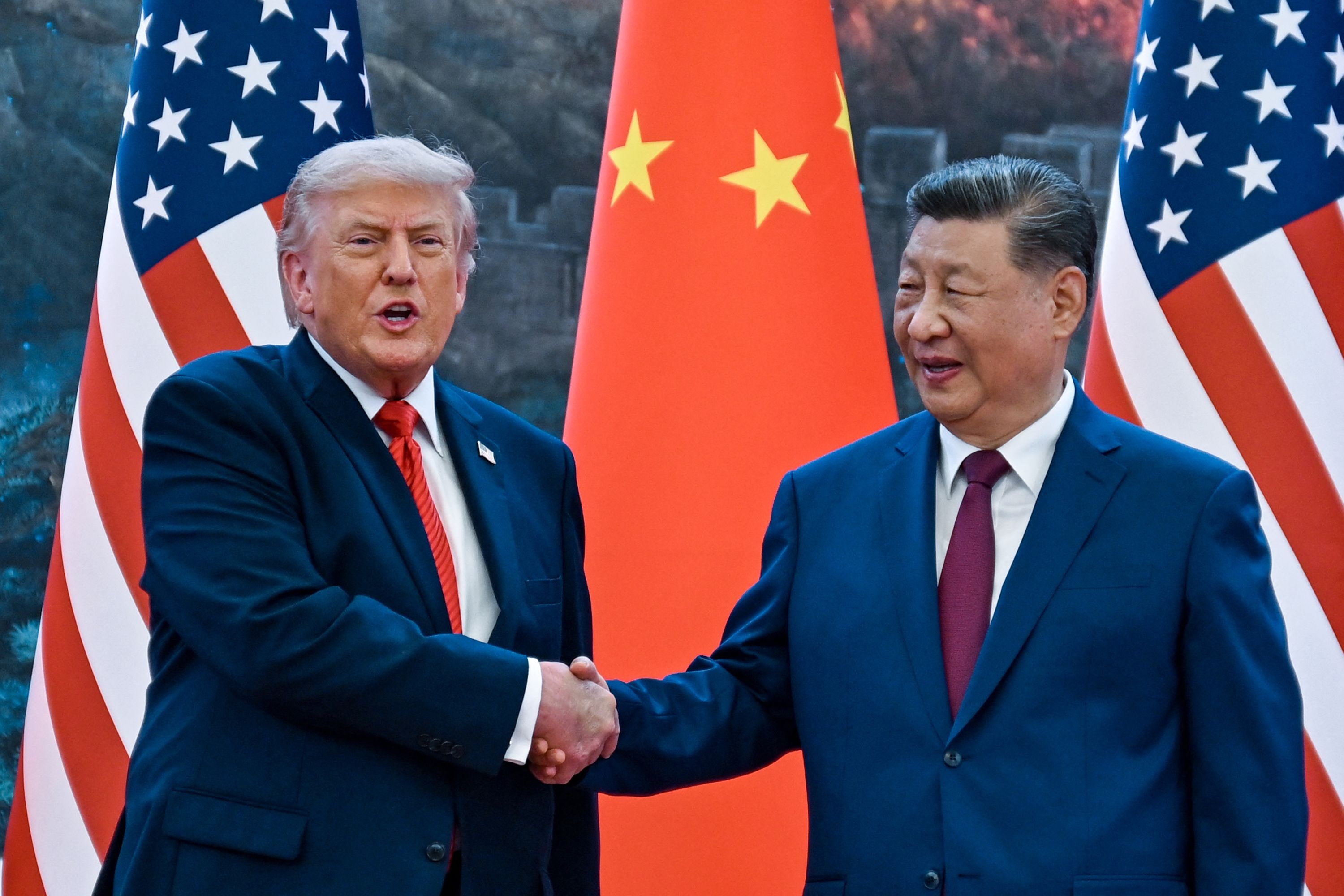
US President Donald Trump welcomed Chinese President Xi Jinping to the White House on Thursday for high-level talks spanning trade, artificial intelligence, Taiwan and the broader strategic rivalry between the world’s two largest economies.
The meeting produced an extension of the existing trade truce, but left many of the most difficult economic disputes unresolved. At the same time, the leaders offered sharply different visions for how artificial intelligence should be governed and used, while Taiwan and the risk of a wider US-China confrontation remained central to the relationship.
For financial markets and multinational companies, the immediate outcome offers some additional breathing room on trade but does little to remove uncertainty around tariffs, technology restrictions, critical minerals and China’s commitments to buy US goods.
Register for the next Tekedia Mini-MBA.
Register for Tekedia AI in Business Masterclass.
Join Tekedia Capital Syndicate and co-invest in great global startups.
Trade Truce Extended, But Key Disputes Remain
The United States and China agreed to extend their trade agreement by two months, according to Treasury Secretary Scott Bessent, giving both sides additional time to negotiate after the existing arrangement was due to expire in November.
Bessent said the extension would give Washington and Beijing “more time to see what we can do on the economic front.”
The extension avoids an immediate escalation in tariffs, but it is not a comprehensive settlement. Issues including tariff levels, Chinese purchases of US agricultural products, rare-earth supplies and restrictions on advanced technology remain subject to negotiation.

The gap between commitments and actual trade flows is already creating friction.
Bessent said on Wednesday that China was meeting its commitment under the previous agreement to purchase 25 million tons of US soybeans, but remained behind on a separate pledge to buy $17 billion in other agricultural goods.
US officials have also said Chinese deliveries of rare earths are falling short of expectations, keeping one of the most important pressure points in the relationship alive. China dominates the processing of many rare-earth materials used in electronics, defense equipment and advanced manufacturing, giving Beijing significant leverage in negotiations over technology and trade.

For businesses, the extension provides a temporary reprieve rather than a definitive change in the operating environment. Lower tariffs can support cross-border trade and investment, but companies still have to make supply-chain and capital-allocation decisions without knowing whether the current arrangements will eventually become permanent.
That uncertainty has become a defining feature of the US-China economic relationship, with periods of tariff escalation followed by temporary agreements that postpone rather than resolve the underlying disputes.
Taiwan Remains A Major Fault Line
Xi also raised Taiwan during his meeting with Trump, according to China’s official Xinhua news agency, calling on Washington to “handle the Taiwan question with prudence” and urging the United States to oppose Taiwanese independence.
That formulation goes further than Washington’s longstanding position that it does not support Taiwan independence.
There was no immediate White House readout of the exchange, and the Trump administration has not indicated that it intends to alter its established language on Taiwan.
The wording matters because even a subtle change in Washington’s position could affect perceptions of US deterrence and the political debate in Congress. Taiwan remains one of the most sensitive issues in the bilateral relationship, particularly because Beijing regards the island as part of China and has not ruled out the use of force to bring it under its control.
For markets, Taiwan also carries an economic dimension. The island is central to the global semiconductor industry, meaning a serious deterioration in US-China relations over Taiwan would extend far beyond defense and diplomacy into technology supply chains, electronics manufacturing and the broader AI industry.
Xi’s reference to the “Thucydides Trap” added another layer to the discussion. The concept describes the risk that rivalry between an established power and a rising power can produce conflict. Xi said the risk could be overcome, while arguing that the two countries should cooperate where their interests overlap.
He called for regular military dialogue and stronger mechanisms for preventing crises from escalating.
Trump likewise emphasized areas where Washington and Beijing have shared interests, invoking the countries’ cooperation during the Second World War against Japan as an example of what the two powers could accomplish when they work together.
The contrasting messages illustrate the broader challenge confronting the relationship. Both governments have incentives to prevent competition from becoming uncontrolled confrontation, while continuing to disagree over trade, technology, Taiwan and the balance of power in the Asia-Pacific.
AI Exposes A Sharper Policy Divide
Artificial intelligence emerged as another important point of difference.
Trump has argued for allowing the US AI industry to develop with limited additional regulation. In a social media post, he said AI should remain “exactly where it is” and suggested relying on the Justice Department rather than imposing new guardrails. He also said China held the same position.
Xi offered a markedly different formulation.
China and the United States, as leading AI powers, have both the capability and responsibility to manage the technology’s development, he said.
“We have both the capability and responsibility to develop and manage AI for good, and ensure that the development of AI is always under human control and serves the well-being of the people,” Xi said.
Washington has imposed restrictions on China’s access to some advanced semiconductor technologies and AI computing capabilities, while Beijing has accelerated efforts to develop domestic alternatives. At the same time, both countries are confronting questions about the security risks posed by increasingly capable AI systems.
The presence of leading US technology executives at the White House state dinner underscored the economic importance of the technology relationship. Alphabet CEO Sundar Pichai, OpenAI CEO Sam Altman and Nvidia CEO Jensen Huang were among the prominent AI figures expected to attend.
Their presence also highlights an important feature of the current US-China rivalry: AI is simultaneously an area of commercial cooperation, technological competition and national-security concern. The companies developing frontier models and the semiconductor infrastructure required to run them are increasingly operating in an environment shaped by government decisions over exports, investment and security.
The meeting therefore produced no comprehensive reset in the relationship. Instead, it established a temporary extension of the trade truce while leaving the core economic and geopolitical disputes in place.
The two-month trade extension may buy negotiators time. It does not, by itself, settle the larger contest that brought Trump and Xi back to the negotiating table.