

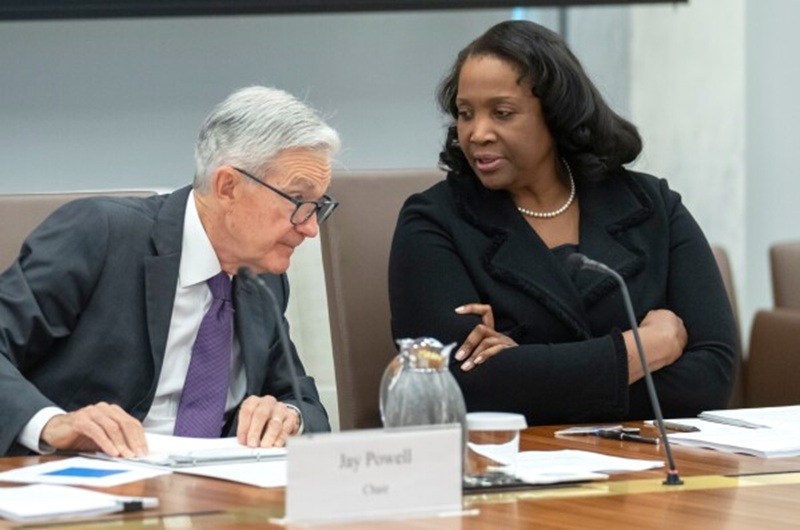
President Donald Trump’s announcement on Monday that he had fired Federal Reserve Board Governor Lisa Cook has triggered an immediate legal and political storm, setting up what could become the most consequential battle over the independence of the U.S. central bank in more than a century.
In a termination letter posted on his Truth Social account, Trump accused Cook of committing mortgage fraud, citing allegations first made by Federal Housing Finance Agency Director Bill Pulte. Trump alleged that Cook signed documents for properties in Michigan and Georgia in 2021, each time declaring them to be her primary residence.
“It is inconceivable,” Trump wrote, “that you were not aware of your first commitment when making the second.”
Register for Tekedia Mini-MBA edition 20 (June 8 – Sept 5, 2026).
Register for Tekedia AI in Business Masterclass.
Join Tekedia Capital Syndicate and co-invest in great global startups.
Register for Tekedia AI Lab.
“There is sufficient reason to believe you have made false statements on one or more mortgage agreements,” Trump added, calling her actions “deceitful and potentially criminal conduct” that undermines her competence as a financial regulator.
The Justice Department confirmed last week it was reviewing Pulte’s referral, though Cook has not been charged with any crime.
Cook Pushes Back
Cook, who in 2022 became the first Black woman to serve on the Fed’s Board of Governors after being nominated by then-President Joe Biden, rejected Trump’s action outright.

“President Trump purported to fire me ‘for cause’ when no cause exists under the law, and he has no authority to do so,” Cook said in a statement Monday. “I will not resign. I will continue to carry out my duties to help the American economy as I have been doing since 2022.”
Cook has retained the prominent Washington attorney Abbe Lowell, who recently launched a new firm specializing in defending government officials targeted by the Trump administration. Lowell, whose clients include Hunter Biden and New York Attorney General Letitia James, called Trump’s move baseless.
“President Trump has taken to social media to once again ‘fire by tweet,’ and once again his reflex to bully is flawed and his demands lack any proper process, basis or legal authority,” Lowell said. “We will take whatever actions are needed to prevent his attempted illegal action.”

Lowell added that Cook’s termination was “based solely on a referral letter” and would be challenged in court.
A Legal and Political Showdown
The confrontation raises profound constitutional and economic questions. Under the Federal Reserve Act of 1913, presidents may only remove governors “for cause.” Historically, this phrase has been interpreted narrowly to mean malfeasance, neglect of duty, or inability to serve — not simply political disagreement.
Senator Elizabeth Warren, the top Democrat on the Senate Banking Committee, has condemned Trump’s action.
“The illegal attempt to fire Lisa Cook is the latest example of a desperate President searching for a scapegoat to cover for his own failure to lower costs for Americans,” Warren said. “It’s an authoritarian power grab that blatantly violates the Federal Reserve Act, and must be overturned in court.”
Edward Mills, managing director at Raymond James, warned of market implications. “This marks an unprecedented moment for both the Fed and the White House, signaling a campaign to exert direct influence over monetary policy decisions. Markets are likely to view this attack on Fed independence negatively, amplifying uncertainty over future policy direction,” he said.
Trump’s Battle With the Fed
Trump’s decision to target Cook did not come out of nowhere. Since returning to the White House in January, he has clashed openly with Fed Chairman Jerome Powell, pressuring him to slash interest rates despite the central bank’s cautious approach.
On July 15, Trump asked a group of Republican lawmakers whether he should fire Powell, with several agreeing he should. Though he later denied any immediate plan, Trump left the door open, saying Powell could face dismissal if allegations of fraud surfaced.
Powell himself, appointed by Trump in 2017, has faced attacks from the president before. During Trump’s first term, he repeatedly berated Powell for raising interest rates, calling him a “bonehead” and even likening him to “an enemy” of the United States.
Historical Clashes Between Presidents and the Fed
The conflict between presidents and the Federal Reserve has deep roots. Though the Fed was designed as an independent body insulated from politics, presidents have often tried to exert influence over its decisions.
- Franklin D. Roosevelt leaned on the Fed during the Great Depression to support New Deal policies and debt financing for World War II.
- Richard Nixon privately pressured Fed Chair Arthur Burns to keep interest rates low before the 1972 election, a move many economists later blamed for fueling runaway inflation in the 1970s.
- Ronald Reagan clashed with then-Fed Chair Paul Volcker, who raised rates aggressively to tame inflation. Volcker resisted political pressure but was replaced by Alan Greenspan, who was seen as more accommodating.
- Barack Obama faced criticism from Republicans who accused the Fed under Ben Bernanke of enabling “easy money” policies that inflated asset bubbles, though he refrained from direct confrontation.
What sets Trump apart is not just the intensity of his pressure campaign but his willingness to test the legal boundaries of presidential authority over the Fed by attempting to remove a sitting governor.
Stakes for the Fed’s Independence
If Trump’s action against Cook is upheld, he would be able to nominate her replacement. Alongside his pending nominee, Stephen Miran — tapped to replace the recently resigned Adriana Kugler — Trump could tilt the seven-member board toward a 4-to-3 majority of appointees loyal to his agenda.
Two governors, Christopher Waller and Michelle Bowman, were already appointed by Trump during his first term. With Powell also a Trump nominee, the president could exert significant influence over monetary policy decisions, including the pace of interest rate cuts.
The implications for financial markets are far-reaching. Already, the ICE U.S. Dollar Index dropped 0.3% following Trump’s announcement, while the 2-year Treasury yield dipped 4 basis points. Stock futures weakened in overnight trading, and gold prices climbed 0.3% as investors sought safe assets.
Now, the courts will need to determine whether allegations of mortgage misrepresentation constitute sufficient “cause” for dismissal under the 1913 statute. If Trump prevails, he could gain extraordinary leverage over the central bank at a moment when global investors are scrutinizing U.S. economic stability.
If he fails, the attempt may backfire, strengthening the Fed’s institutional independence and setting a precedent that insulates its governors from future presidential intervention.