

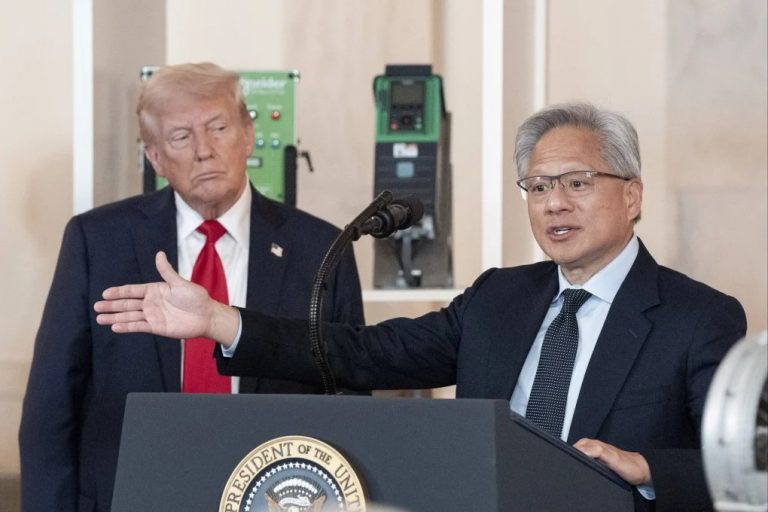
The U.S. government’s landmark 15% revenue-sharing agreement with Nvidia and AMD on Chinese chip sales is drawing both praise and legal questions, as the Trump administration positions it as a model for future deals across other industries.
U.S. Treasury Secretary Scott Bessent described the arrangement as a “beta test” in a Bloomberg TV interview, hinting that the framework could be replicated beyond semiconductors.
“We could see it in other industries over time,” Bessent said, underscoring the administration’s confidence in the policy’s revenue potential.
Register for Tekedia Mini-MBA edition 20 (June 8 – Sept 5, 2026).
Register for Tekedia AI in Business Masterclass.
Join Tekedia Capital Syndicate and co-invest in great global startups.
Register for Tekedia AI Lab.
The deal, announced earlier this month, is part of the Trump administration’s broader effort to increase domestic funding from foreign sales without directly imposing tariffs that might trigger retaliation. Under the agreement, Nvidia and AMD will pay the U.S. government 15% of their revenue from certain high-performance chips sold to China — chips that are not subject to outright export bans but still fall within Washington’s strategic technology oversight.
The move also fits into the White House’s push to use new tariffs and revenue-sharing deals to slow the growth of America’s $37 trillion national debt. According to the Committee for a Responsible Federal Budget, these measures are already bringing in enough money to noticeably offset deficit expansion.
However, the deal faces potential constitutional challenges. Article 1, Section 9 of the U.S. Constitution — the “export clause” — prohibits taxes or duties on goods exported from any U.S. state. The Supreme Court has previously struck down attempts to collect fees or taxes on exports, notably in United States v. IBM (1996) and United States v. United States Shoe Corp. (1998). In both cases, the Court sided with businesses, ruling that such levies violated the export clause. Whether today’s Court would rule the same way remains uncertain, especially given recent rulings that have expanded the powers of the Executive Branch in trade and national security matters.

The Nvidia–AMD deal traces back to months of tense negotiations between the White House, chipmakers, and national security officials. President Trump had initially floated the idea of a complete ban on advanced chip sales to China, citing concerns about military applications.
Industry leaders, led by Nvidia CEO Jensen Huang and AMD CEO Lisa Su, warned that such a move would severely impact revenues, global market share, and America’s technological leadership. The compromise — a revenue-sharing model — allowed companies to continue selling certain downgraded products to China while providing the U.S. government with a steady income stream.
Analysts say the arrangement could become a blueprint for balancing national security concerns with corporate interests in other sensitive sectors, from aerospace to biotech. Yet the constitutional cloud hanging over the policy raises the prospect of legal challenges that could force the courts to revisit the export clause for the first time in over two decades.

Beijing and Washington’s continued weaponization of exports and global supply chains means companies are bracing for further disruption. The disruption comes with some rapid policy shifts that defy the norm. For the Nvidia–AMD agreement, it is not clear if the entities involved, or anyone else, intends to challenge the legality. However, it will be of great interest to business leaders to see if the deal survives court scrutiny.