

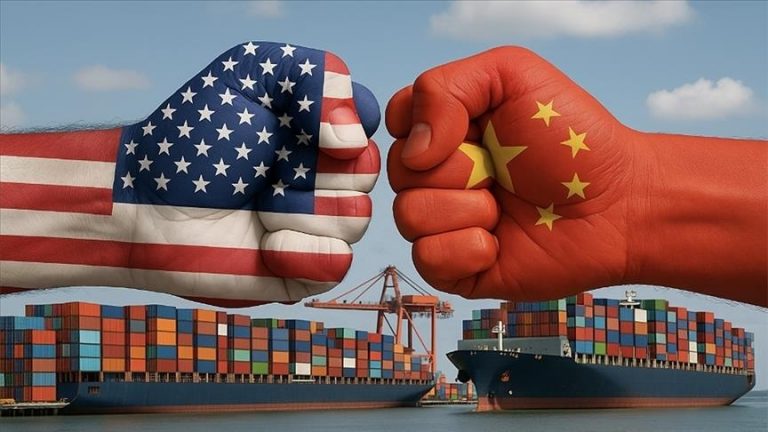
Two of America’s most influential chief executives — Wells Fargo’s Charlie Scharf and Pfizer’s Albert Bourla — have voiced fresh concerns that the United States risks losing its competitive edge to China, warning that inconsistent policy direction and underinvestment are allowing Beijing to catch up fast.
Yet, both believe artificial intelligence could still be the country’s greatest weapon to maintain its global dominance.
Speaking at CNBC’s inaugural Invest in America Forum in Washington, D.C., the pair said that while the U.S. still holds the upper hand across key sectors, the momentum is shifting as China channels massive resources into technology, pharmaceuticals, and high-end manufacturing.
Register for Tekedia Mini-MBA edition 20 (June 8 – Sept 5, 2026).
Register for Tekedia AI in Business Masterclass.
Join Tekedia Capital Syndicate and co-invest in great global startups.
Register for Tekedia AI Lab.
“We will likely have less people, absolutely,” Scharf said, acknowledging that AI will reshape the American labor landscape. “When we look at the tools that we’ve implemented just for people that are coding, you see 20%, 30%, 40% improvement in coders. We haven’t reduced our head count by 20%, 30% or 40%. We’re actually doing more than we otherwise would have been able to do.”
The Wells Fargo CEO noted that artificial intelligence has already begun altering how financial institutions operate. His bank, like others on Wall Street, is using AI to improve coding efficiency and customer analytics — but the changes could come at a cost for workers.
Scharf added that while AI will boost productivity, it also means the industry will have to manage the social and employment consequences that follow.

JPMorgan Chase and Goldman Sachs have already slowed hiring, particularly in operational and back-office roles, as AI-driven tools increasingly automate functions from fraud detection to regulatory compliance.
Scharf, who has overseen Wells Fargo’s sweeping restructuring since taking over in 2019, also hinted at incoming reforms across the financial sector. He said the U.S. banking industry should brace for major regulatory shifts, even amid Washington’s deep political gridlock.
“We ultimately do expect significant changes in capital requirements, liquidity requirements,” Scharf said. “We do expect to see changes which will allow people in the industry, not just big banks and medium-sized banks, but smaller banks as well, to do more in these communities.”

For Scharf, the conversation about America’s competitiveness is as much about regulatory foresight as it is about innovation. He indicated that unpredictable policy swings risk discouraging long-term planning across the financial sector.
Pfizer’s Albert Bourla, who spoke alongside Scharf, directed his warnings toward a different front — biotechnology and pharmaceuticals — where China is closing the gap at an alarming rate. Bourla pointed to China’s growing R&D capabilities and regulatory flexibility, calling it a fundamental shift that the U.S. cannot afford to ignore.
“They [China] filed more patents this year than the U.S.,” Bourla said. “That’s never happened in history. Five years ago, the split was 90%-10%. … The gap is closing, but they probably will become [better than us] unless we get our act together.”
The Pfizer chief described a quiet but dramatic power shift underway, with China’s government prioritizing life sciences as a national development pillar. From gene editing and vaccines to biologics manufacturing, Chinese pharmaceutical firms have accelerated their output with state support, luring top scientists and biotechnology investors from abroad.
Bourla urged American policymakers to focus less on trying to restrain China’s growth and more on revitalizing U.S. innovation.
“We spend more time trying to think about how to slow down China rather than think how we can become better than them,” he said. “We need to have regulatory changes here. We need to have stability. Tariffs and pricing was not helping.”
Pfizer, one of the world’s largest drugmakers, recently signed a drug pricing agreement with the Trump administration aimed at reducing uncertainty around pharmaceutical costs and tariffs. The deal grants Pfizer a three-year exemption from pharma-specific tariffs in exchange for expanded investment in U.S. manufacturing.
“Tariffs and the uncertainty of drastic correction of U.S. pricing — with this deal, we are removing both uncertainties,” Bourla said Wednesday, portraying it as a pragmatic step toward stabilizing long-term research spending.
Beyond trade policy, Bourla views artificial intelligence as the single biggest transformative force in modern medicine. He said AI will help drugmakers compress discovery timelines and find cures that have long eluded scientists.
“We tried for years to find cures,” Bourla said. “AI will make it happen.”
Pharmaceutical research, once constrained by years of trial and error, now has access to algorithms that can simulate molecular interactions in hours. Pfizer and other drugmakers have been quietly building AI models capable of predicting how compounds might behave in the human body. This process could revolutionize the search for treatments for diseases like Alzheimer’s, cancer, and Parkinson’s.
The rise of AI in both finance and healthcare comes as China is making its own major push into generative models, data centers, and quantum computing. Chinese firms like Huawei and Baidu have stepped up their efforts to compete with Western giants like Nvidia and Microsoft in developing foundational AI systems.
For many U.S. executives, that competition has become a proxy for broader technological supremacy. The U.S. pioneered artificial intelligence research and continues to host the world’s largest AI companies — OpenAI, Anthropic, and Google DeepMind — but Beijing’s accelerated policy alignment, cheaper manufacturing base, and domestic data reserves give it an emerging edge.
Bourla’s warning that China is “filing more patents” than the U.S. echoes a wider concern shared across American boardrooms — that Washington’s slow decision-making could squander its innovation lead. The U.S., he argued, needs a more predictable regulatory and fiscal framework to sustain private-sector confidence.
Both CEOs made clear that America’s long-term strength depends on balancing innovation with stability — and on using AI as a catalyst for efficiency rather than a disruptor that deepens inequality.
While Bourla sees AI as a scientific breakthrough that could redefine medicine, Scharf sees it as a structural force reshaping productivity and the labor market. Yet both agree on one central truth: America’s competitiveness in the next decade will hinge not just on its technology, but on how wisely it governs and deploys it.