

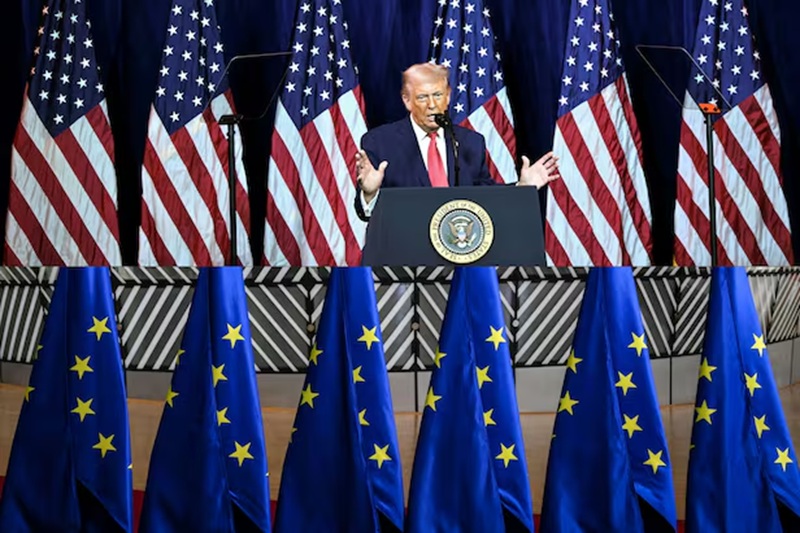
The proposed “freedom.gov” portal signals a sharp escalation in Washington’s clash with European content rules, positioning the U.S. government as a potential facilitator of access to material banned under EU law.
The domain name is live. The page is sparse. And behind it sits a proposal that could redefine how the United States confronts Europe’s tightening grip on online speech.
According to the report, within the U.S. State Department, officials are developing an online portal — freedom.gov — that would enable users in Europe and potentially other regions to access content restricted or removed under local laws. The material could include posts categorized by European regulators as illegal hate speech, terrorist propaganda, or disinformation, according to three sources familiar with the discussions who spoke to Reuters.
Register for Tekedia Mini-MBA edition 20 (June 8 – Sept 5, 2026).
Register for Tekedia AI in Business Masterclass.
Join Tekedia Capital Syndicate and co-invest in great global startups.
Register for Tekedia AI Lab.
The project, overseen by Undersecretary for Public Diplomacy Sarah Rogers, was expected to be introduced at the recent Munich Security Conference. The unveiling did not occur. Two sources said internal concerns had been raised within the State Department, including by legal officials, though they did not specify the nature of those reservations.
A State Department spokesperson denied that any announcement had been delayed and rejected claims that lawyers had objected. The spokesperson said the U.S. does not operate a censorship-circumvention program specific to Europe but added: “Digital freedom is a priority for the State Department, however, and that includes the proliferation of privacy and censorship-circumvention technologies like VPNs.”
The design of the portal, as described by one source, could include a built-in virtual private network function that makes user traffic appear to originate in the United States. The source also said activity on the platform would not be tracked. If implemented, that feature would allow users to access content blocked under national regulations while masking their location.

Such a move would represent a significant shift in how Washington projects its digital policy abroad. For years, U.S. funding for VPNs and circumvention tools focused on countries such as China, Iran, Russia, Belarus, Cuba, and Myanmar — jurisdictions widely characterized by Washington as authoritarian. Extending similar infrastructure to democratic allies would place the U.S. government in unfamiliar terrain: facilitating access to material that partner governments have deemed unlawful.
President Donald Trump has elevated free speech — particularly what his administration describes as the suppression of conservative voices — to a central pillar of foreign policy. That stance has sharpened friction with European regulators enforcing the European Union’s Digital Services Act and related frameworks.
The EU’s speech restrictions stem from post-World War II efforts to prevent extremist ideologies from regaining a foothold. Over decades, those principles have evolved into a layered regulatory system requiring rapid removal of illegal hate speech, terrorist content, and certain forms of disinformation. The burden falls most heavily on large online platforms.

Companies such as Meta and X have faced enforcement actions. X, owned by Trump ally Elon Musk, was fined 120 million euros in December for noncompliance with EU obligations. Germany alone issued 482 removal orders in 2024 for content deemed supportive of terrorism, compelling providers to take down more than 16,000 pieces of material.
To Washington’s current leadership, those measures amount to ideological gatekeeping. In its December National Security Strategy, the administration warned that Europe faces “civilizational erasure” and pledged to prioritize “cultivating resistance to Europe’s current trajectory within European nations.” The freedom.gov project fits squarely within that framing.
Former State Department official Kenneth Propp, now with the Atlantic Council’s Europe Center, described the initiative as “a direct shot” at European regulatory regimes. He said the portal “would be perceived in Europe as a U.S. effort to frustrate national law provisions.”
That perception could complicate already tense transatlantic relations. Trade disagreements, diverging strategies on Russia’s war in Ukraine, and Trump’s stated intention to assert control over Greenland have strained alliances. A U.S.-backed tool encouraging users to bypass European law would deepen the ideological rift.
The operational mechanics also raise questions. Commercial VPN services are widely available in Europe, often for modest subscription fees. It remains unclear what unique functionality a U.S. government portal would provide beyond symbolic endorsement. If the site aggregates or mirrors removed content, it could create diplomatic disputes over jurisdiction and liability. If it simply routes users to existing platforms through anonymized connections, its novelty may lie more in politics than technology.
The domain freedom.gov was registered on January 12, according to the federal registry get.gov. As of midweek, the site displayed the logo of the National Design Studio, the phrase “fly, eagle, fly,” and a log-in form. Two sources said Edward Coristine, a former member of Musk’s Department of Government Efficiency, is involved in the project through the National Design Studio, which was established to modernize federal websites.
For European policymakers, the portal could test the boundaries of digital sovereignty. EU law allows regulators to impose fines and, in extreme cases, restrict access to platforms that fail to comply. If a U.S. government-backed site were seen as systematically enabling circumvention, Brussels would face a choice between tolerating it, negotiating with Washington, or escalating enforcement responses.
At its core, the dispute reflects two competing philosophies. The U.S. constitutional tradition presumes that nearly all speech should remain protected, even if offensive or inflammatory. The European model balances expression against historical memory and public order, granting regulators authority to remove certain categories of harmful content.
Freedom.gov, if launched, would sit at that fault line. More than a website, it would symbolize Washington’s willingness to project its interpretation of digital liberty into allied jurisdictions — not through diplomacy alone, but through code and connectivity.