

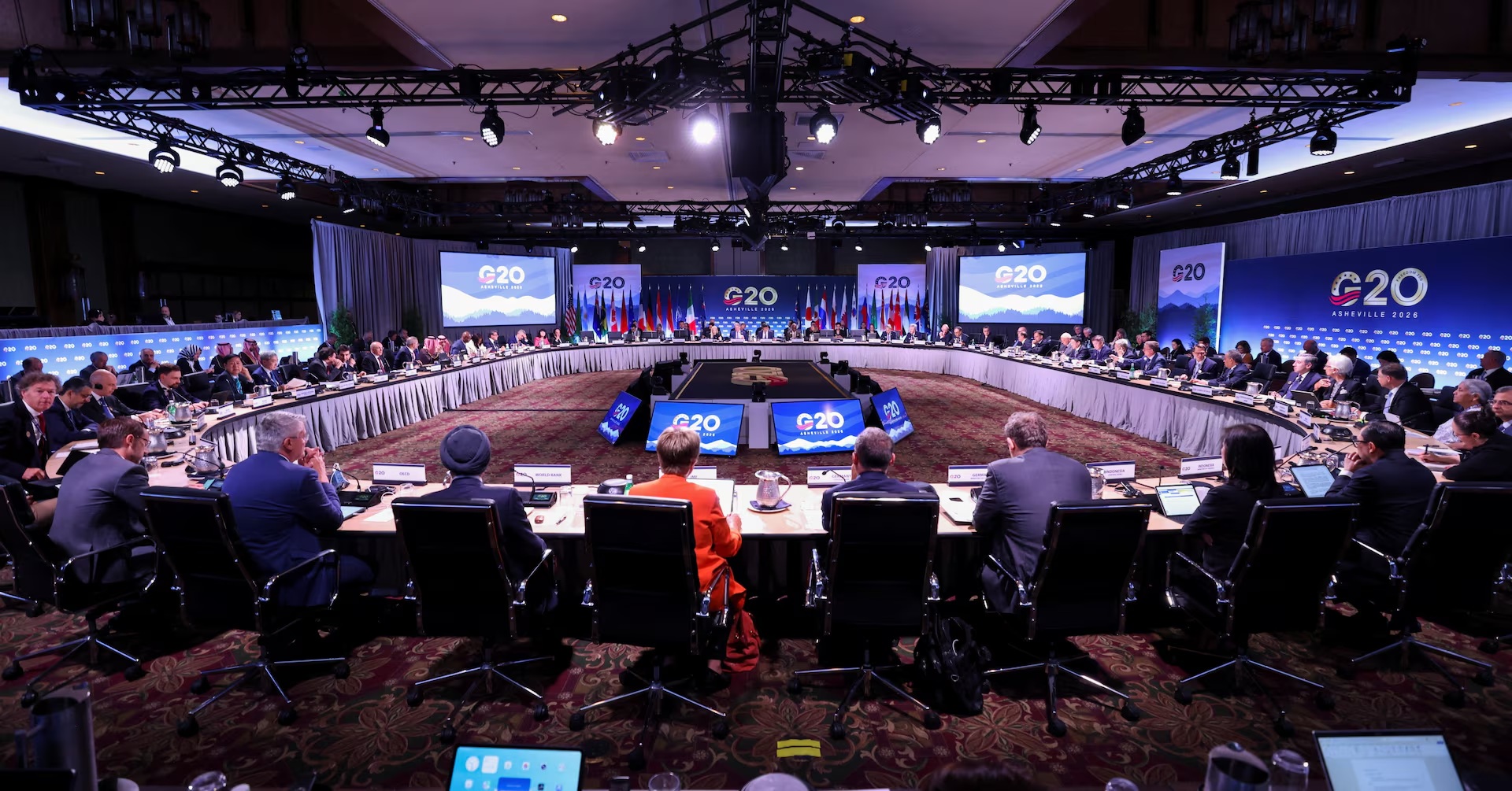
The Trump administration is pressing G20 economies to address global trade and fiscal imbalances as a renewed sell-off in government bonds highlights growing concerns over debt, inflation and the prospect of tighter monetary policy.
U.S. Treasury Secretary Scott Bessent is using the G20 finance ministers’ meeting in Asheville, North Carolina, to push for changes to trade relationships with China, arguing that Beijing’s export-heavy economic model is contributing to persistent global imbalances.
The U.S. is seeking greater pressure on China to shift its economy toward domestic consumption and away from exports. Bessent told Reuters that G20 members should reconsider their trading arrangements with China and examine higher barriers to Chinese goods.
Register for the next Tekedia Mini-MBA.
Register for Tekedia AI in Business Masterclass.
Join Tekedia Capital Syndicate and co-invest in great global startups.
The push comes at a particularly sensitive moment for global financial markets. Government bond yields rose sharply across major economies on Tuesday, with Japan’s 10-year yield reaching 3% for the first time since 1996. U.S., German, Eurozone and British borrowing costs also climbed as investors reassessed inflation and fiscal risks.
The combination of higher energy prices, renewed conflict in the Middle East and concerns about government debt has complicated the outlook for central banks. Higher inflation can delay interest-rate cuts or force policymakers to consider tighter policy, while rising yields increase governments’ debt-servicing costs and can put pressure on equity valuations.
China at the center of the trade debate
Washington’s focus on China reflects a longstanding dispute over the country’s large trade surplus and industrial policy.

China’s domestic demand has remained relatively weak, encouraging manufacturers to rely heavily on overseas markets. Chinese exports rose 23.9% year-on-year in July, according to the figures cited by Reuters, as companies increased shipments of electric vehicles, semiconductors and other manufactured goods.
The surge has intensified concerns in the United States and Europe that excess Chinese production could displace domestic manufacturers and widen trade deficits.
The European Union is also pushing for a more balanced relationship with China. European Economy Commissioner Valdis Dombrovskis said China needs to increase domestic spending, the United States needs to reduce its spending, while Europe needs to invest more.

“To put short the summary of this analysis … China would need to spend more, U.S. would need to spend less, and EU would need to invest more,” Dombrovskis said.
The scale of the imbalance is substantial. China’s goods trade surplus with the European Union reached €360.6 billion in 2025, up 15% from the previous year, and has continued to expand this year as Chinese exports to Europe rise while imports from the bloc decline.
Polish Finance Minister Andrzej Domanski also backed the U.S. position, arguing that China’s currency is significantly undervalued and that state support for exports is creating problems for European economies.
“We do know that Chinese currency is hugely undervalued, that China is supporting very actively subsidizing its exports and this is a problem for Europe as well,” Domanski told Reuters.
Fiscal Imbalance Complicates U.S. Argument
The U.S. push, however, faces a significant complication: Washington is itself running large fiscal and external deficits.
Economists have noted that reducing America’s trade deficit cannot be separated from the country’s fiscal position. The United States continues to run annual budget deficits exceeding $1 trillion, while its public debt has surpassed $40 trillion. That makes it difficult for Washington to demand greater fiscal discipline abroad without addressing its own borrowing requirements.
The bond market is already highlighting this tension. Higher Treasury yields mean the U.S. government must pay more to finance its debt, potentially creating a feedback loop in which larger interest costs contribute to wider deficits and greater borrowing needs.
The problem is not confined to the United States. Japan, Britain and several European economies are also confronting elevated debt burdens and rising financing costs.
The latest global bond sell-off therefore gives the G20 discussions an immediate financial dimension. If yields remain elevated, governments could face pressure to reduce spending, increase revenues or accept slower economic growth to keep debt dynamics under control.
Critical Minerals Add Another Fault Line
Trade tensions are also extending beyond conventional goods. China’s dominance of critical-mineral processing has become a major source of geopolitical leverage. Beijing imposed export restrictions on rare earths in April 2025 following the escalation of U.S. tariffs, measures that have also affected companies outside the United States.
Japanese Finance Minister Satsuki Katayama told G20 counterparts that arbitrary restrictions on critical minerals were damaging the global economy and should be removed.
The issue is proving difficult in negotiations over a joint G20 communique. China opposes language that singles out “non-market economies” and is resisting stronger wording on critical-mineral export restrictions, according to officials.
The dispute illustrates the limits of the G20 as an economic policy forum. The group brings together economies with sharply different interests, including the United States and China, whose strategic rivalry continues to shape global trade and supply chains.
Ukraine Adds Another Division
The talks are also being complicated by Russia’s participation. Russian Finance Minister Anton Siluanov attended the meeting in person, marking the first time Russia has participated in the G20 forum physically since its invasion of Ukraine in 2022.
European finance ministers expressed surprise and dismay at his presence, while European governments are seeking strong language condemning Russia’s war against Ukraine in the joint statement.
That development has created another obstacle to consensus at a meeting already divided over trade, fiscal policy, China and critical minerals.
For Washington, the broader objective is to use the G20 to address what it sees as structural distortions in the global economy. But reaching agreement will be difficult. China is unlikely to accept language that directly targets its industrial model, while European governments have their own concerns about Chinese competition and Russia’s war in Ukraine.
Meanwhile, the bond market is sending a separate warning that regardless of whether the G20 reaches an agreement, investors are increasingly demanding compensation for inflation, fiscal deterioration and geopolitical risk. That makes the debate over global imbalances more than a question of trade policy. Some analysts believe it is increasingly tied to the cost of capital for governments, businesses and households worldwide.