

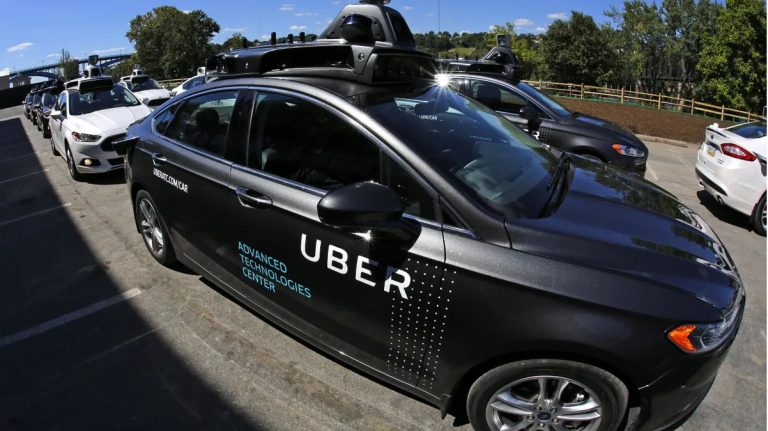
Uber launched autonomous rides in London on Thursday using artificial-intelligence technology developed by British self-driving company Wayve, bringing robotaxis to the British capital as the ride-hailing giant expands its autonomous mobility operations across Europe.
The launch makes London the second European city where Uber offers autonomous rides, following the introduction of robotaxi services in Zagreb.
The initial service will operate with a licensed safety operator in the vehicle to monitor the autonomous system, with fully driverless operations planned for a later stage once regulatory requirements are met, the companies said.
Register for the next Tekedia Mini-MBA.
Register for Tekedia AI in Business Masterclass.
Join Tekedia Capital Syndicate and co-invest in great global startups.
Passengers requesting UberX, Uber Comfort or Uber Electric rides could be matched with a Wayve-powered Ford Mustang Mach-E at no additional charge. Fewer than 20 vehicles will be available when the service launches.
The limited fleet marks an early commercial test of autonomous driving technology in one of Europe’s most complicated urban environments. Uber and Wayve will be able to gather operational data and consumer feedback while regulators assess how the technology performs on London’s roads.
Uber’s Global Head of Autonomous Mobility, Sarfraz Maredia, said the service would help the companies demonstrate the technology’s capabilities to both passengers and policymakers.

The launch would “build credibility with consumers as well as with the government,” Maredia said.
British Transport Secretary Heidi Alexander described the rollout as an important step for the country’s autonomous-vehicle industry.
“This is a major milestone for the future of transport in London, as British innovation brings this technology onto our roads and gives passengers more choice,” Alexander said.

Despite Thursday’s launch, widespread driverless operation in London remains subject to regulatory approval. Transport for London, the city’s transport authority, has yet to authorize fully driverless commercial services, leaving a licensed operator in the vehicle during the initial phase.
That makes the London rollout both a technology demonstration and a test of Britain’s regulatory framework for autonomous vehicles. The companies will need to show that the system can operate safely across London’s dense traffic, complex road layouts, cyclists, pedestrians and frequently changing weather conditions before removing the human safety operator.
Wayve’s autonomous driving system, known as the Wayve AI Driver, is designed to learn from driving experience in a manner similar to a human driver. The company said the system can adapt to new roads, vehicles, weather conditions, and cities rather than relying solely on detailed pre-programmed maps and fixed driving rules.
That approach is central to Wayve’s technology strategy and could give it an advantage as autonomous vehicle companies seek to expand beyond tightly controlled operating zones.
Alex Kendall, Wayve’s chief executive and co-founder, said London was an appropriate location for the company’s first public deployment.
“We’re proud to introduce the Wayve AI Driver to the public for the first time right here in London, our home city and one of the most complex driving environments in the world,” Kendall said.
The rollout builds on Uber’s partnership with Wayve, which began in 2024 and included an investment by the ride-hailing company. The agreement was designed to support the deployment of Wayve-powered autonomous vehicles across multiple markets.
For Uber, autonomous vehicles offer a potential way to expand ride capacity while reducing the industry’s dependence on human drivers over the longer term. Rather than developing its own autonomous-driving system, Uber has pursued partnerships with technology companies and vehicle manufacturers, allowing it to focus on its ride-hailing platform and customer network.
The London launch also comes as competition in autonomous mobility intensifies. Companies across the industry are moving from testing self-driving technology to limited commercial deployments, making regulatory approval, safety performance and consumer acceptance important competitive factors.
Wayve’s London deployment is notable because the company is seeking to demonstrate that its AI-based approach can generalize across different driving environments. Successfully handling London’s unusually complex streets could provide an important validation of the technology as Wayve looks to expand internationally.
For now, the small fleet and continued presence of safety operators mean the service remains far from a fully autonomous transportation network. But the launch marks a transition from testing the technology to putting it directly in front of paying passengers. The next test will hinge on Wayve and Uber’s ability to demonstrate enough safety and reliability to convince regulators to remove the human operator and allow the service to scale beyond a handful of vehicles.