

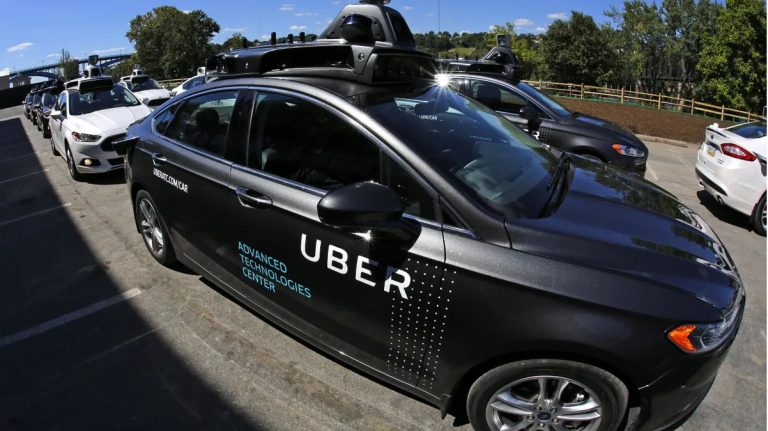
Uber, Lucid Motors, and autonomous driving startup Nuro have lifted the curtain on the production-intent version of their long-anticipated robotaxi, offering the clearest signal yet that Uber plans to play a central role in the next phase of commercial autonomous ride-hailing.
Revealed at the 2026 Consumer Electronics Show, the vehicle is the most tangible outcome so far of a partnership announced more than six months ago, when Uber committed $300 million to Lucid and agreed to purchase 20,000 of the automaker’s electric vehicles. The companies said the robotaxi is already undergoing testing on public roads, ahead of a planned commercial rollout in the San Francisco Bay Area later this year.
The robotaxi is built on Lucid’s Gravity SUV platform and is positioned as a premium autonomous vehicle, a deliberate contrast to the more utilitarian designs that have dominated early driverless deployments. Integrated into the body and a roof-mounted “halo” are high-resolution cameras, solid-state lidar sensors, and radar systems, all powered by Nvidia’s Drive AGX Thor computing platform.
Register for Tekedia Mini-MBA edition 20 (June 8 – Sept 5, 2026).
Register for Tekedia AI in Business Masterclass.
Join Tekedia Capital Syndicate and co-invest in great global startups.
Register for Tekedia AI Lab.
That halo also features LED lighting designed to help riders identify their vehicle, echoing a now-familiar approach used by competitors such as Waymo. Unlike Waymo, however, the Uber-Lucid-Nuro vehicle is being assembled with its autonomous hardware already integrated at Lucid’s Casa Grande, Arizona, factory. This removes the need for costly post-production retrofitting, a step that Waymo currently undertakes by dismantling and reassembling Jaguar I-Pace SUVs.
Industry analysts see this as a meaningful operational advantage. Embedding autonomy hardware during manufacturing can shorten deployment timelines, reduce labor costs, and improve long-term scalability — all issues that have weighed heavily on the economics of robotaxi services.
Visually, the CES version is a more refined iteration of the test vehicles that have appeared in press images over the past seven months. The most notable additions relate to the rider experience, an area where Uber is seeking to leverage its consumer-facing strengths.

The robotaxi features an exterior screen on the halo that greets riders on arrival, as well as multiple interior displays designed to guide passengers through the trip. The rear passenger screen shows an isometric map of the vehicle navigating city streets, complete with visual representations of nearby cars and pedestrians — a design that will feel familiar to anyone who has ridden in a Waymo vehicle.
While the software was not yet interactive at the CES preview, Uber said the interface is being built to display estimated arrival times, remaining journey duration, climate and music controls, and access to rider support. A dedicated control allows passengers to request a pull-over, an increasingly standard feature aimed at improving trust and comfort in autonomous vehicles.
The front passenger screen mirrors much of this information on a larger central touchscreen, with elements also extending to Lucid Gravity’s sweeping 34-inch curved OLED display behind the steering wheel. The emphasis on screens and visual feedback reflects a broader industry consensus that transparency — showing passengers what the vehicle “sees” and “thinks” — is critical to user acceptance of driverless rides.

Uber’s decision to anchor this service around the Gravity underscores its intent to differentiate on comfort and perceived quality. The SUV’s spacious interior, particularly in the two-row configuration showcased at CES, positions the service closer to a premium ride-hailing tier rather than a low-cost mass transit substitute. Uber said a three-row version will also be offered, potentially broadening appeal to families and group travelers.
Still, the choice is not without risk. Lucid’s first full year of Gravity production was marked by software challenges as the company ramped up manufacturing. Those issues became significant enough that interim CEO Marc Winterhoff sent an apology email to customers in December, acknowledging the “frustrations” they faced.
Lucid has since said it has stabilized production and software performance, announcing on Monday that it doubled 2024 production and achieved record sales. Whether the robotaxi variant avoids similar software growing pains remains an open question, particularly given the added complexity of autonomous systems layered on top of vehicle controls.
From a strategic standpoint, the partnership highlights Uber’s evolving approach to autonomy. After exiting its own self-driving unit in 2020, Uber has repositioned itself as a platform partner, investing selectively while leaving vehicle engineering and autonomy stacks to specialists. Nuro, which provides the autonomous driving technology, brings experience from both delivery robots and passenger vehicle autonomy, while Lucid supplies a high-end EV platform that aligns with Uber’s premium ambitions.
Once final validation is complete later this year, the companies said true production versions of the robotaxi will begin rolling off Lucid’s Arizona assembly lines. No firm production or deployment timeline was disclosed, underscoring the cautious tone that continues to surround commercial autonomy even as public testing expands.
However, the CES reveal marks a notable escalation in the autonomous ride-hailing race. While Waymo remains the clear leader in deployed robotaxi miles, Uber’s re-entry through partnerships — and its bet on a premium, factory-integrated vehicle — signals a more assertive attempt to shape how autonomous rides are delivered, branded, and monetized in the years ahead.