

The United States and nine partner countries have agreed to coordinate the protection of critical technologies, semiconductor supply chains and infrastructure supporting artificial intelligence, as Washington seeks to strengthen its position in the global AI race and reduce exposure to China.
The agreement, announced by the US State Department late Sunday, brings together Australia, India, Israel, Japan, South Korea, Qatar, Singapore, the United Arab Emirates and the United Kingdom alongside the United States. The countries signed the San Francisco Declaration, which identifies economic security as a foundation of national security and calls for collective protection of sensitive technologies and the infrastructure needed to develop and deploy AI.
The agreement establishes a framework for cooperation across AI policy, adoption, supply chains, security hubs, and infrastructure resilience. Working groups will be created to coordinate efforts in these areas, although the declaration does not specify binding commitments, funding arrangements or a common enforcement structure.
Register for the next Tekedia Mini-MBA.
Register for Tekedia AI in Business Masterclass.
Join Tekedia Capital Syndicate and co-invest in great global startups.
The initiative gives Washington a broader platform for coordinating technology policy with countries that occupy important positions in semiconductor manufacturing, advanced research, computing infrastructure and critical mineral supply chains. It also extends US efforts to organize an international technology coalition at a time when access to advanced chips and AI infrastructure has become a central issue in relations with Beijing.
The San Francisco Declaration builds on Pax Silica, an initiative launched by Washington last year to secure supply chains supporting AI models, semiconductors and critical minerals.
Pax Silica seeks to encourage joint projects among the United States and its partners, coordinate export controls and reduce dependence on countries regarded by Washington as potential sources of supply-chain vulnerability. The effort covers several layers of the AI industry, from the minerals used in semiconductor production to the chips, computing systems and models that underpin advanced AI applications.

The expansion of the agreement could give the United States greater influence over how allied countries manage access to sensitive technologies and infrastructure. It also creates a framework through which Washington can encourage partners to align their technology policies with US security priorities.
Germany, Sweden, the Netherlands and the European Commission are expected to sign the agreement next week, the Financial Times reported, citing US Under Secretary of State for Economic Affairs Jacob Helberg. Their participation would broaden the initiative’s European reach and bring additional industrial and technological capabilities into the coalition.
The arrangement also comes as Washington weighs how to prevent advanced AI technology and computing resources from reaching Chinese companies. Reuters reported in August that the United States was preparing to tell dozens of countries they would have to choose between participating in a US-led AI coalition and joining a competing framework backed by Beijing.

That approach raises questions for countries seeking to maintain commercial and technological relationships with both powers. Governments in Asia and the Middle East, in particular, have incentives to attract investment, secure access to advanced computing and avoid becoming caught between competing export-control systems.
Washington’s challenge is to turn diplomatic alignment into practical supply-chain coordination. Signing a declaration does not automatically create alternative sources of critical minerals, expand semiconductor production or guarantee that participating countries will enforce common restrictions. Those outcomes will depend on investment, industrial capacity and the willingness of governments to accept the commercial costs of tighter controls.
China’s Chip Access Looms Over Trump-Xi Meeting
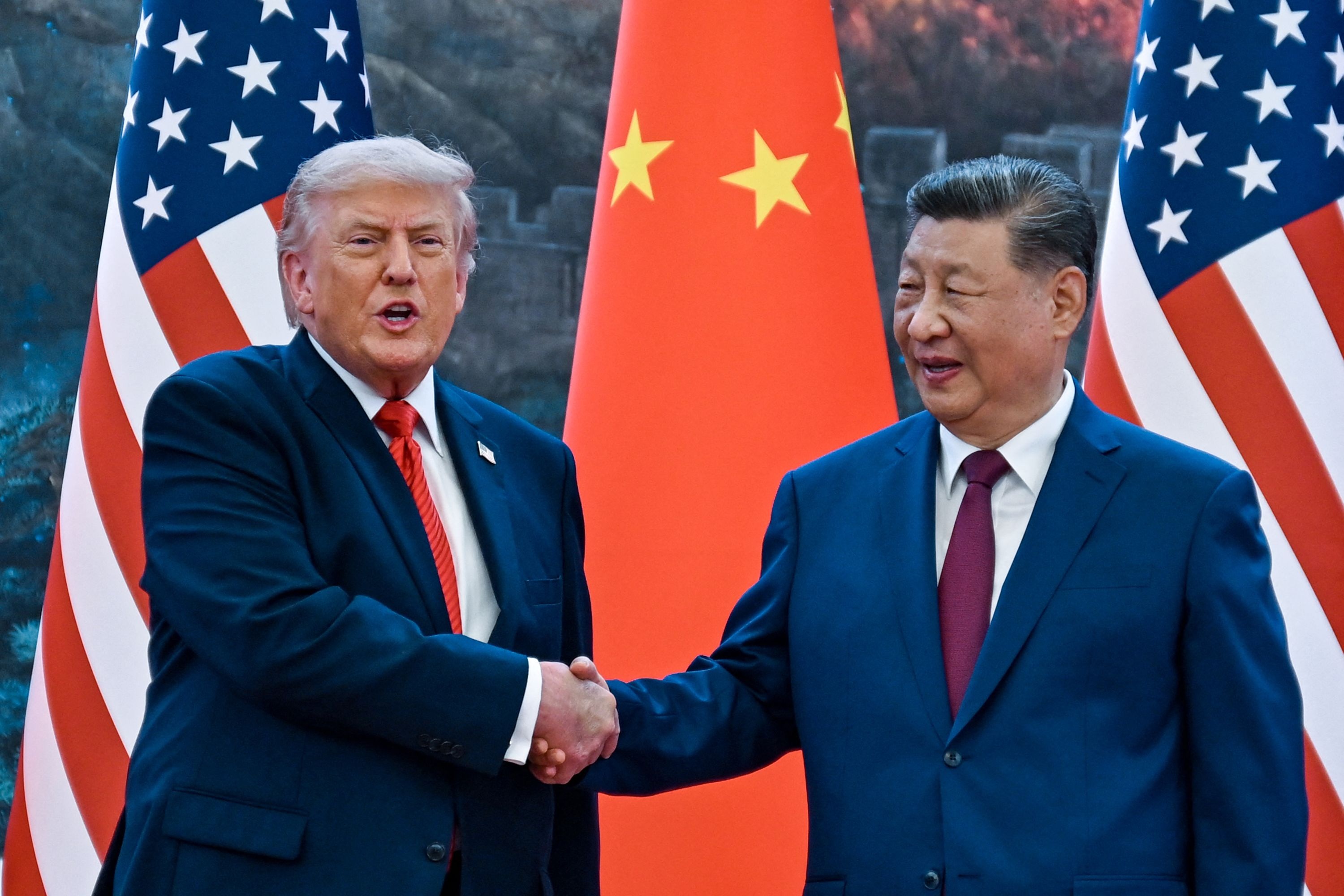
The declaration comes days before US President Donald Trump and Chinese President Xi Jinping are scheduled to meet at a summit in Shenzhen on Thursday. Analysts expect restrictions on China’s access to advanced AI chips to feature prominently in the discussions, although both governments have also explored cooperation on AI safety.
The issue has become more sensitive following the resignation of Nvidia co-founder Jensen Huang, who had played a prominent role in earlier US-China discussions on chip sales. His departure, following reports of an affair with a woman suspected by US authorities of having links to Chinese intelligence, has prompted calls among US lawmakers for tighter restrictions on China’s access to advanced processors. The allegations surrounding the relationship have not been established as fact.
The controversy adds political pressure to an existing dispute over how much access Chinese companies should have to US-designed AI chips. Nvidia remains a major supplier of advanced processors used in AI development, and restrictions on its products could affect Chinese technology companies’ ability to obtain computing capacity.
George Chen, chair of digital practice at consultancy The Asia Group, said export controls would likely be high on the agenda when Xi meets Trump.
“President Xi may not name or mention Jensen Huang, but I’m pretty sure export controls will be high on the agenda when he meets Trump,” Chen said.
He added that Beijing’s concern extends beyond individual chip restrictions to the broader direction of US policy towards China’s technological development.
“If we are moving from strategic stability to strategic containment, that’s a big shift and that’s what Beijing is watching,” Chen said.
Export controls can affect more than the immediate availability of processors. They can influence investment decisions, access to foreign computing infrastructure, semiconductor partnerships, and the ability of Chinese companies to compete in advanced AI development.
AI Safety Offers a Channel for Cooperation
Even as the two governments compete over technology, Washington and Beijing have been exploring ways to manage the risks posed by powerful AI systems.
Three people briefed on preparations for the Shenzhen talks said the two sides had planned further discussions on safeguards against AI misuse. One proposal involves an emergency communication mechanism that would allow each government to notify the other of serious AI incidents before they escalate into wider national security concerns.
The mechanism was discussed in September by US Treasury Secretary Scott Bessent and Chinese Vice Premier He Lifeng but has yet to become operational, according to people familiar with the discussions cited by Reuters. They did not identify the reasons for the delay.
So far, communication has relied largely on direct contacts between senior officials. A formal notification arrangement could provide a more structured channel for sharing information about dangerous AI incidents and reducing the risk of misinterpretation.
Bessent said in New York last week that the two sides would discuss communication protocols for AI safety incidents at the APEC AI talks and expected to exchange best practices for testing advanced models.
The proposed mechanism would not resolve disputes over chip exports, intellectual property or competition in AI development. It could, however, provide a limited area of cooperation at a time when both governments are trying to manage the risks associated with the technology.
“Right now, I don’t think it’s in the interest of either side to let the potential export control squeeze sour the leaders’ summit,” said Bo Zhengyuan, a Shanghai-based partner at research consultancy Plenum.
The competing priorities are expected to shape the Shenzhen meeting. Washington wants stronger safeguards around the technologies and infrastructure underpinning AI, while Beijing is concerned that restrictions could become part of a wider effort to constrain its economic and technological development.