


The media environment in Nigeria has never been more dynamic, pressured, or unpredictable. For journalists and editors navigating today’s information ecosystem, understanding how news values operate within a VUCA environment, defined by Volatility, Uncertainty, Complexity, and Ambiguity, has become increasingly important. Newsrooms are no longer simply selecting stories based on traditional editorial judgment. They are making rapid decisions in a digital landscape shaped by audience behavior, misinformation, economic pressures, political tensions, and technological disruption.
Our analysis of journalists and academics’ views regarding the presence of news values in Nigerian online newspapers offers useful insight into what matters most in today’s editorial climate. The results point towards a strong preference for stories that are timely, socially relevant, geographically proximate, and impactful to large audiences. For newsroom leaders, this raises an important question: Are editorial priorities aligned with the realities of a VUCA-driven media environment?
In a volatile environment, audiences increasingly expect speed without sacrificing credibility. Unsurprisingly, stories reported as events unfold emerged as one of the most highly valued characteristics in online news reporting. Real-time journalism has become a competitive necessity. Breaking news, live updates, and immediate verification mechanisms are no longer optional editorial luxuries. They have become audience expectations.
Register for the next Tekedia Mini-MBA.
Register for Tekedia AI in Business Masterclass.
Join Tekedia Capital Syndicate and co-invest in great global startups.
However, speed alone is insufficient. In uncertain environments, where public trust is fragile and misinformation spreads rapidly, journalists must reaffirm the centrality of verification and contextual reporting. Nigerian audiences are not merely seeking information. They are searching for clarity. Editors should therefore encourage newsroom cultures that prioritize explanation over sensationalism, particularly during crises involving elections, economic reforms, insecurity, or public health concerns.
Another notable trend is the strong emphasis on stories perceived as valuable to large numbers of people. This suggests that relevance continues to be one of the most enduring principles of journalism in Nigeria. Citizens increasingly engage with stories that directly affect their daily realities, including inflation, electricity supply, fuel prices, education, healthcare, governance, and public safety. In a complex media environment saturated with competing narratives, relevance becomes a strategic editorial advantage.
This result also reinforces the continuing importance of proximity. Stories that are close to Nigerians received consistently strong ratings, highlighting an enduring preference for geographically and culturally resonant reporting. In practice, this means editors should resist the temptation to over-prioritize international content at the expense of deeply localized storytelling. Hyperlocal reporting, regional accountability journalism, and community-centered narratives may become more influential than broad and generalized coverage.

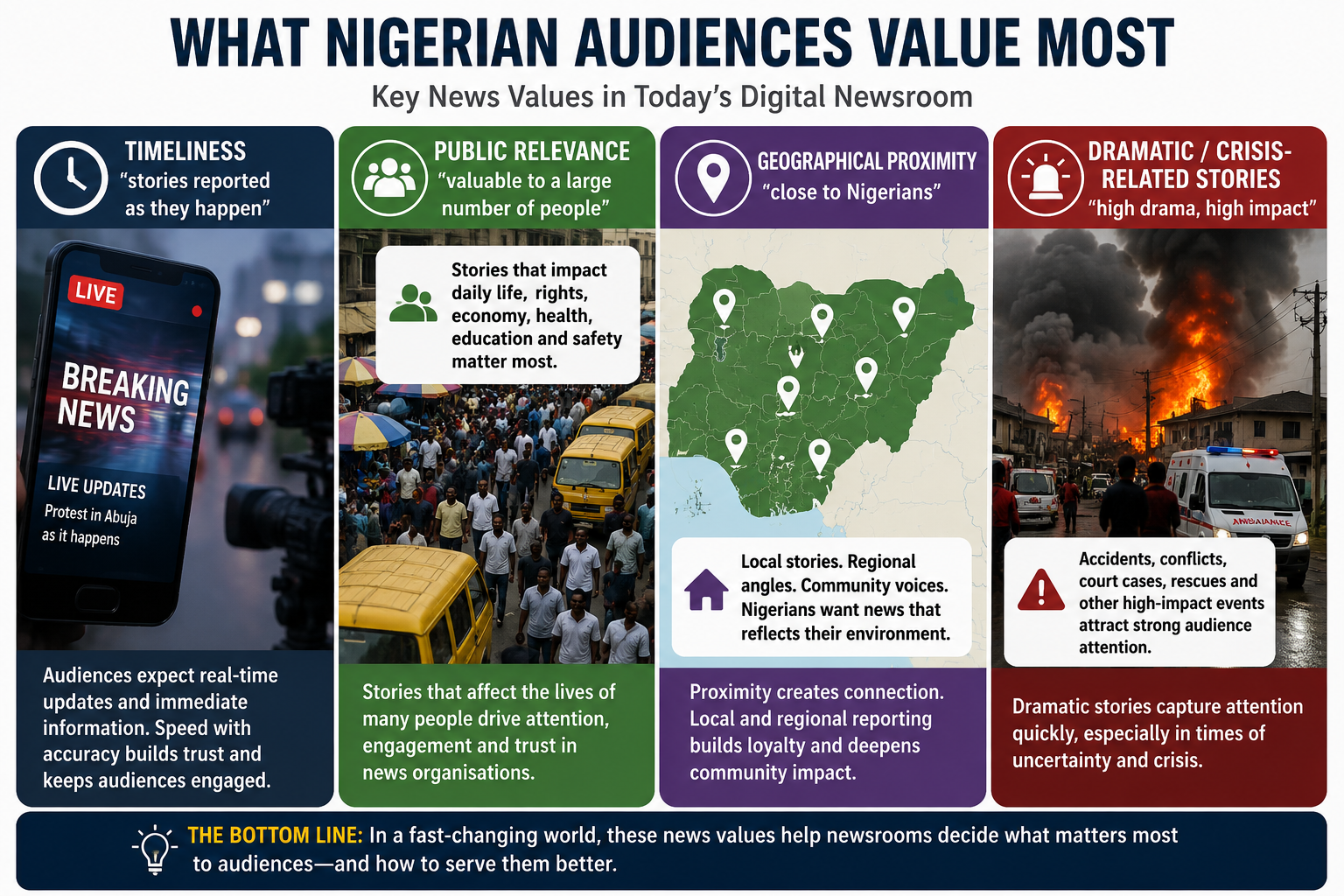
At the same time, Nigerian online newspapers continue to demonstrate a strong orientation towards dramatic and crisis-related stories, including court cases, accidents, political disputes, rescues, and social conflicts. Such stories naturally align with audience attention patterns, particularly in digital spaces where urgency drives clicks and engagement. Yet VUCA conditions require greater editorial sophistication. Journalism should not only report crises but also explain their implications, causes, and possible solutions.
This distinction matters because a media environment driven solely by dramatic narratives risks amplifying fear, polarization, and fatigue. Editors should consider balancing crisis reporting with constructive journalism approaches that highlight resilience, policy alternatives, and recovery efforts. Audiences deserve more than awareness of problems. They deserve informed pathways towards understanding.
Interestingly, participants appeared less enthusiastic about stories aligned primarily with a news organization’s internal agenda. This signals an important editorial lesson for Nigerian media leaders. Audiences and professionals increasingly value public-interest journalism over institutional positioning. In an era where credibility is continuously contested, editorial independence remains one of a newsroom’s strongest assets.

Another emerging reality is the growing significance of multimedia storytelling. Stories featuring compelling visuals, audio, and video received strong ratings, reflecting how digital audiences increasingly consume news across formats. For editors, this means text-first approaches may no longer be enough. The future newsroom must think visually, audibly, and interactively. Journalists equipped with multimedia competencies are likely to become indispensable in sustaining audience engagement.
The VUCA environment is not merely a challenge for journalism. It is also an opportunity. Nigerian editors and journalists now have a chance to redefine newsroom priorities around trust, relevance, speed, context, and audience-centered storytelling. The core principles of journalism remain intact, but the conditions surrounding them have changed.
Ultimately, news values in Nigeria are evolving from simply determining what gets published to shaping how journalism remains meaningful amid uncertainty. For newsrooms willing to adapt thoughtfully, the future is not simply about surviving disruption. It is about leading through it.