

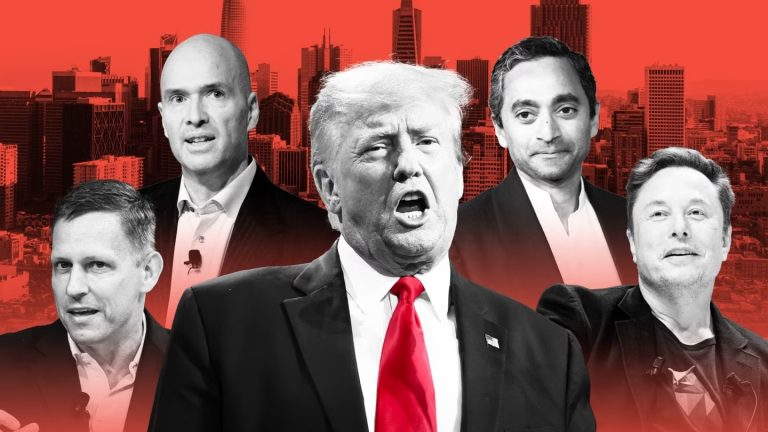
American corporate executives are increasingly finding themselves caught between political loyalty, business interests, and the changing expectations of their customers and employees.
After years of navigating the influence of Donald Trump’s MAGA movement, some of the country’s most powerful business leaders appear to be reconsidering how closely they associate themselves with the president and his political agenda.
The emerging effort to de-MAGAfy corporate America reflects growing concerns about reputational damage, economic uncertainty, political polarization, and the long-term consequences of allowing business decisions to become extensions of partisan politics.
Register for the next Tekedia Mini-MBA.
Register for Tekedia AI in Business Masterclass.
Join Tekedia Capital Syndicate and co-invest in great global startups.
For much of Trump’s political rise, prominent American executives adopted a cautious approach. Some openly embraced his administration.
While others maintained relationships with the White House to secure favorable policies, regulatory concessions, tax advantages, and access to political decision-makers. Corporate America understood that maintaining a constructive relationship with Washington could deliver substantial benefits.
Particularly in industries dependent on government contracts, trade policies, immigration rules, and regulatory approvals. However, political relationships can become liabilities when public sentiment changes.

Companies that previously benefited from appearing close to Trump now face questions about whether their political associations could alienate customers, employees, investors, and international partners.
For multinational corporations, the challenge is particularly significant because their commercial interests extend far beyond the American electorate.
Technology companies are among the businesses facing this complicated balancing act. Silicon Valley executives have historically criticized several Republican positions, particularly on immigration, climate policy, and social issues.

Yet the importance of artificial intelligence, semiconductor manufacturing, data centers, and government technology contracts has encouraged many technology leaders to establish closer relationships with the administration.
That cooperation does not necessarily translate into permanent political allegiance. Corporate leaders are confronting pressure from employees who increasingly expect employers to demonstrate consistency between their public values and business decisions.
Political endorsements, controversial executive appearances, and donations can generate internal disagreements, especially among workforces with diverse political beliefs. Some companies may prefer to reduce visible political associations and concentrate on commercial priorities.
The financial implications are equally important. International investors generally prioritize predictable regulations, stable institutions, and access to global markets.
A company perceived as excessively dependent on one political administration could face additional reputational risks if government priorities change following future elections. Diversifying political relationships is therefore becoming a practical business strategy rather than simply an ideological decision.
De-MAGAfying corporate America does not necessarily mean executives are abandoning conservative policies or rejecting Trump’s administration entirely.
Many still support tax reductions, deregulation, domestic manufacturing incentives, and policies intended to strengthen American competitiveness.
Their concern may be less about individual policies and more about being permanently identified with an increasingly divisive political movement. There is a commercial calculation involving international markets.
American brands operate across Europe, Asia, Africa, and other regions where Trump’s policies and political rhetoric may attract criticism. Maintaining a recognizable distance from partisan politics can help multinational companies protect customer relationships and preserve their global reputations.
Corporate America’s attempt to de-MAGAfy reflects the uncomfortable reality that political influence can be commercially valuable while simultaneously creating long-term liabilities.
Executives want access to government without becoming politically dependent, and they want favorable policies without alienating customers.
Whether this shift becomes a lasting transformation or another temporary adjustment remains uncertain. One thing is increasingly clear: American business leaders are discovering that maintaining political flexibility may be just as important as maintaining political influence.