

Xpeng is accelerating a pivot beyond electric vehicles, betting on flying cars, robotaxis, and humanoid robotics as intensifying competition in the EV market forces automakers to search for new growth engines.
President Brian Gu said the company expects to begin large-scale production of its “flying” cars next year, while targeting mass production of humanoid robots in the fourth quarter of 2026. The timelines place Xpeng at the forefront of an emerging shift in the auto industry, where companies are expanding into adjacent technologies to sustain growth as margins in core EV businesses come under pressure.
The company has already secured more than 7,000 orders for its flying vehicles, the majority of which are within China. Yet the commercialization path remains heavily dependent on regulatory clearance, with aviation approvals likely to be the key gating factor. Unlike EVs, where policy frameworks are relatively mature, urban air mobility operates in a far more complex regulatory environment, potentially slowing deployment even as demand builds.
Register for the next Tekedia Mini-MBA.
Register for Tekedia AI in Business Masterclass.
Join Tekedia Capital Syndicate and co-invest in great global startups.
Xpeng’s push into aerial mobility comes against the backdrop of an increasingly crowded EV market. Price competition in China has intensified sharply over the past two years, compressing margins and forcing manufacturers to differentiate beyond hardware. In that context, automakers are beginning to position themselves less as carmakers and more as technology platforms.
The pattern is becoming clearer across the industry. Tesla has invested heavily in humanoid robotics and AI-driven automation, while Xpeng is extending its portfolio into flying vehicles alongside robotics. Both strategies underpin an effort to capture future value pools that extend beyond traditional vehicle sales.
Xpeng, at the same time, is scaling its autonomous driving ambitions. Gu said the company will begin robotaxi tests in Guangzhou this year, with 2027 expected to be a “critical year” for global trials conducted with partners. Over the next 12 to 18 months, Xpeng plans to produce hundreds to thousands of robotaxis, signaling a transition from pilot programmes to early-stage fleet deployment.

The robotaxi push aligns with a broader industry view that mobility services, particularly autonomous ride-hailing, could become a significant long-term revenue stream, potentially surpassing one-time vehicle sales in value.
Partnerships are central to Xpeng’s strategy. Gu pointed to “tremendous potential” for deeper collaboration with Volkswagen, which recently began mass production of its first EV model developed jointly with Xpeng. The alliance reflects a growing convergence between Western manufacturing scale and Chinese software capabilities, particularly in areas such as autonomous driving and in-car intelligence.
“There are a lot of areas that we can partner and really provide value to each other,” Gu said, adding that the company remains open to working with multiple automakers across regions. “We need to be nimble and willing to partner with different players in different regions.”

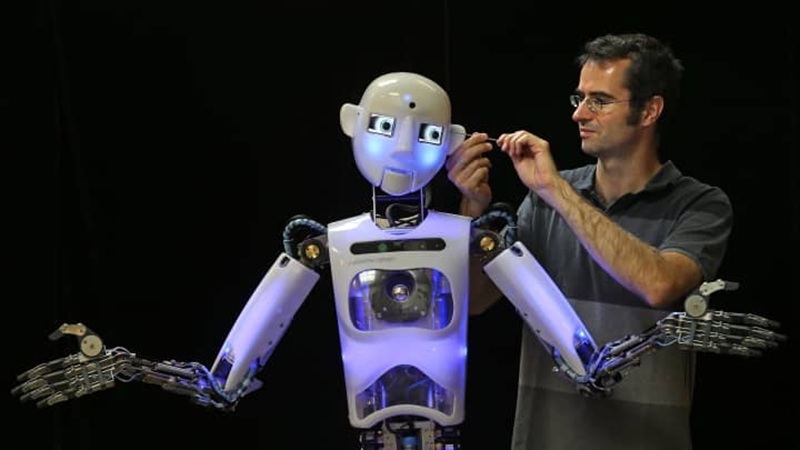
Beyond mobility, Xpeng is making a longer-term bet on humanoid robotics, an area Gu suggested could eventually eclipse its automotive business.
Initial deployments will focus on controlled, customer-facing environments such as reception and sales roles, where interaction models can be refined. Over time, the company expects broader adoption across service and potentially industrial use cases.
“Within the next 10 to 20 years, there will be more use cases for humanoid robots in our lives,” Gu said, adding that the robot business could ultimately become larger than the company’s EV division.
This underscores a deeper technological overlap. Advances in sensors, computer vision, and machine learning, initially developed for autonomous driving, are increasingly transferable to robotics and other autonomous systems. For companies like Xpeng, leveraging that shared technology stack across multiple products could improve returns on research and development spending.
Geographically, the company is also shifting toward a more global revenue mix. Xpeng currently operates in around 60 countries outside China and generated roughly 10% of its sales volume and about 15% of its revenue from overseas markets last year.
Gu said that in the next five to 10 years, more than 50% of revenue is expected to come from outside China, highlighting the importance of international expansion as domestic competition intensifies and pricing pressure persists.
Execution risks remain substantial across all fronts. Flying cars face regulatory and infrastructure hurdles, robotaxis must meet stringent safety and liability standards, and humanoid robotics is still at an early stage of commercial viability. Each initiative also requires sustained capital investment, raising questions about profitability timelines.
Still, the direction of travel across the industry is becoming harder to ignore. As EVs transition from high-growth disruptors to a more mature and competitive segment, leading players are extending into adjacent frontiers, from robotics to aerial mobility, in an effort to define the next phase of technological leadership.