

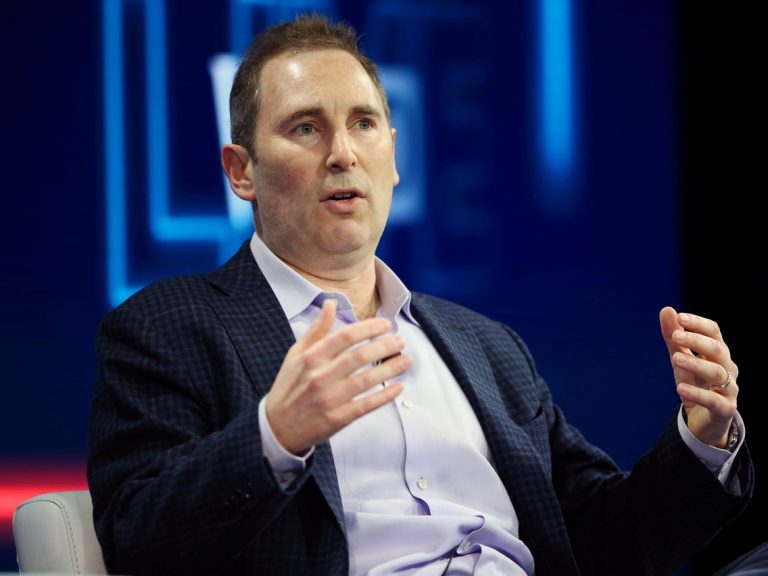
Amazon CEO Andy Jassy is standing firm in his conviction that the company’s record-shattering investments in artificial intelligence infrastructure are not a cause for investor alarm but rather the foundation for decades of future growth and market leadership.
In a wide-ranging interview on CNBC’s “Mad Money,” Jassy described artificial intelligence as nothing less than “the biggest technology transformation in our lifetimes.”
“It’s going to reinvent every single customer experience we know and altogether new ones we never imagined,” he said.
Register for the next Tekedia Mini-MBA.
Register for Tekedia AI in Business Masterclass.
Join Tekedia Capital Syndicate and co-invest in great global startups.
The remarks come amid ongoing debate about Amazon’s aggressive capital spending plans. In February, the company shocked markets by announcing it would pour $200 billion into capital expenditures this year, the bulk of it directed toward AI-related infrastructure such as data centers, chips, and networking equipment.
The disclosure triggered an immediate negative reaction from investors worried about margin pressure and cash flow. Shares tumbled in the aftermath but have since recovered strongly, reaching a new all-time high earlier this week.
At the heart of investor skepticism is a simple question: Can Amazon generate attractive returns on this massive deployment of capital, or is it risking shareholder value in a frantic race to keep up with rivals in the AI arms race? Some analysts have also flagged projections showing Amazon could post negative free cash flow in 2026, according to FactSet estimates.

Jassy, who ran Amazon Web Services before succeeding Jeff Bezos as CEO in 2021, argues that such concerns miss the bigger picture. He believes the scale of spending reflects the enormous opportunity ahead rather than recklessness, and he repeatedly drew parallels to Amazon’s experience building its cloud computing business more than a decade ago.
“After the first three years of this incarnation of AI, our run rate is over $15 billion, 260 times what it was the first three years of AWS,” Jassy said.
AWS is on track to generate roughly $166 billion in revenue this year.

“When you have shifts that are this momentous … you want to bet big,” he added.
Lessons from the AWS Playbook
Jassy’s confidence stems directly from Amazon’s history with AWS. In its early years, the cloud unit required heavy upfront investment and operated at thin or negative margins as the company built out data centers and global infrastructure years before meaningful revenue materialized. Critics at the time questioned whether the bet would ever pay off.
History proved the doubters wrong. AWS eventually became Amazon’s most profitable segment and a critical growth engine that helped fund expansion across the rest of the company. Jassy believes the current AI investments are following a strikingly similar trajectory, only on a much larger scale and with potentially greater rewards.
“We have to lay out capital and cash in advance of when we can monetize it,” he explained, referring to the years-long lead time required to build and equip new data centers. “Those assets, however, have multiyear long lifespans,” allowing Amazon to generate strong returns over an extended period once utilization ramps up.
He continued: “When your revenue growth starts to catch up with the capital expenditure growth, you actually end up really liking the operating margin, the free cash flow, and the [return on invested capital]. We’ve lived this movie once before in the first wave of AWS … and I think the same story is going to play out, except with much larger revenue and free cash flow downstream.”
Amazon is far from alone in its massive spending. Microsoft, Google, Meta, and Oracle are all pouring tens of billions of dollars annually into AI infrastructure. The collective spending by major tech players is reshaping the entire semiconductor and data center supply chain, driving up prices for chips, power, and cooling systems in the process.
Jassy acknowledged the intensity of the competition but argued that Amazon’s combination of AWS leadership, vast retail and advertising businesses, and deep logistics network gives it unique advantages in monetizing AI across consumer and enterprise use cases. From personalized shopping experiences and supply chain optimization to new AI-powered services for businesses, the CEO sees AI touching nearly every corner of Amazon’s empire.
Still, the near-term financial math is challenging. Heavy capital expenditures are weighing on free cash flow in the short term, even as AWS continues to deliver strong growth and the core retail business generates substantial operating cash. Jassy’s message to investors is one of patience: the current period represents the necessary investment phase before the substantial harvest.
Investors appear to be warming to Jassy’s vision. After the initial post-earnings sell-off, Amazon shares have steadily climbed, reflecting growing comfort with the long-term AI thesis. The stock’s recovery and subsequent record close suggest that many large shareholders are willing to give management the benefit of the doubt, especially given Amazon’s track record of successfully navigating major technological shifts.
However, questions remain. Execution risk is significant because building and efficiently operating AI infrastructure at this scale is enormously complex, involving everything from securing reliable power sources to managing relationships with chip suppliers like Nvidia and custom silicon partners.
Competition is intensifying, and any delay in monetizing these investments could test investor patience.
There’s also the question of returns on invested capital. While AWS eventually delivered exceptional profitability, the AI opportunity, while larger, comes with higher complexity and potentially different margin profiles depending on how successfully Amazon can differentiate its offerings.
Jassy’s leadership style, characterized by operational discipline and long-term thinking, is being put to the test. Having spent years running AWS, he brings deep technical and commercial knowledge to the role. His willingness to defend the spending plan so publicly signals confidence not just in the technology but in Amazon’s ability to execute where others might stumble.
A successful AI transformation is expected to cement Amazon’s position as one of the most important technology companies of the era, extending its influence far beyond retail and cloud computing. Failure to deliver adequate returns, on the other hand, could weigh on the stock for years and limit flexibility.
Jassy is clearly betting that history will rhyme. By investing aggressively now, Amazon aims to secure the infrastructure, talent, and technological edge needed to lead in the AI era — just as it did in cloud computing more than a decade ago.