

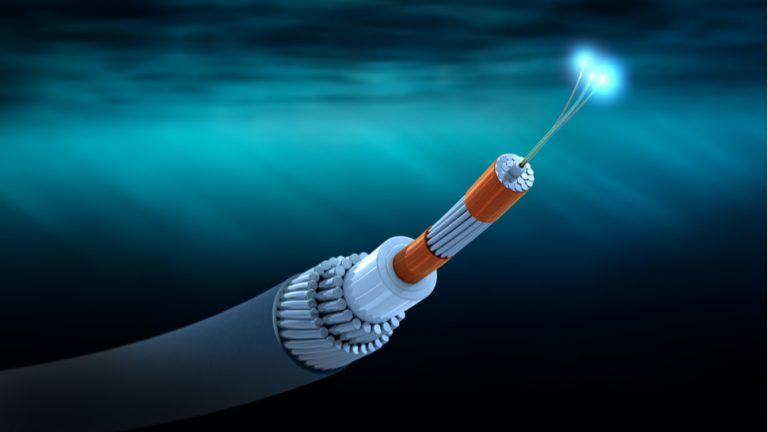
Amazon has announced plans to build its first wholly-owned subsea fiber-optic cable, a project named Fastnet, connecting Maryland’s Eastern Shore in the United States to County Cork, Ireland.
The landmark initiative marks a major milestone for the company as it continues to diversify beyond its traditional e-commerce roots and deepen its foothold in artificial intelligence and cloud computing — sectors that are rapidly transforming the global economy.
The project, which is expected to become operational by 2028, underscores Amazon’s growing ambition to control the physical infrastructure underpinning its vast data network. Subsea fiber-optic cables are responsible for carrying more than 95% of global internet traffic, including financial transactions, cloud data, streaming, and international communications. They form the invisible foundation of the modern digital world — and increasingly, of the AI revolution.
Register for Tekedia Mini-MBA edition 20 (June 8 – Sept 5, 2026).
Register for Tekedia AI in Business Masterclass.
Join Tekedia Capital Syndicate and co-invest in great global startups.
Register for Tekedia AI Lab.
Amazon Web Services (AWS) Vice President of Core Networking, Matt Rehder, told CNBC that subsea systems are “essential for AWS and for any connectivity internationally across oceans.” He explained that without these cables, companies would have to rely on satellite links, which “can work, but satellite has higher latency, higher costs, and you just can’t get enough capacity or throughput to what our customers and the internet in general need.”
Fastnet will deliver over 320 terabits per second of capacity — the equivalent of streaming 12.5 million HD movies at once — and will play a crucial role in supporting the explosive demand for AI and cloud computing infrastructure. The system will bolster Amazon’s transatlantic connectivity, strengthen network resilience, and reduce latency for AWS users in North America and Europe.
Amazon’s AI Infrastructure Push
The new project comes as Amazon pivots aggressively toward AI, building the backbone needed to sustain its rapidly expanding cloud and machine learning operations. The company has just finalized a $38 billion cloud computing deal with OpenAI, the maker of ChatGPT, which will see OpenAI migrate large portions of its model training and deployment workloads to AWS infrastructure.

The deal marks one of the largest corporate cloud partnerships in history, and highlights Amazon’s ambition to dominate the infrastructure layer of the AI economy — the high-performance computing, storage, and networking capacity that makes advanced AI models possible.
Amazon’s AI ambitions have also led to massive investments in data centers, semiconductors, and energy-intensive facilities across the globe. The company is currently building and leasing new data center complexes in North America, Europe, and Asia, while advancing its in-house chip technology, such as the Trainium and Inferentia processors, to power AI workloads more efficiently.
Fastnet is seen as a critical addition to this infrastructure ecosystem. By owning the subsea route connecting the U.S. and Europe — two of its largest markets — Amazon will gain a competitive edge in terms of speed, cost-efficiency, and security, especially as generative AI applications drive exponential increases in data transfer volumes.

A Shift Beyond E-commerce
The subsea project also underpins Amazon’s ongoing transformation from a retail company to a global technology conglomerate. While e-commerce remains its foundation, Amazon’s fastest-growing revenue engine today is AWS, which provides cloud services to corporations, governments, and startups worldwide.
AI represents a new frontier for Amazon, and one that demands colossal computing and networking capacity. Amazon has previously invested in several undersea cable systems — including JAKO, Bifrost, and Havfrue — but always as part of a consortium with other tech firms. Fastnet marks the first time Amazon is undertaking such a project independently, signaling its desire to control its data pipeline end-to-end, without depending on third-party infrastructure.
Fastnet joins a growing list of private transoceanic cable projects by major technology companies racing to expand AI connectivity. Google operates several of its own systems — including Dunant, Grace Hopper, and Equiano — while Meta and Microsoft have funded new routes between the U.S., Europe, and Africa.
These cables have become strategic assets as AI reshapes the internet economy. The need to train ever-larger models, transmit petabytes of data, and power real-time applications such as virtual assistants and autonomous systems has created unprecedented demand for bandwidth and ultra-low latency.
Amazon’s Fastnet initiative has been described as a defining move in the new AI arms race — a physical manifestation of the competition for data dominance. By 2028, the company’s subsea system is expected to form part of a global network interlinking data centers that host not just retail, but the world’s most powerful AI models.