

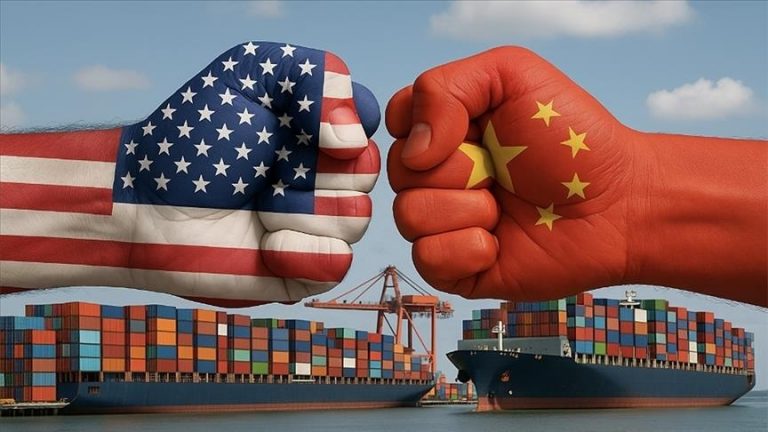
China has sharply escalated its dispute with the United States over artificial intelligence, accusing Washington of practicing “AI hegemonism” and warning it will take retaliatory measures if Chinese technology companies are sanctioned over allegations of intellectual property theft.
The statement from China’s Ministry of Commerce comes after senior U.S. officials signaled that Chinese AI developers, including Moonshot AI, could face sanctions, export restrictions and placement on the U.S. Commerce Department’s Entity List over claims they unlawfully copied advanced American AI models.
The exchange marks another escalation in the technology rivalry between the world’s two largest economies, extending a battle that has already included export controls on advanced semiconductors, restrictions on chipmaking equipment and tighter oversight of AI technologies.
Register for the next Tekedia Mini-MBA.
Register for Tekedia AI in Business Masterclass.
Join Tekedia Capital Syndicate and co-invest in great global startups.
In a statement issued Monday, China’s commerce ministry accused Washington of threatening Chinese firms without sufficient legal or factual justification.
The ministry said U.S. officials were attempting to punish Chinese companies based on allegations that they used model distillation, a machine learning technique commonly employed throughout the AI industry to improve or train new models using outputs from more capable systems.
Chinese authorities said that the United States was politicizing the issue to suppress China’s AI industry.

“For any action that causes substantive harm to Chinese interests, China will take all necessary measures to firmly safeguard its legitimate rights and interests,” a ministry spokesperson said.
The ministry also characterized Washington’s approach as “AI hegemonism,” suggesting the U.S. is attempting to preserve its technological dominance by restricting Chinese competitors rather than allowing fair market competition.
The latest tensions center on Beijing-based Moonshot AI, whose recently launched Kimi K3 model has emerged as one of China’s strongest challengers to leading American AI systems. Kimi K3 has attracted significant attention for its coding performance and reasoning capabilities while offering an open-weight architecture that allows developers greater flexibility than many proprietary Western models.

Its rapid progress has fueled debate in Washington over whether Chinese AI firms are benefiting primarily from original research or from distilling the capabilities of frontier U.S. models.
The controversy mirrors the intense scrutiny that surrounded DeepSeek earlier, when its competitive performance raised questions about China’s pace of AI development.
U.S. Signals Tougher Enforcement
The diplomatic clash follows forceful comments from senior U.S. officials. Last week, White House Office of Science and Technology Policy Director Michael Kratsios said the U.S. government possesses information indicating that Moonshot distilled Anthropic’s Claude Fable 5 model during development of Kimi K3.
Kratsios alleged the company operated a sophisticated internal infrastructure capable of conducting large-scale model distillation while rotating multiple methods of accessing American AI systems to avoid detection. He also claimed Moonshot acquired servers equipped with Nvidia GB300 AI processors and accessed computing resources in Thailand to support model training.
Neither allegation has been independently verified.
U.S. Treasury Secretary Scott Bessent subsequently warned that companies found to have crossed the line into intellectual property theft could face financial sanctions or inclusion on the Commerce Department’s Entity List, a trade blacklist that limits access to U.S. semiconductors, software and other advanced technologies.
“We support open-source AI and the innovation it unlocks. But open source is not open season on American IP,” Bessent wrote on X.
“When PRC firms conduct covert, industrial-scale distillation attacks that cross the line into IP theft, sanctions and Entity List designations will be on the table.”
Moonshot AI has rejected the accusations.
The company told China’s National Business Daily that Kimi K3’s advances stem from original architectural innovations rather than distillation of American models. The denial comes as Moonshot seeks fresh funding and reportedly prepares for a potential Hong Kong initial public offering, making the dispute particularly significant for its future expansion.
If the company were added to the Entity List, it could face severe restrictions on acquiring advanced U.S. semiconductors, cloud computing services and critical software, potentially slowing its ability to train future AI models.
The Entity List has previously been used against Chinese technology firms including Huawei, dramatically limiting their access to U.S. technology since 2019.
Anthropic has previously disclosed evidence suggesting attempts to extract information from its models. In February, the company said it identified more than 3.4 million interactions with Claude models linked to Moonshot AI. According to Anthropic, hundreds of fraudulent accounts were used to probe capabilities including reasoning, coding, computer vision, data analysis, tool use and computer operation.
While Anthropic has cited the activity as evidence of systematic model extraction efforts, Moonshot has consistently denied that distillation was responsible for Kimi K3’s capabilities.
Distillation Becoming The Next AI Battleground
The dispute highlights an emerging fault line in the AI industry over model distillation, a technique widely used by researchers and companies worldwide.
Distillation itself is generally considered a legitimate machine learning method. However, U.S. officials increasingly distinguish between conventional distillation conducted with authorization and what they describe as industrial-scale extraction of proprietary models without permission.
That distinction remains contentious.
Several AI researchers argue that distillation is only one component of model development and note that Chinese AI firms have built sophisticated research teams capable of independently advancing frontier AI systems.
After years of restricting China’s access to advanced AI chips and semiconductor manufacturing equipment, Washington is now signaling that AI models themselves may become a new focus of export controls, sanctions and national security policy.
Beijing’s response suggests China is prepared to retaliate if such measures target its leading AI companies, raising the prospect that the technological rivalry between the two countries will now extend beyond hardware into the algorithms and models that underpin the next generation of artificial intelligence.