

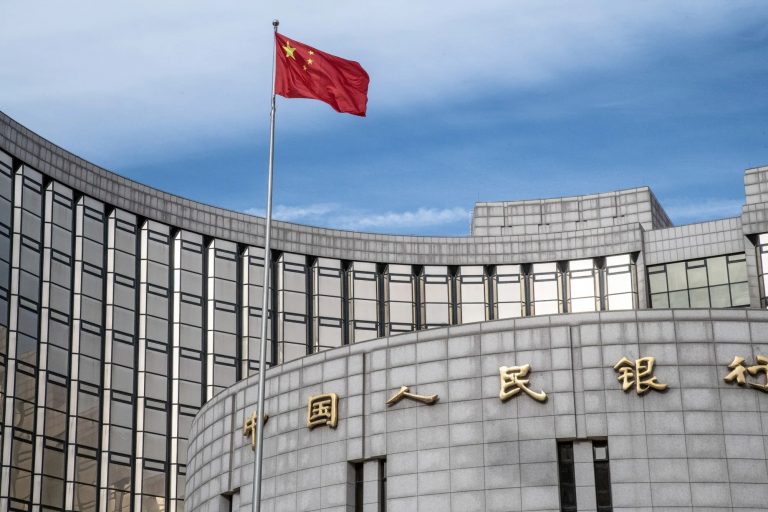
China’s central bank left its benchmark lending rates unchanged for the 13th consecutive month in June, signaling that authorities are in no hurry to deliver broad monetary stimulus despite persistent weakness in domestic demand and a deepening divergence in the world’s second-largest economy.
The People’s Bank of China (PBOC) kept the one-year loan prime rate (LPR) at 3.00% and the five-year LPR at 3.50%, in line with the unanimous expectations of 30 market participants surveyed by Reuters last week. The decision underscores a cautious policy stance that continues to favor incremental measures and fiscal support over aggressive rate cuts.
This steady approach comes as China grapples with a pronounced two-speed economy. Factory output and exports have shown surprising resilience, helped by global demand for Chinese goods and firms front-loading shipments amid trade tensions. However, domestic activity remains subdued, weighed down by a prolonged property sector downturn that continues to drag on household confidence and borrowing.
Register for the next Tekedia Mini-MBA.
Register for Tekedia AI in Business Masterclass.
Join Tekedia Capital Syndicate and co-invest in great global startups.
New bank lending in May rose less than expected, following a contraction the previous month, with household borrowing particularly weak amid the real estate slump. The data highlights the limited traction of monetary policy in reviving private sector demand, even as liquidity conditions remain relatively ample.
PBOC Governor Pan Gongsheng addressed these dynamics directly last week at the annual Lujiazui Forum in Shanghai. He noted that loan growth has slowed in recent years while bond and equity financing have gained ground — a development he described as evidence of “profound economic restructuring” and the emergence of new growth engines.
Rather than viewing the slowdown in credit as purely negative, Pan framed it as part of a necessary transition away from debt-fueled investment toward higher-quality, consumption- and innovation-driven expansion. This perspective helps explain why the central bank has held rates steady even as some analysts called for more support.

Analysts Expect Incremental Policy Response
Market observers largely see the decision as consistent with Beijing’s current playbook. Jing Sima, chief strategist at BCA Research, does not anticipate outright policy-rate cuts in the second half of the year.
“The persistent issue facing the aggregate economy is not a shortage of liquidity supply, but a lack of credit demand. Our base case is that fiscal policy becomes more supportive in the second half of the year, while the PBOC remains broadly accommodative but refrains from outright rate cuts,” Sima said.
Ho Woei Chen, economist at UOB, echoed this view, suggesting policy responses will stay measured unless growth threatens to undershoot the official target range of 4.5%-5.0%.

“Unless further evidence suggests that growth could slow below the official target of 4.5%-5.0%, we think policy responses will be incremental,” Chen said.
This approach reflects a deliberate strategy to avoid flooding the system with cheap credit that could exacerbate existing imbalances, particularly in the property sector, while directing support toward strategic areas such as advanced manufacturing, technology, and green industries.
By keeping rates on hold, the PBOC is effectively placing greater emphasis on fiscal tools and structural reforms to address the economy’s challenges. Beijing has already signaled more proactive fiscal measures in the second half of the year, including potential infrastructure spending and support for consumption.
The steady LPR also preserves policy space for future adjustments if downside risks intensify. However, it leaves the central bank navigating a narrow path: supporting growth without reigniting leverage concerns or property speculation, while managing external pressures from global trade fragmentation and shifting supply chains.
For businesses and households, the unchanged rates mean borrowing costs remain stable in the near term, providing some predictability. Yet some business leaders are concerned that the lack of broader easing may prolong the pressure on domestic demand, particularly in real estate and related sectors that have been key drivers of past growth.
China’s policymakers appear to be betting that a combination of targeted fiscal support, ongoing economic restructuring, and resilient external demand will be enough to keep growth within target without resorting to the kind of aggressive monetary stimulus seen in previous cycles.