

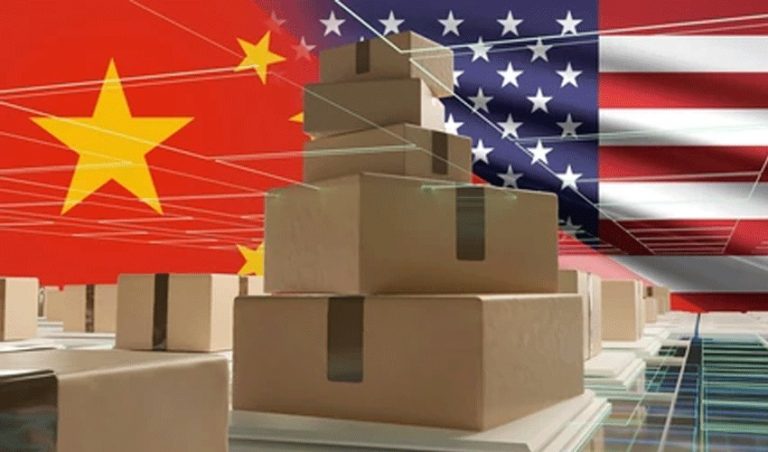
Beijing has signaled a sharp turn in its diplomatic tone as it warned on Monday that it will “resolutely” retaliate against any country that aligns with U.S. efforts to economically isolate China.
The warning, issued by the Ministry of Commerce, comes just as U.S. President Donald Trump intensifies a campaign that now seeks not only to pressure China directly through tariffs but also to force Washington’s trading partners to curb their dealings with Beijing.
China’s statement underlines a significant shift in posture. What began as an appeal to cooperation, rule-based trade, and diplomatic resolution has now taken on the contours of a threat. The message denotes that nations that sacrifice China’s interests to curry favor with the United States should expect consequences.
Register for Tekedia Mini-MBA edition 20 (June 8 – Sept 5, 2026).
Register for Tekedia AI in Business Masterclass.
Join Tekedia Capital Syndicate and co-invest in great global startups.
Register for Tekedia AI Lab.
“China firmly opposes any party reaching a deal at the expense of China’s interests. If this happens, China will not accept it and will resolutely take reciprocal countermeasures,” the Commerce Ministry said, according to a CNBC translation. It added that the international trade system risks descending into the “law of the jungle” if such practices are allowed to take root.
Until now, Chinese officials had taken a more restrained tone even as relations with Washington deteriorated. President Xi Jinping has repeatedly called for multilateral dialogue and global economic inclusiveness. But with Trump’s latest tariff hikes, now set at 145% on Chinese goods, and reports that the U.S. is using trade deals as leverage to pressure other countries to cut ties with Beijing, China appears to have concluded that appeals to fair play are falling on deaf ears.
Trump’s decision to suspend major tariff hikes on other countries for 90 days, while simultaneously ratcheting up duties on China, is seen in Beijing as a calculated move to recruit allies into an anti-China economic bloc. The new strategy has deepened fears among Chinese policymakers that Washington is attempting to reconstruct global trade networks around Beijing’s exclusion.

In response, China is escalating its own retaliatory tools.
Earlier this month, it imposed new duties of up to 125% on a wide range of American imports. It also restricted the export of critical minerals needed for semiconductor and green tech manufacturing—a direct hit to supply chains already strained by geopolitical tensions. In parallel, Beijing added several small and mid-sized American firms to its “unreliable entities” blacklist, curbing their ability to do business inside China.
These countermeasures were matched with a broadening diplomatic front. In his first overseas trip of 2025, Xi Jinping visited Vietnam, Malaysia, and Cambodia—three Southeast Asian nations that are strategically vital in the tug-of-war between Washington and Beijing. At each stop, Xi called for joint resistance to “unilateral bullying” and emphasized the need for developing nations to stand together against protectionism.

The shift in its message aligns with Beijing’s defiance of the United States. Though no country was mentioned by name, the warning was loud and clear.
“Any deal that compromises China’s interests will be met with reciprocal action,” the Ministry stated. The use of the word “reciprocal” is not a mere euphemism for tariffs—it hints at a broader toolkit that includes export controls, regulatory pressure, and selective market access.
Countries such as Vietnam, Malaysia, and even long-standing U.S. allies in Europe now face a precarious dilemma. Many depend on Chinese imports and investments, yet are under growing pressure from Washington to choose sides. The stakes are especially high for nations that form part of complex global value chains—particularly in electronics, rare earth minerals, and critical infrastructure.
China last week replaced its chief international trade negotiator, indicating its readiness to confront the trade war from all angles. Li Chenggang, formerly Beijing’s ambassador to the World Trade Organization, was promoted to vice minister of commerce, in what insiders see as a preparation for a more aggressive strategy at the WTO and beyond.
Shortly after his appointment, China filed a new complaint against the United States at the WTO over the 145% tariff rate hike. While Beijing’s chances of obtaining swift relief at the WTO are slim—given the appellate body’s paralysis caused by Washington—filing the suit underscores China’s long-term strategy of documenting grievances for future legal and diplomatic leverage.
The tariff war pressure is getting more intense for China in Southeast Asia. With the U.S. remaining China’s largest single-country trading partner and Southeast Asia now its largest regional one, the region has become central to both superpowers’ economic strategies.
Trump’s trade team has reportedly offered tariff waivers and investment incentives to countries that agree to reduce technology and investment links with China. But for countries like Vietnam and Malaysia, both of which hosted Xi this month, cutting ties with China is economically risky.
While these countries have tried to maintain neutrality, the squeeze is tightening. The message from both Beijing and Washington hints that future economic cooperation will increasingly be tied to political alignment.
Analysts believe the current standoff could morph into a permanent reshaping of global trade, with nations being forced to pick a side or risk exclusion from both.