

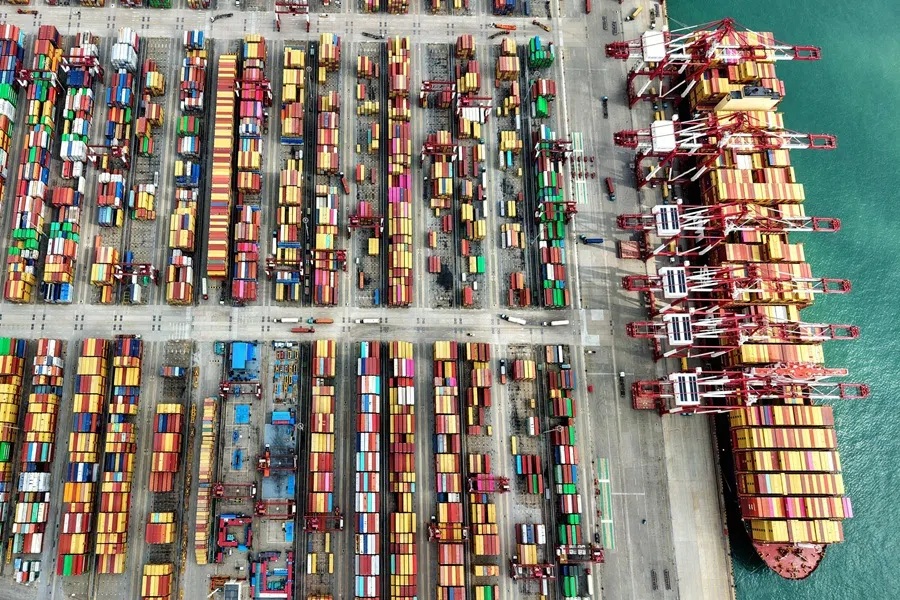
China’s once-formidable export machine showed its first meaningful signs of strain in March, with growth tumbling to a six-month low of just 2.5 percent year-on-year in dollar terms—well short of the 8.6 percent Reuters-polled analysts’ median had expected and a sharp reversal from the 21.8 percent combined surge of the prior two months.
The figures, released by Chinese customs on Wednesday, reveal how the escalating conflict in the Middle East has begun to cloud global demand and reshape Beijing’s trade ledger in subtle but telling ways.
Imports, by contrast, exploded 27.8 percent year-on-year—the strongest clip since November 2021 and far above the 11.2 percent consensus forecast. The surge reflected Beijing’s aggressive stockpiling of commodities amid disrupted global supplies, driving the monthly trade surplus down to roughly $51 billion, its smallest in over a year.
Register for the next Tekedia Mini-MBA.
Register for Tekedia AI in Business Masterclass.
Join Tekedia Capital Syndicate and co-invest in great global startups.
For the first quarter as a whole, the cumulative surplus narrowed 3 percent to $264.3 billion, ending an earlier record run and underscoring the limits of China’s export-led resilience in an era of geopolitical volatility.
The divergence carries a clear geopolitical fingerprint. Disruptions around the Strait of Hormuz have kept oil prices near $100 a barrel, sending energy and raw-material costs rippling through supply chains. Customs Vice Minister Wang Jun described the environment as “complex and severe,” citing “fierce fluctuations” in global oil markets.
Pinpoint Asset Management chief economist Zhiwei Zhang pinpointed the uncertainty from the Middle East conflict as the primary drag on the demand side, while noting that China’s massive manufacturing base and operational efficiency should shield its export volumes better than smaller rivals—though higher input costs cannot be fully passed on to foreign buyers, squeezing margins and trimming the surplus.

“The uncertainty of the global macro outlook, driven by the conflict in the Middle East, likely weighed on the demand side,” straining exports, said Zhang.
Beijing has leaned hard on its buffers with strategic and commercial oil reserves, together with cargoes already in transit, which cover more than 120 days of net imports, according to Eurasia Group’s China director Dan Wang. That cushion, combined with a diversified energy mix and the option to ramp up coal use, has prevented outright shortages.
Yet the data still shows restraint: crude imports slipped nearly 3 percent by volume and 4.4 percent by value, while natural gas inflows dropped 10.6 percent to their lowest since late 2022. On the export front, the pain was uneven. Shipments to the United States plunged another 26.5 percent year-on-year amid persistent tariffs and tensions, while trade with the Middle East itself contracted after two months of gains—prompting customs spokesman Lyu Daliang to urge all parties to “stabilize and de-escalate.”

Offsetting pockets of strength emerged in strategic categories: rare-earth imports more than tripled in value, and soybean volumes rose a modest 20 percent, signaling selective procurement for critical supply chains.
The import binge is already feeding through to domestic prices. Factory-gate inflation ticked up 0.5 percent in March, the first annual gain in more than three years, as energy and commodity costs worked their way into manufacturers’ thin margins.
Consumer prices, however, rose a subdued 1 percent, reflecting lingering softness in household demand and the limits of price controls. Net exports, which powered roughly one-third of China’s economic activity last year, had been a vital prop amid domestic headwinds such as a sluggish property market and cautious consumers. That support now looks fragile.
The numbers arrive on the eve of Thursday’s first-quarter GDP release, where analysts expect a 4.8 percent year-on-year expansion—modestly better than the 4.5 percent three-year low of the final quarter of 2025. Yet the March trade print hints at downside risks if the Hormuz impasse drags on.
Prolonged uncertainty could sap external orders further, intensify margin pressure, and complicate Beijing’s delicate balancing act between supporting growth and managing inflation.
What sets China apart is its strategic agility in crisis. While other export-heavy economies might face outright shortages or forced production cuts, Beijing’s scale allows it to absorb shocks by drawing on stockpiles and pivoting to alternatives—effectively turning a global energy crunch into a managed cost rather than an existential threat.
Still, the narrowing surplus and softening demand signal that the era of easy export windfalls is closing. Policymakers may now need to accelerate domestic stimulus, targeted fiscal spending, easier credit, or consumption incentives, to offset the external chill.
In the end, March’s trade data paints a nuanced portrait of an economy that remains formidable in procurement and production yet increasingly exposed when the world’s energy arteries seize up.