

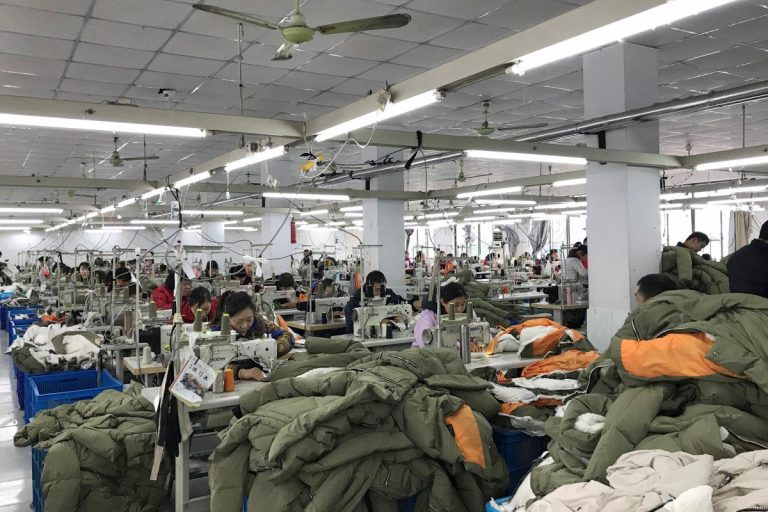
China’s manufacturing sector extended its recovery for a fourth consecutive month in March, reinforcing signs that the world’s largest industrial base entered 2026 with renewed momentum.
But beneath the headline expansion, a more consequential story is emerging: the sharpest surge in factory costs since the post-pandemic commodity shock, raising fresh concerns about margins, inflation, and the durability of the recovery.
The latest private-sector survey from S&P Global and RatingDog showed the manufacturing purchasing managers’ index easing to 50.8 in March from 52.1 in February, still above the 50-point threshold that separates expansion from contraction but below market expectations.
Register for Tekedia Mini-MBA edition 20 (June 8 – Sept 5, 2026).
Register for Tekedia AI in Business Masterclass.
Join Tekedia Capital Syndicate and co-invest in great global startups.
Register for Tekedia AI Lab.
The reading confirms that China’s factories are still growing, but at a slower pace than the previous month, suggesting that momentum is increasingly being tested by external shocks rather than domestic demand weakness alone.
The most striking feature of the survey was the surge in input costs. Manufacturers reported the fastest increase in raw material and input prices since March 2022, as the Iran war continues to disrupt global energy and shipping markets. Higher crude prices, rising petrochemical costs, and longer freight times are now feeding directly into factory operations.
“Notably, cost pressures intensified significantly,” said Yao Yu, founder at RatingDog.

For China, the situation rings a bell because manufacturing remains the backbone of its economic engine, directly and indirectly employing hundreds of millions of workers and anchoring supply chains from electronics and machinery to textiles and chemicals.
What makes the current phase particularly important is that China appears to be entering a cost-push inflation cycle within the industry. Factories are no longer merely absorbing higher costs. The survey shows firms are increasingly passing those costs through to customers, with output prices rising at the fastest pace in four years.
This shift matters globally because China sits at the center of global manufacturing supply chains; any rise in Chinese producer prices tends to ripple outward into global trade flows. Goods imported into Europe, Africa, and North America may begin to reflect higher embedded costs, especially in sectors such as electronics, industrial machinery, consumer appliances, and intermediate goods.

In effect, China’s factory inflation could become a new transmission channel for global inflation.
The supply chain picture is also deteriorating, posing another threat to production and supply. Supplier delivery times lengthened for the first time in five months and to the greatest extent since late 2022, suggesting that logistical strains are beginning to intensify again. Companies cited shipping disruptions, volatile raw material pricing, and supplier capacity bottlenecks.
This is where the report becomes especially important, as a rising PMI alongside worsening delivery times can sometimes flatter the headline reading. During the pandemic, elevated PMIs occasionally masked stress because slower deliveries and inventory rebuilding mechanically lifted the index.
While the March expansion is real, some believe part of the resilience may also reflect supply distortions and precautionary ordering, rather than purely organic demand growth.
Demand indicators have remained reasonably firm despite headwinds. New orders rose for a tenth straight month, while production growth over the first quarter was the strongest since the fourth quarter of 2024. Export orders also stayed in expansion territory, though growth slowed, indicating that external demand remains supportive but is beginning to soften under the weight of higher costs and geopolitical uncertainty.
This gives the report a dual message.
On one side, China’s manufacturing recovery remains intact and appears stronger than many advanced economies. France, for example, is already flirting with stagnation, while Canada’s factory activity has slowed sharply. On the other hand, the recovery is becoming more inflationary and more fragile.
Economists are increasingly focused on the possibility of an industrial margin squeeze. Many Chinese manufacturers, particularly exporters, operate on thin margins and compete aggressively on price. If energy and shipping costs continue rising, smaller firms may struggle to preserve profitability, especially if overseas buyers resist price increases.
That could eventually weigh on hiring, capital expenditure, and future output.
It is also seen as a macro policy dimension. A central bank adviser has already warned that imported inflation from the Middle East conflict is adding pressure to the economy, complicating Beijing’s policy mix. Authorities may now be forced to balance support for growth with the risk that easing measures could worsen inflationary pressures.
China had been one of the few major economies showing improving industrial momentum entering the year. But the Iran war is now threatening to transform that recovery into a more complex environment marked by rising costs, longer lead times, and softer confidence.
Manufacturers remain optimistic about the year ahead, supported by expectations of stronger demand, capacity investment, and government support. Yet confidence has eased from February’s recent high, a sign that firms are becoming more cautious.
The broader significance is that China may be better insulated than many peers, but it is not immune. Its factories are still expanding, but the cost of that growth is rising rapidly. If the energy shock persists into the second quarter, the world’s manufacturing powerhouse may soon face the same challenge confronting other major economies: how to sustain output without allowing inflation and supply disruptions to undermine the recovery.