

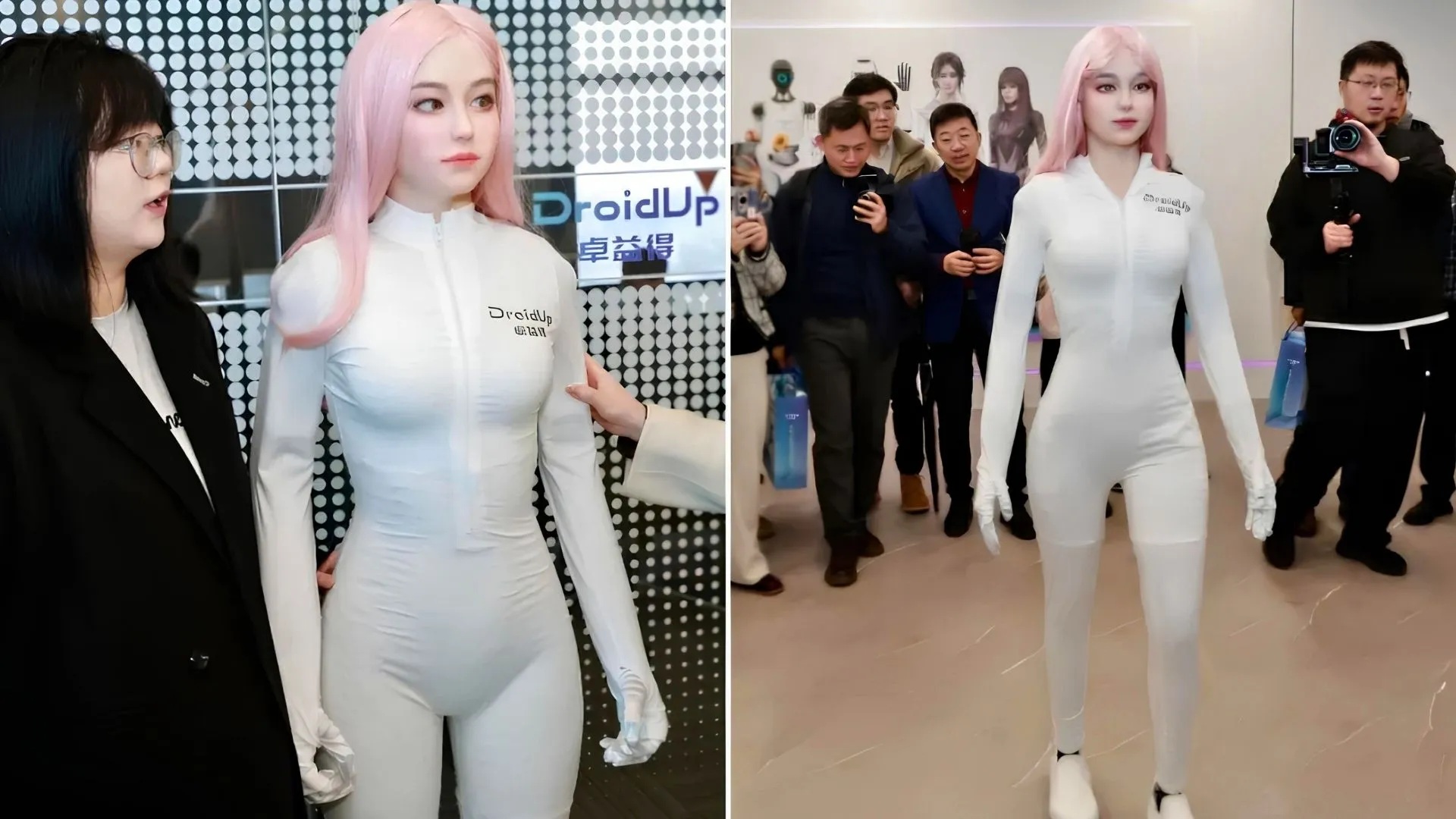
Moya represents a strategic shift in robotics from functional automation to emotionally proximate machines designed to occupy social and care roles.
A Shanghai-based robotics company has taken humanoid technology into territory that goes well beyond efficiency or task completion, unveiling a robot engineered to look, move, and even feel human. The machine, known as Moya, has gone viral in China and beyond, not because it folds clothes or walks long distances, but because it is designed to simulate human presence itself.
Developed by DroidUp, a robotics startup focused on humanoid systems, Moya is being positioned as a “fully biometric” robot, a term Chinese media have used to describe its combination of realistic movement, dense skin-like material, and regulated body heat. Unlike most consumer-facing robots, which still present clearly mechanical cues, Moya is built to minimize the sensory distance between human and machine.
Standing 165 centimeters tall and weighing roughly 31 kilograms, Moya mirrors average adult proportions. Its body is modular, allowing users to alter physical attributes such as gender, build, hairstyle, and facial configuration. Beneath the silicone exterior are multiple layers of padding designed to replicate the resistance and softness of human tissue, including a ribcage structure intended to give the torso a natural firmness when touched.
Register for Tekedia Mini-MBA edition 20 (June 8 – Sept 5, 2026).
Register for Tekedia AI in Business Masterclass.
Join Tekedia Capital Syndicate and co-invest in great global startups.
Register for Tekedia AI Lab.
One of the robot’s most discussed features is temperature. Internal heating systems keep Moya’s surface between 32 and 36 degrees Celsius, a range close to that of human skin. In practical terms, this means the robot does not feel cold when interacted with, a detail that DroidUp views as essential for acceptance in social environments. Cameras embedded behind the eyes allow Moya to visually track its surroundings, recognize faces, and maintain eye contact, reinforcing the illusion of attentiveness and presence.
DroidUp founder Li Quingdu has framed the project in explicitly human terms. In comments to Shanghai Eye, Li said a robot meant to integrate into everyday life should feel warm and approachable rather than metallic and distant. His argument is that emotional comfort, not just intelligence or dexterity, will determine whether humanoid robots gain traction outside industrial settings.
That philosophy shapes the company’s commercial strategy. Moya is not aimed at factories or warehouses, but at healthcare providers, rehabilitation centers, and elder-care facilities. DroidUp intends to market the robot as a social companion, capable of interaction, observation, and basic assistance rather than heavy physical labor. With China facing a rapidly ageing population and a shrinking workforce, demand for technological supplements to human care is rising steadily.

At an estimated price of about $173,000, Moya is firmly positioned as an institutional product rather than a consumer gadget. Sales are expected to begin in late 2026, giving DroidUp time to refine both the hardware and the software layer that governs interaction and responsiveness. The company has not detailed the extent of Moya’s conversational AI or cognitive autonomy, suggesting that its immediate value lies more in presence and companionship than in independent decision-making.
Moya’s debut comes amid a broader acceleration in China’s humanoid robotics sector. In recent years, Chinese firms have gained attention for rapid progress in physical robotics, often emphasizing endurance, balance, and real-world navigation. In 2025, Shanghai-based Agibot Innovations set a Guinness World Record when its humanoid robot walked 100 kilometers unassisted, navigating traffic, pedestrians, and uneven terrain. That achievement underscored China’s growing capability in deploying robots outside controlled environments.
What sets Moya apart from these developments is its focus on realism rather than robustness. While many humanoid robots are still clearly identifiable as machines, Moya is designed to blur visual and tactile cues. At technology showcases elsewhere, developers have sometimes cut open humanoid robots on stage to prove they are not human actors in suits. DroidUp appears less concerned with reassuring audiences than with testing how close a robot can come to human likeness without crossing ethical or regulatory lines.

That raises difficult questions about the social implications of such technology. Robots marketed as companions could reshape how societies think about care, loneliness, and emotional labor, particularly in healthcare settings where human interaction is already strained. There are also unresolved issues around consent, dependency, and transparency when machines are built to evoke emotional responses while remaining fundamentally artificial.
Currently, Moya stands as a marker of how robotics is evolving from utility to intimacy, reflecting a broader shift in which companies are no longer satisfied with building machines that work like humans, but are increasingly focused on machines that feel human to interact with.