

Global chip stocks surged on Wednesday, riding a convergence of strong earnings from key industry heavyweights and a fresh signal that China may be reopening a critical door for Nvidia, easing one of the sector’s most persistent geopolitical pressure points.
The VanEck Semiconductor ETF climbed more than 3% in premarket trading, reflecting broad-based optimism across the industry. In Europe, shares of Dutch chipmaking equipment giant ASML jumped about 5% in morning trade, lifting peers such as Infineon and STMicroelectronics. In Asia, South Korea’s SK Hynix closed more than 5% higher after posting record profits.
The rally was underpinned by three reinforcing forces: booming demand for AI-related hardware, tightening supply in key chip segments, and signs that U.S.-China technology restrictions may be evolving in practice, even if not in policy.
Register for Tekedia Mini-MBA edition 20 (June 8 – Sept 5, 2026).
Register for Tekedia AI in Business Masterclass.
Join Tekedia Capital Syndicate and co-invest in great global startups.
Register for Tekedia AI Lab.
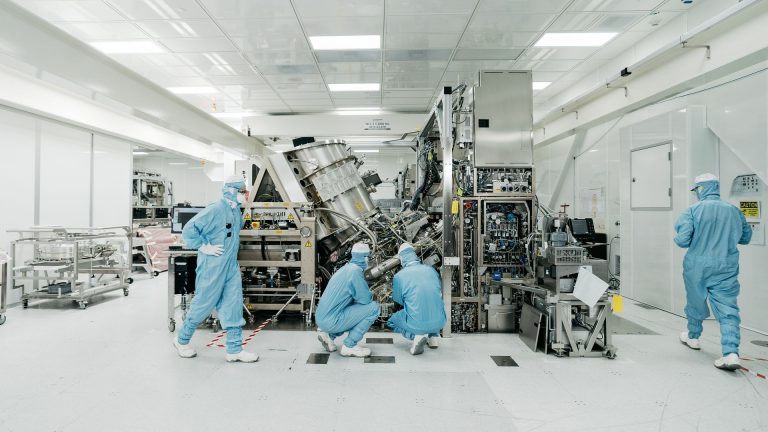
At the center of the earnings momentum was ASML, whose results once again highlighted its unique position in the global chip supply chain. The Dutch company reported bumper fourth-quarter earnings, with orders exceeding analyst expectations and a 2026 sales forecast that also came in ahead of estimates. ASML booked 13.2 billion euros ($15.8 billion) in new orders, a closely watched metric that offers visibility into future demand from chipmakers.
ASML’s dominance stems from its monopoly on extreme ultraviolet (EUV) lithography machines, essential tools for manufacturing the world’s most advanced chips. As semiconductor manufacturers race to expand capacity for AI processors, high-performance computing, and advanced memory, demand for ASML’s machines has surged. For investors, the company’s order book is increasingly seen as a proxy for the health of the entire advanced-chip ecosystem.
In South Korea, SK Hynix delivered another piece of the bullish puzzle. The memory-chip maker reported record full-year profit for 2025, benefiting from a severe global shortage of memory chips used in smartphones, PCs, and, increasingly, data centers powering artificial intelligence workloads. Prices for high-bandwidth memory, a crucial component for AI accelerators, have risen sharply, boosting margins for suppliers with scale and technological edge.

The earnings strength from ASML and SK Hynix adds to a growing list of upbeat signals from the semiconductor industry. Earlier this month, Taiwan Semiconductor Manufacturing Co., the world’s largest contract chipmaker, reported record fourth-quarter profit, reinforcing the view that AI-driven demand is offsetting lingering weakness in consumer electronics.
Yet it was a separate development, reported by Reuters, that gave the rally a distinct geopolitical dimension. According to the report, China has approved domestic tech giants ByteDance, Alibaba, and Tencent to purchase Nvidia’s H200 systems, a high-end AI chip platform that sits near the center of Washington’s export control debates.
The approval marks a notable turn in the long-running uncertainty over Nvidia’s access to the Chinese market, one of its most important growth engines. While the U.S. government said earlier this year it would authorize H200 sales to China, Beijing had reportedly been encouraging local companies to switch to domestic alternatives, part of a broader push for technological self-reliance.

In May, Nvidia warned that export restrictions to China would cost the company about $8 billion in lost sales, underlining how much revenue was at stake. The reported approvals suggest that, at least for now, Chinese demand for Nvidia’s systems remains strong enough to overcome political headwinds on both sides. Nvidia shares rose about 1.6% in premarket trading.
Taken together, the developments offer a snapshot of a semiconductor industry in the midst of a powerful but uneven expansion. AI has become the dominant growth driver, reshaping demand patterns across logic chips, memory, and manufacturing equipment. At the same time, trade restrictions and national security concerns continue to cast a long shadow, injecting volatility into company outlooks and investor sentiment.
Wednesday’s rally shows how quickly confidence can return when earnings validate the AI narrative and geopolitical risks appear, even briefly, to ease. Investors are currently betting that demand for computing power is strong enough to keep chipmakers and their suppliers on an upward trajectory, even as policy uncertainty remains an ever-present backdrop.